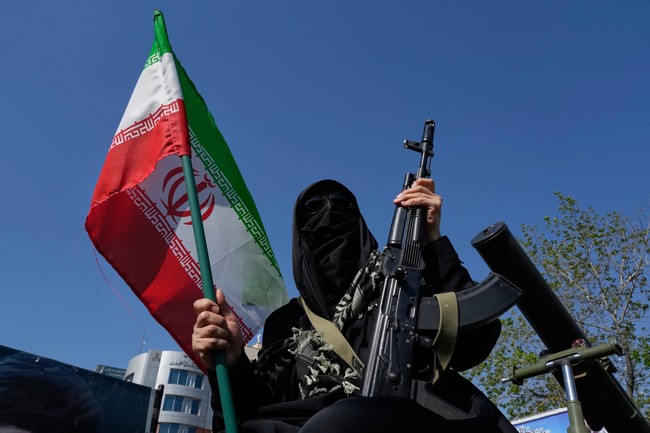
Iran has watched its Strait of Hormuz strategy backfire spectacularly. Rather than recognize that, the IRGC keeps doubling down, apparently convinced that Donald Trump will back down and allow the regime to keep control of international waters and its highly enriched uranium.
After Trump pulled out of Islamabad II: Taqqiya Boogaloo yesterday, the IRGC began firing on commercial shipping through the strait again. Iran claimed to have seized two vessels, a claim that has yet to be confirmed:
Three ships came under attack in the Strait of Hormuz as tensions flared in the waterway, after President Trump said the U.S. would extend its cease-fire with Iran and continue its blockade until Tehran presents “a unified proposal.”
An Iranian gunboat fired on a containership northeast of Oman, before a second vessel reported being fired at off the coast of Iran. Then the Islamic Revolutionary Guard Corps fired on a third ship. The incidents within hours of each other demonstrate that while the aerial war between the U.S. and Iran is on pause, the fight for control of the strait continues.
The attacks were confirmed by an outside organization, although not the seizures. Tehran named two tankers that its navy supposedly seized, but this raises questions as well:
Earlier Wednesday, U.K. Maritime Trade Operations, a shipping monitor run by the British Navy, reported that two ships had been attacked near the strait, one by a gunboat belonging to the Revolutionary Guards. Iranian news media reported that the Guards had targeted two cargo vessels, the MSC Francesca and Epaminondas, and the force’s Navy later claimed to have seized the ships after they attempted to navigate “without the necessary permits.”
The attacks showed how both Iran and the United States were seeking to exert control over shipping in the area. Even as Mr. Trump announced the cease-fire extension late on Tuesday, before it was set to expire, he said the United States would continue to block ships heading to and from Iranian ports — a move that Iran’s foreign minister called “an act of war.”
Vice President JD Vance’s planned trip to Pakistan for a second round of peace talks was put on hold Tuesday because Tehran had not responded to American demands in the negotiations, a U.S. official said.
The IRGC does not have a blue-water navy any longer. It does operate a small fleet of gunboats, though, and that might be enough to target and board commercial ships that generally lack military assets on board. This came up in the Somali piracy spree and the seizure of the Maersk Alabama, but it’s one thing to fend off Somali pirates, and another thing entirely to repel a real military force.
This may prompt Trump and Pete Hegseth to act more aggressively in the Strait of Hormuz. The US has been operating near it in the Gulf of Oman, sufficient for enforcing the naval blockade of Iran without risking fire on US Navy vessels and providing Iran with the ability to force escalations. However, as I noted yesterday, Trump’s decision to freeze the ceasefire while maintaining the blockade forces Iran to either make a deal on Trump’s terms or escalate. The IRGC is choosing escalation, although not directly on American forces, as a way to pressure Trump into dropping the blockade.
The regime still believes that its threats against shipping in the Strait of Hormuz will force the world to meet Iran on the IRGC’s terms. However, the world is already adapting around Iran’s “closure” of the strait, and the IRGC’s leverage has vanished:
There are times when bad news is bad news for markets. There are times when bad news is good news for markets. Then there are times like this—when bad news doesn’t even register for investors, including Reid.
From day traders to hedge funds, investors are once again running full-speed into stocks and loading up on risk. A skeptic could find plenty cause for gloom: Oil tankers still can’t freely traverse the Strait of Hormuz. The two sides were still trading threats when the next round of U.S.-Iran peace talks was put on pause. President Trump said Tuesday he would extend the cease-fire, but the U.S. would continue to blockade Iranian ports.
Yet the three major U.S. stock indexes have marched back to prewar levels and then some. The tech industry’s Magnificent 7 gained $2.5 trillion in market value over a recent eight-day stretch. Speculative bets are back. Allbirds, the onetime footwear favorite of techno optimists in the 2010s, gained almost 600% in one day last week after pivoting to—what else?—AI. …
Grizzled investors say the run-up merely confirms the age-old wisdom of keeping money in markets through turbulence. Near-term threats pale in comparison to a U.S. economy that has weathered crisis after crisis in recent years, often with help from Washington. America’s massive oil and gas output also shields the U.S. economy from the shocks that boosted inflation and slowed growth in the 1970s.
That is the big strategic change from the 1970s model of the global economy. Had Iran closed the Strait in 1979, the economic impact would have been catastrophic and almost certainly would have precipitated a major world war. Forty-seven years later, it’s a major headache but not much more. Most of the GCC states already have workarounds for a closure of the Strait, mainly in ways that will negatively impact Iran’s partners in Asia, as the shipping will go west rather than east. The new, robust production by the US can backstop crude, and adding in the now-unsanctioned production that can now take place in Venezuela in the near future will make the Strait much less relevant even for China and India.
“Drill baby drill” was never just about gas prices at the pumps. That policy pushed by the GOP in the 2008 election and them championed by Trump in 2015 onward always prioritized its strategic impact. Energy independence didn’t just allow the US to disconnect from OPEC manipulations, but also removed checks on our ability to project power on our own terms. Trump laid the groundwork for that in his first term, and his war with Iran is the first acid test of that strategic vision.
Iran has to keep escalating or return to the table, and they don’t have much time to choose. They are just about out of storage for the crude they pump, and at that point, they will have to start capping wells. That process can only be reversed with a lot of work, time, and cost, and the risk of ruining a well to the point where it no longer produces is high. The regime doesn’t have the money to run that risk, and likely doesn’t have the time either. Trump can choose to escalate, but he can just stand pat with the blockade and watch the Iranians run out of options, too.
Best bet: the US Navy sails fully into the Strait at some point to deal with Iran’s lightweight gunboats while otherwise maintaining the ceasefire. The blockade is the most effective strategy, and also the one that carries the least risk, which makes it a good choice until Iran starts shooting at the US or our allies again – which, notably, Iran has not yet started to do again. This is negotiation by other means, and when it doesn’t get any concessions from Trump, the regime will need to start making very hard choices.
Editor’s Note: Thanks to President Trump and his administration’s bold leadership, we are respected on the world stage, and our enemies are being put on notice.
Help us continue to report on the administration’s peace through strength foreign policy and its successes. Join HotAir VIP and use promo code FIGHT to receive 60% off your membership.