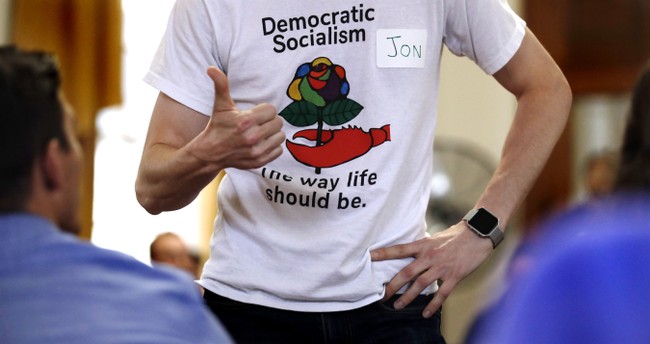
“Something new is stirring on the left,” begins a story on socialism in The Economist. “A fresh crop of socialists wants to remake the economy with price controls, hefty wealth taxes, and a spree of nationalizations. Supercharged by fury over Gaza, they are winning voters at a formidable pace.”
The Economist points to Zack Polanski, who leads the Green Party in Britain, and Zohran Mamdani, the mayor of New York, as well as the aging radical French politician Jean-Luc Mélenchon, as examples of these “new” socialists.
“Call it Gen-Z socialism,” says The Economist. “Not because all its adherents are young—or because it is new for young people to lean leftward—but because it is the brand of leftism, made for the TikTok era, that today’s young revolutionaries support.”
These “new socialists” don’t care about the same things that their fathers and grandfathers manned the left-wing battlements to win. They express little enthusiasm for seizing the means of production. Climate Change, racial issues, and other concerns of the 2010s and 2020s don’t stir their blood. Even social issues (except Gaza) don’t interest them.
The issues that animate this “new” left are wealth and how to confiscate and share it.
“This country is awash in wealth,” says Avi Lewis, newly elected leader of the New Democratic Party in Canada. “We can have nice things.”
It’s easy! Slap some price controls on everyday items while forcing the rich to pay more in taxes, so someone else pays for your public services. It’s an electorally seductive message that got Zohran Mamdani the New York mayor’s office, and it’s about to bring to power a half dozen to a dozen Democrats in House districts in mostly blue states.
It’s not just inflation that bothers these new socialists. It’s rents in big cities, and most especially, the idea that AI will take their jobs.
No country’s Gen-Z socialists are quite alike. The realities of power have forced some, like Mr. Mamdani, to become more moderate. But they broadly agree on three core principles. First, that growth does little to help ordinary people. Theirs is a zero-sum mindset, where a better outcome comes not from creating but from taking—as they fear AI barons will soon do on a vast scale. Second, that spending can be paid for by the richest. Once the left wanted higher taxes for everyone; Gen-Z socialists demand handouts funded by billionaires. The third tenet is a remarkable hostility to private enterprise. Gen-Z socialists are uninterested in letting the market rip and redistributing the proceeds. They would have chunks of everyday life, from housing to groceries, governed by state diktat.
The Economist notes that “what is so worrying about the Gen-Z socialists is how deeply their ideas are bleeding into the center-left.” Indeed, most Democrats realize that killing the fatted calf of capitalism is not a good idea. They only want to keep milking the cow, skimming the cream off the top for themselves and their favored constituencies. Turning the cow into hamburger would mean that it would stop giving milk altogether.
Gen Z socialists don’t care. They are slash-and-burn economic terrorists who would just as soon tear it all down as allow any part of the economy to escape their control.
Desperate to compete, even mainstream Democrats in America now propose mad schemes like exempting over half of tax filers from federal income tax. In Britain the Labour Party, having won power on a centrist platform, has been spooked by the Greens and is rekindling its zeal for higher taxes and state control. Increasingly, the ideas of the Gen-Z socialists can win even when their candidates lose.
That is bad news. Rent controls would worsen housing shortages by crushing the incentive to build. The profit margins of big supermarket chains, demonised by Gen-Z socialists, are already wafer-thin after years of ruthless competition—a miracle of modern capitalism. Wealth taxes would become confiscatory and deter innovation. Do not assume that the failure of these policies, if implemented, would bring about an automatic course correction. Europe has struggled for decades to escape the low-growth funk left by its own over-regulation; the rise of statist “Peronists” in Argentina helps explain its century of relative decline.
The inevitable failure of socialist policies, as it did in the old Soviet Union, will lead apologists to claim that it was the “wrong people” in charge who caused all those dead bodies and moribund economies. The socialist gospel is sound policy. All that’s needed is to get the right people in office to bring about a socialist utopia.
Exclusively for our VIPs: Law Enforcement Is Warning of ‘Anti-Tech Extremism’ as Hatred and Fear of AI Grows
This has been a favorite refrain of American socialists since the 1950s. For some reason, it keeps capturing young people. Before they can be won over, a radical sea change is necessary for those on the left who still see the free market as the best panacea for what ails us.
Resisting Gen-Z socialism is therefore an urgent task. The first step is for free-market liberals to stop apologising. A series of popular criticisms of capitalism, each containing a grain of truth, has in aggregate obscured the fundamental wisdom that private enterprise is at the root of human prosperity. Yes, people aren’t always rational, as behavioural economics shows. True, inequality matters and growth is better when broad-based. Free trade and globalisation create losers as well as winners. But this is the best time in human history to be born, given record real incomes, high life expectancy and low rates of extreme poverty. A punchier defence of capitalism would work better in the social-media age than hand-wringing by uncharismatic centrists like Sir Keir Starmer.
Even a left-wing outlet like The Economist recognizes the danger of these new socialists, who want to kill capitalism, drive the wealthy out by forcing them to seek greener pastures, and bring about a Luddite revolution that stops technological progress in its tracks.
There’s a whiff of potential cooperation between left-wing free-market capitalists and conservatives. On many issues, we’re far apart. But why couldn’t we cooperate on issues we agree on?
Otherwise, the U.S. will be unrecognizable in a decade.
Editor’s Note: Thanks to President Trump’s leadership and bold policies, America’s economy is back on track.
Help us continue to report on the president’s economic successes and combat the lies of the Democrats. Join PJ Media VIP and use promo code FIGHT to receive 60% off your membership.