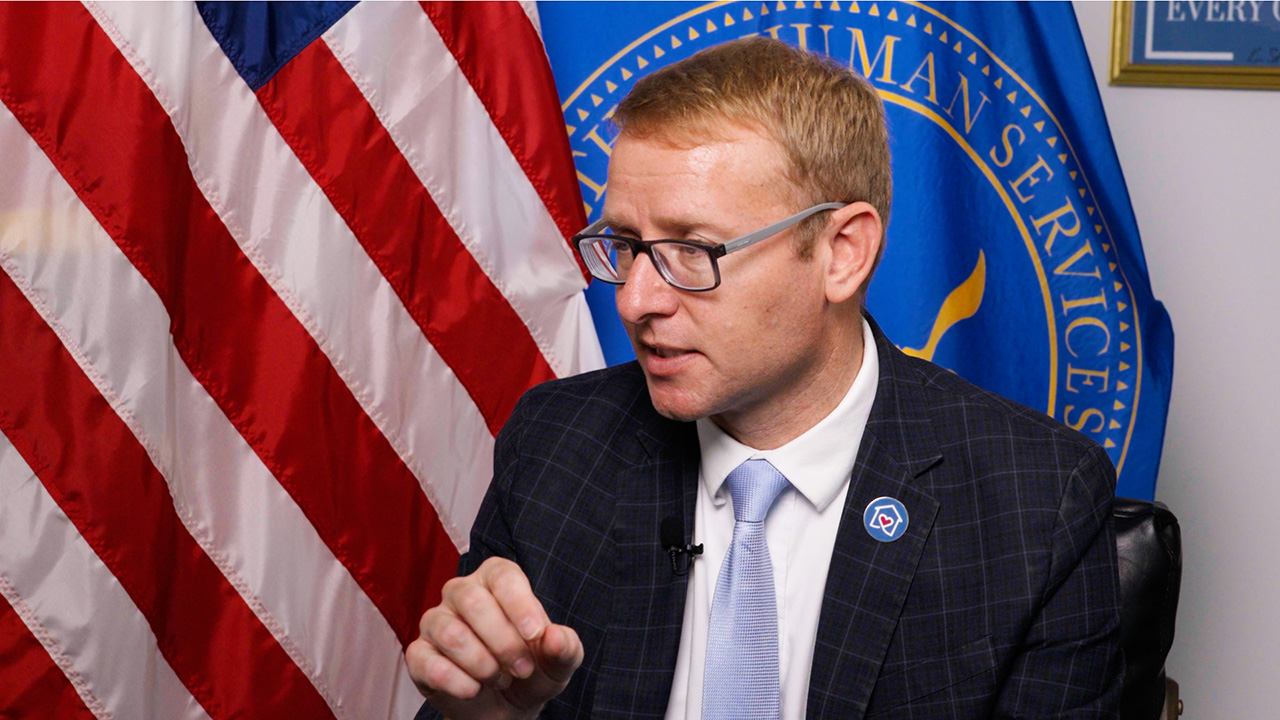
When Assistant Secretary of Health Alex Adams led the Idaho Department of Health and Welfare, he ended the state’s “orphan tax.” Now he is helping every other state do the same thing.
“We’ve got a long way to go, but we’re gonna keep at this,” said Adams, who leads the Administration of Children and Families at the Department of Health and Human Services. “I think it’s morally wrong, and we’re gonna use every lever available to us.”
When parents die before withdrawing their Social Security benefits and their children subsequently enter the foster care system, about 30 states have a policy of taking the benefits to pay for their care instead of that money going directly to the child.
Every child in the foster care system costs the state the same amount, but only orphans are expected to pay their own way.
“That’s why it’s called the orphan tax,” Adams told The Daily Signal. “States are taxing orphans at 100% of their benefits to offset government expenses.”
When Adams first heard about the tax, he couldn’t believe it was real.
“It is literally the worst of the worst government I have come across,” Adams said.
In December, ACF sent letters to 39 states that continued to tax orphans’ benefits, and so far, 10 have changed their policy. Utah, Idaho, Mississippi, and Kentucky passed legislation, while Nebraska and Louisiana’s governors signed executive orders.
To push states to end the orphan tax, Adams said he started with “honey,” writing the letters, and said soon he’ll work up to “vinegar,” conditioning grants on ending the orphan tax.
“Every governor has the ability to end this today through courage and executive action,” he said. “Several Republican governors ended it through executive order. I would challenge Gov. [Tim] Walz in Minnesota to end this through executive action and others. Let’s do right by these orphans.”
If an orphan has access to their parents’ Social Security benefits, it could change the course of their life, Adams said.
“Having the resources that their parents left for them might change the entire trajectory between success or failure in life,” he said. “That’s a down payment on a house. It’s helps with rent. It’s an education or career technical education.”
“We’re gonna look for ways to continue to preserve those resources so that when youth age out of foster care,” he continued, “they have the resources necessary to be successful.”
The Biden administration also attempted to end the orphan tax, but it was unsuccessful.
“The Biden administration put out a thin gruel on this, and basically tried to create the perception that they cared about the issue without taking any actual actions,” Adams said.
“We’re traveling around the states—I’m actually gonna be in a state next week to do an event with a governor who’s gonna be ending it—and we mean what we say,” he said, “and we’re gonna continue to push on this.”
Adams said the only argument he has heard in favor of the tax is that the state governments need the money. Adams, who was a state budget director for six legislative sessions, said he’s never seen this argument ring true.
“There is no state budget director that I have ever come across that wants to balance their budget on the backs of orphans,” he said. “Have an honest conversation with your state budget director. Put a little bit of elbow grease in this and demonstrate the creativity with which I know every state budget director and child welfare director in the country can.”