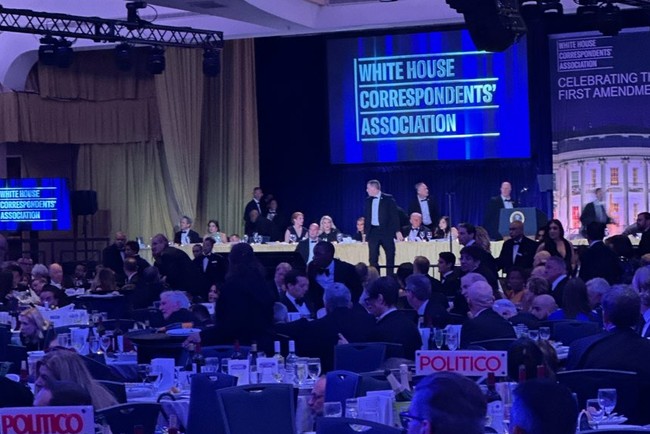
Saturday night at the Washington Hilton, two worlds met in real time. A 31-year-old Caltech-educated teacher and indie game developer, Cole Tomas Allen, had traveled across the country believing he was the “Friendly Federal Assassin,” duty-bound to stop what he saw as a criminal administration. When the shooting started, tuxedoed journalists, America’s self-appointed guardians of democracy and architects of The Narrative, scrambled across and underneath tables, snatching bottles of wine and champagne while the President and his staff were rushed to safety.
On X, Cynical Publius called the scene a potential “Bridge on the River Kwai Effect.” Many of those journalists, he suggested, genuinely see themselves as narrative heroes, just as the shooter did.
I have posted elsewhere that last night’s events will have a sobering effect on many media members in attendance.
About 80% of respondents to those posts say I am nuts.
But most people don’t realize that the great majority of journalists see themselves as being good and decent… pic.twitter.com/QzliNLL4hW
— Cynical Publius (@CynicalPublius) April 26, 2026
The replies were harsh, but Allen’s manifesto — careful, reflective, morally anguished — makes the point hard to dismiss. Allen is not deranged, not the way we think of derangement. Rather, he possesses a tidy constructed reality that just collided with messy real life.
We live in two competing paradigms. One paradigm holds that we largely construct reality through shared language, institutions, repeated narratives, and selective emphasis. The other insists that there is an objective reality, messy and full of tradeoffs, contradictions, and stubborn facts. Unfortunately, the people who should be reporting that second paradigm too often create a version that suits them better.
That substitution is seductive precisely because it works like good fiction. As a fiction writer, I understand the impulse: you take the rough mess of real life and tidy it, trimming the bumps, sharpening the moral lines, and creating coherence that, the writer thinks, people can actually understand. The constructed version feels truer: more emotionally satisfying, more purposeful. And then it smacks into actual reality. Someone winds up on the floor, naked and wrapped like a baked potato in federal custody, wondering what the hell happened.
The Fiction Instinct
Humans have always told stories to make sense of chaos. Fiction delivers what raw life does not: clean causation, moral clarity, a clear storyline, an emotional payoff. The shaper of the narrative sands off the irrelevant details and clarifies ambiguities. Everything is created through the lens of the Hero’s Journey. Readers love it. Humans have craved it since men told hunting stories at tribal campfires.
Modern media, activism, and large parts of online discourse have borrowed fiction’s tools and applied them to current events. The result is a constructed reality that seems more coherent and morally understandable than the real one. It offers simple heroes and villains, clear stakes, and the gratifying sense that you are on the right side of history. No wonder so many intelligent people prefer to live there. It’s like a warm blanket, cozy and comforting.
And it is a natural response to a uniquely modern stress. Contemporary life is vastly more complex than it was 150 or even 100 years ago. In 1875, most people’s world was local, tangible, limited, and repetitive. You knew your neighbors and the natural rhythms of seasons and soil. Information traveled slowly. Choices were fewer.
Today, our eyes and minds are bombarded with global crises, competing expert claims, statistical noise, historic grievances, and algorithmic outrage, all delivered instantly into our pockets. Our brains did not evolve for this volume of complexity. We are pattern-seeking apes wired for small bands and present threats. When reality overwhelms us, a tidy fictional map crafted by someone else that we can simply consume becomes a relief.
How Constructed Reality Is Built
Language creep provides the prefabricated bricks: tyranny, oppression, complicity, fascism. I’ve talked before about how those words are emptied out and filled with whatever meaning the narrative requires. Selective emphasis and omission in reporting do the rest.
Cole Allen’s manifesto (linked above) illustrates this well. He drew on real kernels of suffering and turned them into absolute moral warrants:
- Detention center abuses became “administration policy” rather than the failures of local sheriffs and contractors.
- Strikes on suspected narco speedboats (many with triple go-fast motors and sealed containers inconsistent with fishing) became “fishermen executed without trial.”
- The tragic strike on a girls’ school in Iran — adjacent to an IRGC facility where human shielding is a documented tactic — became deliberate child-killing.
- Disruptions in aid flows (amid greater USAID critiques of inefficiency and calculated compromise) became deliberate starvation.
- Decades-old, heavily contested Epstein-linked allegations became proven systemic pedophilia.
Each thread contained truth. None was clean. Hence, the tidy mental moral architecture Allen constructed, crafting clean stories from each element that were more comfortable but also not really true. The fiction instinct, carefully shaped by the mainstream media, had done its work: real bumps were trimmed, tradeoffs erased, enemy agency ignored. The resulting story felt coherent. A likable, reflective young man concluded that “turning the other cheek when someone else is oppressed is complicity.” He set personal rules of engagement to spare bystanders. He apologized to his students. He believed with complete sincerity that he was doing the right thing. And he was enabled by a press corps that provided the tidy little stories.
The same instinct operates in the press corps. Journalism schools and newsrooms have increasingly trained people to see their role as moral narrators rather than humble truth-tellers. Career incentives reward speed and simplicity; Darwinian elegance rewards those who adhere to The Narrative. Audience capture rewards emotional coherence. The ballroom folks didn’t invent the constructed reality. They simply marinated in it, profited from it, and performed it while the consequences headed through the checkpoint, guns blazing.
It’s like a sleight of hand: pay attention to the spell the media weaves while quietly, reality is stolen away from us.
Why People Choose the Tidy World
The constructed reality offers something precious: relief from complexity. It assigns clear roles. You are not a confused participant in a messy republic full of flawed humans and intractable tradeoffs. You are cast, in the tidy media narrative, as a defender against existential evil. That feels better than being helpless in a chaotic world. It feels purposeful.
Allen was not uniquely gullible. He was educated, gentle, and productive. Many of the journalists who seized champagne that night, dulling their senses with a little alcohol when the real world intruded, are equally sincere. They have spent years inside a constructed reality that flatters their self-image and punishes deviation. When objective reality intrudes like messy policy complications, wartime tragedies that involve enemy tactics, old allegations that remain contested, the tidy map is easier to cling to.
This preference isn’t new, but today’s information environment supercharges it. We have more data, more voices, and more complexity than our minds can comfortably process. The fiction instinct is a coping mechanism. It tidies the world so we can feel oriented again. And it offers great profits and fame to those who are willing to take advantage of this enormous human weakness (and strength, for it is a blessing as well).
The Moment of Collision
Then comes the crash.
For Cole Allen, the collision was literal. He moved from constructed moral certainty to federal custody in one night. The baked-potato imagery of a subdued suspect is almost too perfect: a man who had built an elegant fictional justification suddenly exposed to raw, unforgiving reality.
For the journalists in the ballroom, the collision was subtler but still visible — scrambling for bottles while the story they had helped construct produced real gunfire. Some will experience the Colonel Nicholson moment from The Bridge on the River Kwai: “My God, what have I done?” Many will not. Sunk costs, identity, and continued social rewards make it hard to abandon the tidy map.
These collisions are becoming more frequent. The gap between constructed reality and objective territory is widening, and the human cost is rising.
Remedies: Reclaiming the Common Tongue
We cannot ban the fiction instinct, even if that were a good idea. But we can insist that journalism and political discourse remember their proper role: mapping reality as honestly as possible, bumps and all.
Personally, we should cultivate better habits by checking news stories reporters should have checked for us; new tools like Grok make this easier. We should ask what has been omitted. We should be suspicious when a story feels oddly tidy. We should cross-check primary sources when possible, and reward writers who leave the rough edges intact with our time and attention.
Culturally, we can reward outlets and independent voices that value honesty and clarity over narrative satisfaction. Creators who refuse to sand off the bumps are telling the truth.
This is the heart of the project I’ve been working on, The Common Tongue. It is an attempt to restore shared language as a reliable map rather than a reality-substitution tool. When we reclaim precise meanings for words like tyranny and complicity, we make it harder for good hearts to wander into catastrophic fiction.
Choosing the Rough World
Cole Allen is a tragic warning. A likable, intelligent young man with his heart in the right place absorbed a tidy narrative that felt more just and honest than actual reality. He acted on it and destroyed his life.
The journalists in the ballroom represent the other side of the same trap — comfortable inside their own coherent story while the consequences unfolded nearby.
We do not have to choose between them. We can reject the impulse to substitute prettier fictions for the imperfect territory. Reality is lumpy, complex, and often unsatisfying. But it is the only ground firm enough to stand on.
Mythbuster Adam Savage’s line, “I reject your reality and substitute my own,” is one of my favorite quotes. It’s funny. But taken seriously, it is fatal. The world is not obligated to conform to our tidy stories, nor will it. The sooner we accept that, the fewer bright, sincere people will end up cold and naked on the floor, wondering where their beautifully constructed reality went wrong.
Editor’s Note: Do you enjoy PJ Media’s conservative reporting that takes on the radical left and woke media? Support our work so that we can continue to bring you the truth.
Join PJ Media VIP and use promo code FIGHT to receive 60% off your membership.