Good morning and welcome to Friday, May 1, 2026. It’s Mayday, of course. I’m sure the leftists are all over that one. It’s also Law Day, Loyalty Day, and Silver Star Banner Day. It’s also National Tuba Day. (Does anyone recall Martin Mull’s Dueling Tubas, from his film, Belligerence? No? Never mind.)
1786: Wolfgang Amadeus Mozart’s opera The Marriage of Figaro premieres.
1891: Legendary pitcher Cy Young wins first game played at Cleveland’s League Park.
1898: U.S. Admiral George Dewey commands, “You may fire when you are ready, Gridley,” as the U.S. routs the Spanish fleet at Manila Bay.
1912: The Beverly Hills Hotel opens on Sunset Boulevard in Beverly Hills, Calif.
1915: British liner Lusitania leaves New York for Liverpool on its last, fateful journey.
1920: Longest MLB game by innings: Brooklyn Robins and Boston Braves tie, 1-1 in 26 innings.
1924: German automobile manufacturers Daimler-Motoren-Gesellschaft and Benz & Cie begin their first joint venture, later merging into Mercedes-Benz.
1931: Singer Kate Smith begins her long-running association with CBS radio; various programs continue until 1945.
1939: Batman first appears in Detective Comics #27.
1941: The film Citizen Kane premieres.
1941: General Mills introduces CheeriOats, an oat-based, ready-to-eat cold cereal; renamed Cheerios in 1945.
1947: Radar for commercial and private planes is first demonstrated.
1950: Pulitzer Prize for Drama is awarded to Richard Rodgers and Oscar Hammerstein II for their musical “South Pacific”
1960: Russia shoots down Francis Gary Powers’s U-2 spy plane over Sverdlovsk in the Soviet Union
1971: Rolling Stones release single “Brown Sugar”
Birthdays today include: Glenn Ford, actor (Cade’s County, Big Heat, Midway); Jack Paar, comedian and TV host of The Jack Paar Show and The Tonight Show; Art Fleming, TV game show host (Jeopardy, 1964-75, 1978-79); Terry Southern, screenwriter (Dr. Strangelove, Easy Rider); Rita Coolidge, singer-songwriter (“Higher & Higher,” “We’re All Alone”); Steve Farris, guitarist (Mr. Mister — “Kyrie,” “Broken Wings”); and Tim McGraw, singer (“Live Like You Were Dying”).
If today’s your day, celebrate it.
* * *
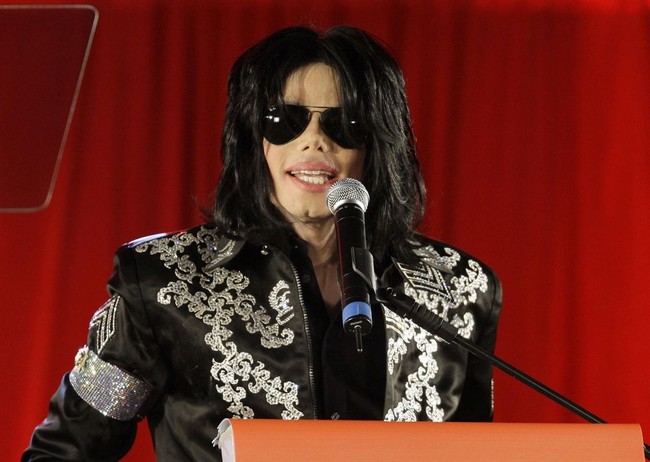
Brace yourselves: The creative minds of Hollywood, never ones to let a perfectly mediocre idea drift off into the obscurity it richly deserves, have gifted humanity with confirmation that Michael Jackson 2 is indeed happening, supposedly next year. Yes, that is the actual title: Michael Jackson 2. How original and insightful! Doubtless, someone in a very expensive suit presumably sat in a plush office overlooking Hollywood and Vine, when they wisely decided to green light THAT little gem. (Ahem… sorry, I’m a little annoyed. The original made a few bucks, so instead of trying something new, they go for a sequel. How depressingly typical. I’m still waiting for Star Wars episode 57 just so I can ignore that, too.)
Stay with me to the end on this one, because there’s a plot twist that’s the point of today’s column.
Yeah, I own it: I liked a lot of Jackson’s recorded output, and it was because of him that I once again became a fan of the vast talents of producer Quincy Jones.
WARNING: Shocking revelation incoming.
Michael Jackson, a man who moonwalked his way into owning half the known universe in record sales, turned out to be a bit of an odd duck. Who could have possibly seen that coming? I mean, here’s a twist that has absolutely never happened before in the entire history of fame and fortune: a spectacularly talented human apparently found it difficult to cope with being spectacularly talented. Excess got the better of him. Groundbreaking stuff. Quick, someone alert the historians!
His epitaph, then, is the timeless cautionary tale from which Hollywood has never, even once, learned anything: Gifted person implodes under the weight of their own mythology. First time for everything, I guess. Yeah, I’m feeling a little sarcastic on this topic, which I assure you is nothing new. That admission aside, let’s not lose sight of the fact that Jackson was far from alone in those private (and eventually very public) excesses.
In an early-2003 interview in an ITV documentary, Living with Michael Jackson, he said: “I have slept in a bed with many children… Why can’t you share your bed? The most loving thing to do is to share your bed with someone.”
In a sit-down with CBS’s Ed Bradley, he said: “When you say ‘bed,’ you’re thinking sexual. They make that sexual. It’s not sexual; we’re going to sleep. I tuck them in.”
In a concurrent article that has since gone offline, a writer at The Scotsman, one Stephen McGinty, observed:
His difficulty in relating to people his own age probably stems from the emotional and physical abuse he suffered as a child, and the fact he grew up in the spotlight of fame. I see a damaged man who has not had the chance to develop to his full potential in an emotional sense. Jackson’s relationships with the mothers of his children – two by ex-wife Debbie Rowe and one conceived using a surrogate mother – further illustrate this. Rather than create a family environment, he’s taking these children away from their mothers almost from the moment they are born. That is a terrible thing to do to a child, which has a basic right to know its biological parents, unless one of them poses a threat. What kind of father does this? Not a healthy individual.
Yeah, damaged goods, he was. He quite literally was a product of what Todd Rundgren so cleverly labeled “The Ever Popular Tortured Artist Effect” — as if the rest of us needed a catchy title for something humanity has been tripping over for literally thousands of years.
Let’s be honest: Tennessee Williams, Ernest Hemingway, and John Steinbeck — three high-profile exhibits from outside the music world — all boarded that same doomed train. They just (apparently) rode it at a speed the rest of us could almost excuse. Though a nagging thought keeps surfacing: The comparatively limited technology of the day may have partially buried their self-destruction until after they died, sparing them the proverbial “live broadcast” of those excesses that we were treated to in the cases of Jimi Hendrix, Janis Joplin, Keith Moon, Judy Garland, John Belushi, River Phoenix, Jim Morrison, and so on. That particular rabbit hole deserves its own column, I suppose.
Even Aristotle himself weighed in when he announced that “No great genius has ever existed without a strain of madness.” Aristotle moonlighted as a therapist? Who knew? Seriously, most of us know as a matter of instinct that there’s a very thin line between madness and genius.
Anyway, did Jackson run a few white gloves short of a full wardrobe? Unarguably. He’s simply one of the most glaring examples of the effect. I was a DJ back in those days, and one could hardly do top forty radio, as I did, without spinning at least some of the man’s product. But from that experience, I can also tell you that reports of his oddball behavior tended to get louder when he was about to release a new album. Make of that point what you will.
Anyone who survived VH1’s Behind the Music — or its knockoffs scattered across every channel and genre known to mankind — knows exactly how this script reads: [Insert band or star name here] clawed their way to the top, promptly fell apart like a wet paper bag, and spent the next decade proving that stardom and emotional stability make terrible roommates. That quite repeatable scenario is exactly the crux of such shows.
In my observation, stardom hands its recipients a peculiar gift: a free pass for behavior that would get the rest of us fired, divorced, or institutionalized. Fans don’t just tolerate the oddball antics — they demand them. We pour enormous energy into chasing fame, wealth, and whatever glittering prize sits atop the mountain, then completely fall apart once we actually grab it. And nobody should find that surprising, because nobody ever bothers to hand the newly crowned their instruction manual. Jackson certainly never got one.
At some level, both sides of the star-fan equation bear responsibility here, since existing outside the mainstream is the job description. Rock and Pop stars don’t just drift from normal society; they sprint from it, and their fans cheer every step. Oddball behavior isn’t a side effect of stardom; it’s a deliverable. Anti-social conduct, overt sexuality, manufactured controversy — the audience doesn’t merely accept this package, they purchase it, with mucho moolah. I’m not arguing this represents civilization’s finest hour, mind you. I’m simply pointing out that somewhere in the last few decades, this became the norm, and everyone involved — star and fan alike — signed off on the arrangement without reading the fine print. They never once considered where it leads, except for a brief period surrounding the end of the shortened life of one star or another. Then, before the old star is cold, the new one gets the blind adulation, and the cycle repeats.
Consider the glaring double standard basking in plain sight: Jackson’s increasingly bizarre behavior drew sympathy, fascination, and a seemingly bottomless well of public forgiveness.
Now, in comparison, picture a homeless person doing any of it. Society most assuredly wouldn’t extend understanding — it would extend a squad car, a pair of handcuffs, and housing, a cot, and three squares a day for the next 50 years or so.
The bitter irony? That homeless person almost certainly grew up in a far more normal environment than Jackson ever saw. Jackson never stood a chance at normal. The homeless person once had it, lost it, and still gets less grace from the rest of us than a man who built a private zoo and tourist attraction, and called it a home. Again, I am not defending Jackson here; I’m simply identifying an aspect of all of this that most folks tend to willingly ignore.
Here’s where I land after years of careful observation: Andy Warhol’s famous fifteen seconds of fame — and the dopamine chaser that comes with it — is the culprit. The late Mr. Warhol, ever the prophet, apparently understood it, but he also understated it, by an order of scale.
And there, dear reader, is the plot twist I mentioned at the top. It was the first thought in my coffee-addled brain when I noted the proposed film being reported. And at least part of the answer to the question I raised in yesterday’s VIP — What’s fueling the recent surge in political violence?
Exclusively for our VIPs: What Do All These Political Attacks Have in Common?
The attackers I listed yesterday, were using the ideology and the manifestos and the breathless news coverage, all to get that 15 seconds of fame. The mechanism becomes depressingly familiar. Those people I named yesterday, the ones who decided to translate the left’s years of carefully cultivated hatred into actual action, were chasing the same drug as every other broken star. Approval. Dopamine. Alas, that our society has always delivered such things. They certainly did in the cases I cited yesterday, at least to the degree that society all too often shares the hatred each of these attackers capitalized on.
Every last one of them got their moment — the camera time, the corner of the internet, the reaction they craved — because they understood, if subconsciously, that a ready supply of idiots would deliver the adulation and hero worship they sought. A response that, for the rest of us, their actions had absolutely no business receiving.
Eric Notes: If you think that my linking to a VIP column is in part an attempt to get you to sign up for VIP status here at PJ Media, you’re sharper than I look.
Join PJ Media VIP and use promo code FIGHT to receive 60% off your membership. Trust me, it’s worth it.