There’s a pretty good opinion piece in the NY Times today about America’s long history of technological doomerism. If you think all of the pessimism about AI and data centers is something new and unique to our time, consider this.
In the 19th century, groups of textile workers (the Luddites) destroyed the new machines they believed were replacing them. In the 1920s, the play “R.U.R.” — the letters stand for “Rossum’s Universal Robots” — depicted a war of the robots against humans…
As the economist Christina D. Romer’s seminal study on the era points out, the stock market crash didn’t cause the Depression. It couldn’t, given that only about 2 percent of American households owned stocks at that time. The fatal blow was a massive subsequent collapse in consumer spending, a collapse she attributed to a sudden onset of widespread uncertainty among consumers about their future incomes…
It was also a moment of heightened technophobia. Aldous Huxley’s famed “Brave New World,” published in 1932, depicts a dystopian society in which advanced technology destroys free will; Charlie Chaplin’s masterpiece “Modern Times,” released in 1936, depicted the Little Tramp battling a cruel, industrialized world. Dial telephones would render telephone operators unnecessary. The television would severely curtail jobs for live performers.
Now that same kind of doomerism seems to have taken over discussions of AI. Data centers are now about as popular with the public as the plague.
Seven in 10 Americans oppose constructing data centers for artificial intelligence in their local area, including nearly half, 48%, who are strongly opposed. Barely a quarter favor these projects, with 7% strongly in favor…
The data center question parallels the wording Gallup uses to ask about local nuclear power plant construction. In the same March survey, 53% of Americans say they oppose building a nuclear energy plant in their area, far less than the 71% opposed to data center construction. Since Gallup first asked the nuclear power plant question in 2001, the high point in opposition has been 63%.
The same Gallup poll found a strong correlation between people’s views and their politics.
Majorities of all major demographic groups, including all party groups, say they would oppose having a data center built where they live. However, Democrats are much more likely than Republicans to be strongly opposed, 56% vs. 39%, with independents between the two at 48%.
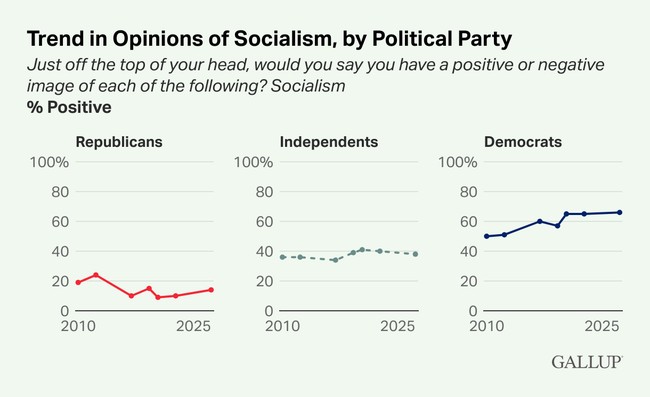
And of course the partisan dislike for AI matches up pretty well with the partisan dislike for billionaires. The wealthy are increasingly seen as a sign of societal failure by many on the left. It’s not a coincidence that the same people who dislike AI data centers also hate Elon Musk. Last year, Gallup looked at the changing popularity of socialism and, not surprisingly, it’s now very popular on the left even as support for big business declines.
Stability in U.S. adults’ opinions of socialism obscures Democrats’ more positive views of it over time, from 50% rating it positively in the initial 2010 reading to roughly two-thirds in three readings since 2019. Those increases have been mostly offset by declines in positive ratings of socialism among Republicans. Independents’ ratings of socialism have generally been steady.
Democrats are the only partisan group of the three that views socialism more positively than capitalism — 66% to 42%, respectively…
Sixty percent of Republicans, 36% of independents and 17% of Democrats rate big business positively, with the latter two figures being new lows for those groups.
The suggestion I’d like to make is that all of these things are bound together more tightly than people realize. The tech doomerism, the increasing dislike of big business and billionaires and the left’s romance with socialism are all fundamentally part of the same impulse. There is some evidence that politics and certain mental outlooks trend together.
For nearly two decades, researchers have consistently found that people high in neuroticism – a personality trait characterized by anxiety and emotional volatility – are more likely to support left-wing economic policies and to vote for parties that advocate redistribution…
Given renewed interest in the link between ideology and negative emotions, we think the time is right to refine our understanding of what drives this relationship. We propose the social support hypothesis, which argues that one reason neuroticism is linked to politics is because neurotic people are more sensitive to social exclusion and, therefore, more likely to feel needy and vulnerable. These feelings, in turn, cause people to favour policies associated with care and provisioning, such as redistribution…
This psychology of inclusion and exclusion evolved to operate in a world few modern humans inhabit. For our ancestors, exclusion meant that you would soon be needy and helpless…This leads to a key premise of our hypothesis: when modern people reason about economic policy, they often use intuitions designed for reasoning about care and sharing within small foraging bands…
Because humans evolved in ecologies where social support and not money was a key source of material security, our anxiety system is selectively triggered by cues of exclusion.
And this is in fact what we’ve seen from the left since Trump was first elected. The things that really kicked off opposition to him were his anti-immigration stance and promise to build a wall along the border. This was a form of literal exclusion which triggered a lot of people on the left. Remember that image of AOC at a fence outside an ICE detention center? She wasn’t having a strong emotional reaction to the idea of the place even though all she could see was a parking lot.
To be clear, I don’t think most people on the left could explain their own views on all of these issues coherently, much less how their views on tech, wealthy people and socialism relate to one another. But the ability to explain is a separate meta-function. Most people don’t read a graduate level thesis to become anti-capitalists (or capitalists for that matter), they just adopt a view that feels right to them. And to anxious liberals, looking to redistribute other people’s wealth feels right to them.
To bring this full circle, we live in difficult times for anxious liberals. They don’t like the President or the Congress or the Supreme Court and they are worried about what technology is going to do to their jobs. It’s a moment in time when doomerism feels like the only possible response to many of them. And that is tied directly (at least in my view) to adopting views of social welfare that look a lot like socialism. The fact that we live in a time when things are changing so quickly is probably why so many of them are now eager to seize people’s wealth and use it for any number of things, from free health care to child care to free buses, etc., etc.
Bottom line: The more anxiety-ridden some Americans feel, the more they are going to be voting for Zohran Mamdani or Graham Platner. And if you think there’s a way to argue them out of it, that’s because you’re assuming (wrongly) that reason had something to do with it in the first place. The left’s current direction makes a lot more sense if you think of it as the self-soothing. Any attempt to stop it only makes them feel more anxious.
Editor’s Note: New York City is now facing the consequences of Mayor Zohran Mamdani’s socialist takeover.
Help us continue to report on his radical policies and expose the Democrats who support him. Join HotAir VIP and use promo code FIGHT to receive 60% off your membership.