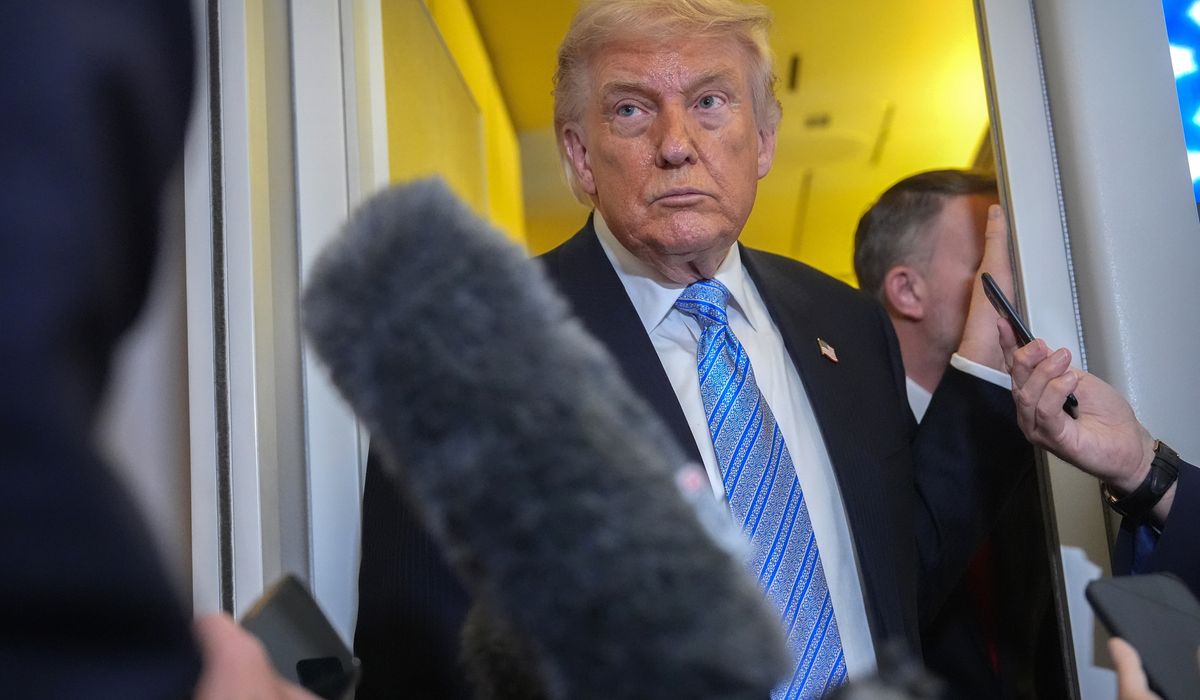
The Justice Department unveiled a new $1.8 billion pool of money it said it will use to pay off people who claim to have been victimized by the Biden administration’s “weaponization” of government against them — which analysts said could span from Jan. 6 defendants to President Trump’s inner circle.
Mr. Trump, for his part, agreed to drop his $10 billion lawsuit against the IRS, which he’d filed after an agency contractor illegally leaked his tax information during his first term.
It was dubbed the “Anti-Weaponization Fund,” and acting Attorney General Todd Blanche said it will pay for “victims of lawfare and weaponization.”
It was seeded with $1,776,000,000 — suggesting the year 1776, the year of the Declaration of Independence. The Justice Department also said it will issue formal apologies along with payments.
“The machinery of government should never be weaponized against any American, and it is this Department’s intention to make right the wrongs that were previously done while ensuring this never happens again,” Mr. Blanche said.
Mr. Trump’s opponents were incensed at the idea — and the president.
“Of all the corrupt things he has done, this is one of the most depraved,” said Senate Minority Leader Charles E. Schumer, New York Democrat. “No president should be able to use the Department of Justice as a personal rewards program for the people who helped him attack our democracy.”
Mr. Trump’s $10 billion lawsuit was unprecedented. It asked the government to pay its own chief, raising all manner of conflict-of-interest issues.
The president’s legal team calculated the $10 billion as the amount of damage done to himself and his interests by the leak of his tax information, which he had jealously guarded from public view, breaking with presidential precedent.
Mr. Trump told a court on Monday he was dropping his lawsuit as part of the deal to have DOJ create the new fund.
He will get a formal apology for the leak.
He will also drop claims for damages resulting from what Mr. Blanche called the “unlawful raid” of the president’s Mar-a-Lago resort home and “the Russia-collusion hoax.”
That chain of events infuriated Democrats who said the president was part of an unprecedented collusion himself.
“No one can be both plaintiff and defendant in the same case. And no president can concoct a fake case for $10 billion in damages against the government so he can be plaintiff and defendant and then ’settle’ his bogus case against himself as a judge,” said Rep. Jamie Raskin of Maryland, the top Democrat on the House Judiciary Committee.
Nearly 100 members of the U.S. House asked Judge Kathleen Williams to block the settlement by dismissing the case outright.
Mr. Trump has long complained about unequal treatment for himself and supporters.
He faced two Justice Department indictments under President Biden, one charging him with mishandling classified documents and the other with attempting to overturn the results of the 2020 election.
The former was dismissed after a judge ruled that Special Counsel Jack Smith was illegally appointed. The other was dropped when Mr. Trump won the 2024 election.
Some of Mr. Trump’s inner circle served prison time for defying congressional subpoenas related to the 2024 election.
And more than 1,500 people were also prosecuted for activities specifically surrounding Jan. 6, 2021, when a pro-Trump mob invaded the U.S. Capitol, disrupting the counting of the Electoral College votes for hours as most roamed and some rampaged through the building.
Mr. Trump has already pardoned those involved.
Doling out the money from the fund would depend on a “systematic process” that the Justice Department has yet to detail.
Mr. Blanche said the Obama administration created a similar settlement fund in a case involving claims from Native American farmers and ranchers who said the Agriculture Department discriminated against their loan applications.
Mr. Blanche said that fund totaled $680 million.
In Mr. Trump’s first term, the Justice Department agreed to pay out $3.5 million to settle claims from political tea party groups that said they were victimized by the IRS unlawfully targeting them for extra scrutiny in their nonprofit status applications.