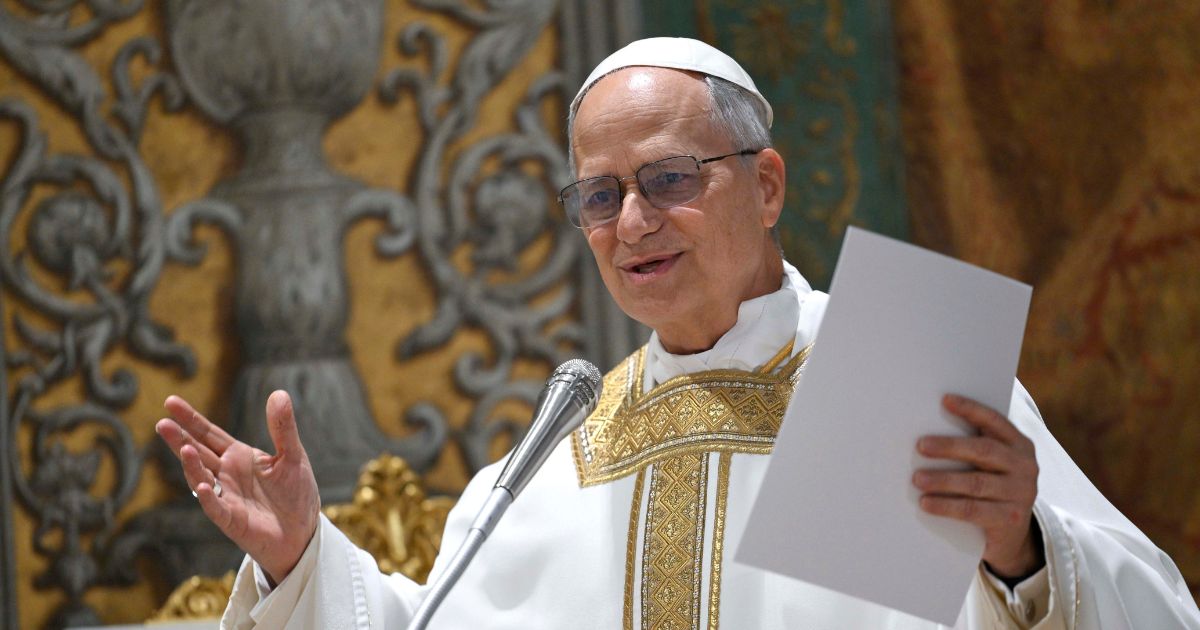
Both President Trump and Pope Leo XIV have cooled the frenzy surrounding their sparring over illegal immigration and the war in Iran. The pope stated he has no interest in debating Trump, while the president said he has nothing against the Holy Father and is not fighting with him.
However, the papal criticisms have caused confusion for many Christians — specifically Roman Catholic Americans — and have unfortunately distracted from the significant victories President Trump has delivered for Christian Americans and Christianity as a whole.
To alleviate any moral conflict for Roman Catholics, it’s important to remember that a pope’s opinion is just that — an opinion. Roman Catholics are not obligated to agree with his views on complex and ever-changing social matters.
Only when he speaks from “the chair of Peter” (ex cathedra) to definitively settle a matter of faith or morals — which has not occurred since 1950 — must the laity agree with him. Therefore, it is perfectly acceptable for Pope Leo’s statements on war and immigration, which have created angst for Trump-supporting Roman Catholics, to be challenged.
Popes have every right to speak on social and political matters, just as presidents have the right to speak about religious developments. The last thing America — and specifically conservative Roman Catholic Americans — needs, however, is contradictory messaging that sows even more spiritual confusion in a world where so much already exists.
Saint Thomas Aquinas’s Summa Theologica, which has long been held in high regard by the church that Pope Leo now heads, outlines Just War Theory. This theory defines the specific conditions that must be met for a war to be considered just.
The first condition is that only a legitimate government or sovereign can declare war — not private groups, individuals, or vigilantes.
The second condition is that a real and serious wrong — such as unprovoked attacks or unlawful seizures of property — must have occurred first and warrant a response.
The third condition requires that proper intention be maintained, with all actions aimed at achieving a good, such as restoring peace or preventing further evil. Any act intended to dominate, seek vengeance, or inflict cruelty would render a war unjust.
Pope Leo’s espousing of platitudes about war in general, and his alluding to this war already being considered an unjust one, are worthy of scrutiny for two reasons.
First, his stance on war in general borders on pacifism, which, as previously covered, is not the stance held by the Roman Catholic Church.
Second, these comments have come before the war’s conclusion, when an appropriate review of objectives could be conducted to determine whether the aforementioned criteria were indeed met.
Ironically, if he were to make any premature judgment about the war being just or unjust prior to its conclusion, the current circumstances suggest that the criteria for a just war have indeed been met.
President Trump is the head of a legitimate government, Iran has committed countless “real and serious” wrongs — such as unprovoked attacks and territorial seizures dating back decades — and Trump’s “Peace Through Strength” mantra calls for the minimum amount of military force necessary to bring about peace, but only after diplomatic negotiations have failed.
Five months ago, Pope Leo also took aim at President Trump’s immigration policies. While he initially stated that “every country has a right to determine who enters, how, and when,” he immediately contradicted himself by defending hypothetical illegal aliens who have resided in the U.S. for “10, 15, or 20 years.”
If he truly believed every country had that right, there would be little room for scrutiny of the Trump administration’s attempts to remove illegal aliens, regardless of how they have conducted themselves while living illegally in the U.S. He then insinuated that such individuals have been deliberately treated disrespectfully as a matter of policy and wrongly asserted that “no one has said that the United States should have open borders,” both of which are provably false.
According to the Catechism of the Catholic Church — the official summary of Catholic teaching — governments not only have the right, but are obligated to protect and promote the overall well-being of their citizens. This means that whoever is in power is entrusted with determining the rules, requirements, and limits on immigration.
The Catechism also states that those legally immigrating to a new nation are to conduct themselves with gratitude and thanksgiving by respecting the host nation’s values and assimilating to become productive members of society.
It is clear that President Trump, along with tens of millions of Americans — including countless Roman Catholics — who feel that America’s immigration system has been abused and exploited, and that those entering illegally have not shown respect for American values, are justified in their support of Trump’s immigration enforcement as well as their resistance to Biden’s and the Democrats’ agenda.
Lost in the noise of these two hot-button issues are President Trump’s countless victories for Christians during his decade in the political arena.
Even prior to winning the presidency for the first time in 2016, he led the charge to “bring back Merry Christmas” in American culture after a period of increasing political correctness (brought on by the Obama administration neglecting to mention Christmas or Jesus Christ specifically in any of their yearly Christmas cards, if one can even call them that, given the omission) that replaced the true reason for the season with phrases like “Happy Holidays” and “Season’s Greetings.”
Once in office, Trump fulfilled his campaign promise to appoint pro-life justices to the Supreme Court, which led to the overturning of Roe v. Wade shortly after he left office in 2021.
During his current term, Trump has cut funding to Planned Parenthood and overseen the locating of more than 145,000 children who were — ironically, given the pope’s criticisms — separated from their families, kidnapped, or trafficked as a result of the horrific, reckless, and unconscionable open-border policies.
Michael Knowles recently said it best: Presidents can’t govern without religion, and popes shepherd flocks that live in political communities. The belief that popes should stay out of politics, and politicians should avoid discussions regarding religion, is flawed.
Issues do not arise from cross-discussion in and of itself, but rather from what is being said within it. While in this instance it would be better for the pope to say nothing at all than to criticize the President, nobody could disagree that it would be far more beneficial if the pope commended President Trump for these inarguably good actions as opposed to ignoring them altogether.
Despite this confusion, a majority of the Roman Catholic laity possess a solid enough foundation to discern the truth thanks to their deep understanding of the faith. The Ten Commandments condemn idolatry.
That prohibition applies not only to literal idols such as the golden calf in the Old Testament, but also to anything that is prioritized ahead of God. This is why the political beliefs of most Christians and Roman Catholics flow downstream from their religious views.
If Trump were as “anti-Christian” as many have recently tried to depict him, Christians would withdraw their support, because their faith comes first. Instead, the opposite is occurring, as recent polling shows his approval increasing among Roman Catholics.
Roman Catholics are well within their rights to support Trump and his fight against abortion, the evil and sinister transgender movement, and open borders — all while he pardons previously persecuted pro-life advocates and works to neutralize hostile foreign threats.
It is also acceptable for them to disagree with the views of the pope, so long as that disagreement is accompanied by prayers for his discernment, which the laity are surely offering.
The first Trump presidency thrived while delivering spiritual victories despite criticisms from the Francis papacy. The second Trump administration appears prepared to do the same if Leo’s critiques continue too. For the good of the world, let us pray that they don’t.
The views expressed in this opinion article are those of their author and are not necessarily either shared or endorsed by the owners of this website. If you are interested in contributing an Op-Ed to The Western Journal, you can learn about our submission guidelines and process here.
Advertise with The Western Journal and reach millions of highly engaged readers, while supporting our work. Advertise Today.