Civil War history and heroic sacrifice will be commemorated this Memorial Day at famed battlefields like Gettysburg, Antietam, Fredericksburg, and Chancellorsville. But history was also made at places long lost to time.
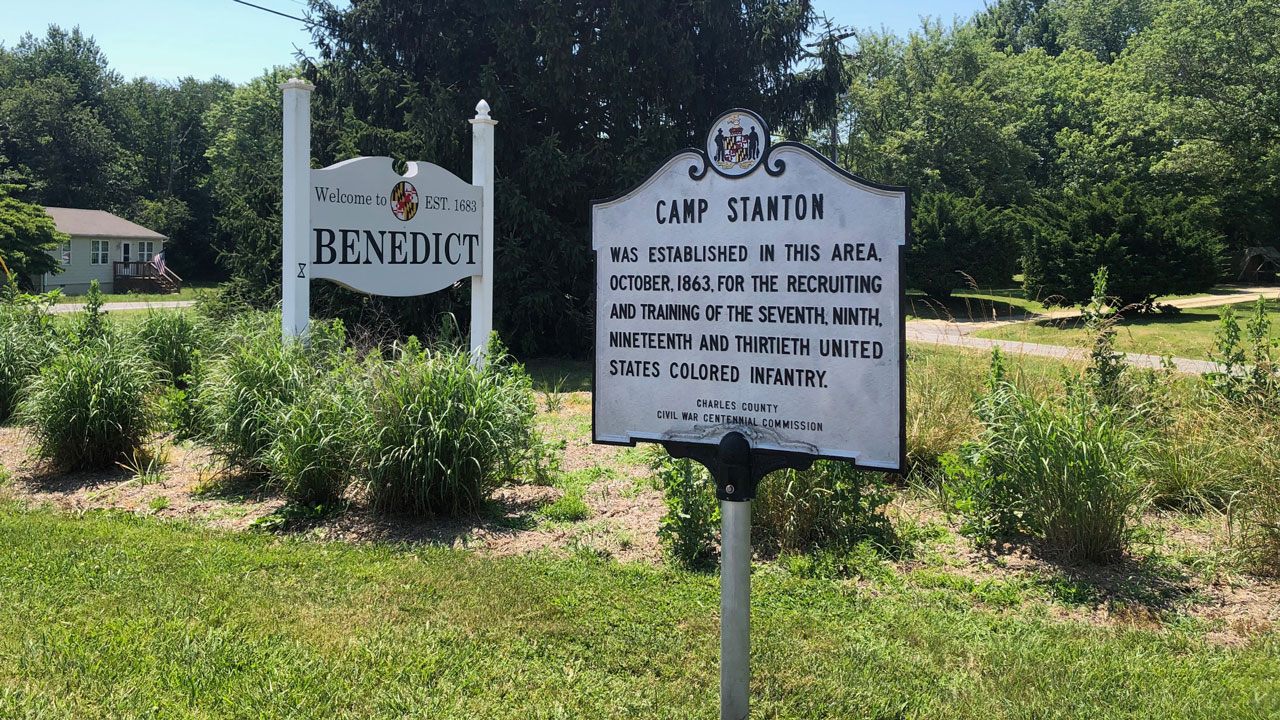
As you approach the scenic Patuxent River on Maryland’s Route 231 heading east, at the tiny town of Benedict, a gray historic marker is easy to miss. Miss it and miss a great story.
Camp Stanton
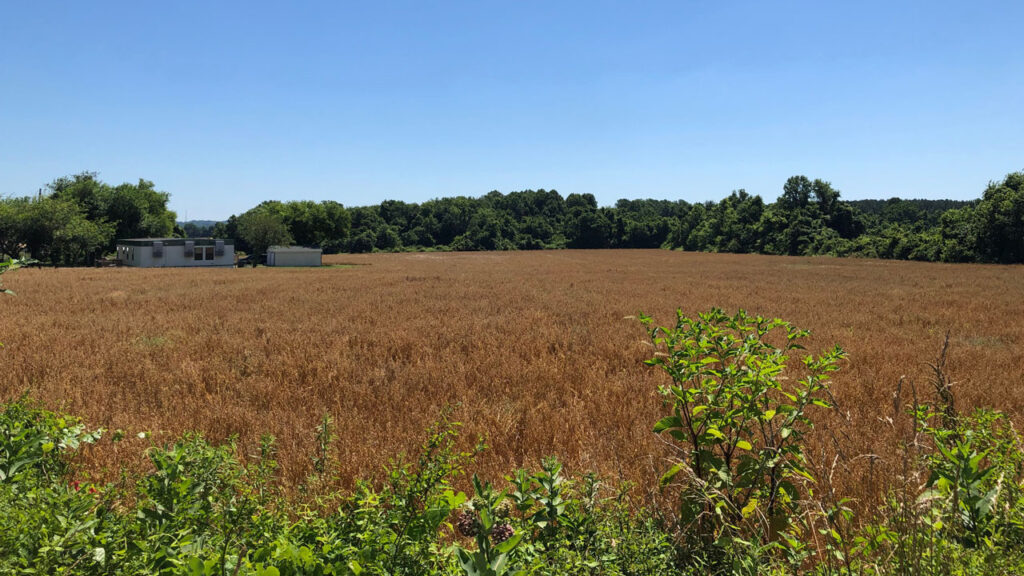
The marker records that near this spot, on what is now flat farmland along the water, sat for a brief period during the Civil War Camp Stanton.
Named after Secretary of War Edwin Stanton, Camp Stanton was formed for the purpose of recruiting and training black soldiers from Maryland for the Union Army. Freemen, runaway slaves, even those still enslaved like William H. Coates, aged 18, and William B. Jones, aged 19, whose owner, George Peterson, agreed to let them join—for a price of $300.
Together, these men were enlisted to form the 7th, 9th, 19th, and 30th United States Colored Infantry regiments, and over the ensuing months and brutal winter, they trained and drilled and prepared for the fight.
Indeed, conditions were so rough that Camp Stanton would be shut down after only six months because so many soldiers were falling ill. Plus, the camp had done its job.
All told, 8,718 men had trained at Camp Stanton and were ready for battle.
The Story of Camp Stanton
By January 1863, Stanton was desperate for more troops, and he and abolitionists in the North were urging President Abraham Lincoln to recruit black soldiers. In May, Lincoln relented. By October, Camp Stanton was established.
Benedict was chosen because it provided water access for ships that could be used for recruitment in the Chesapeake Bay basin and eventually for transporting trained soldiers.
Fortifying Benedict also meant the Union would have a military presence in a region with very heavy Confederate sympathies, the sight of Union blue helping discourage pro-Rebel activities.
Maryland was a slave state, but by virtue of not having left the Union was not subjected to the Emancipation Proclamation. Not only did Camp Stanton serve as a recruitment facility, but runaway slaves made their way to the camp, hoping for help from the federal government. They were additionally looking to enlist.
Also making his way to the camp was Maj. Alexander T. Augusta, the first African American to be commissioned as a medical officer in the Union Army. He would be the ranking medical officer of the four regiments at Camp Stanton, which upset the white medical officers to no end. They couldn’t touch Dr. Augusta’s medical skills, but they also couldn’t stomach being outranked by a black man either and pleaded with Lincoln in a letter to remove the good doctor.
Although there’s no evidence Lincoln saw the letter, Augusta was transferred to the USCT camp in Baltimore to conduct physicals on black recruits, while still remaining regimental surgeon of the 7th Infantry. He’d never be permitted to join them in battle. He’d go on to become the first African American appointed to any medical college in the U.S.
Other white officers at Camp Stanton had an entirely different attitude. Col. Samuel Chapman Armstrong volunteered to command the 9th Regiment. He saw leading—and educating—the Colored Troops as a sacred privilege, not a sacrifice. There was nothing he’d rather be doing than leading these men, he would later write. “This content, this almost supreme satisfaction has shed a rich glow upon my life.”
To the Battlelines
With training completed, the soldiers from Camp Stanton joined up with Union Army forces in Florida, South Carolina, and Virginia. The first troops to leave camp in March 1864 fought in the Battle of the Crater at Petersburg, Virginia, a crucial battle in the taking of the Confederate capital of Richmond.
The 7th and 19th USCT also had a role in blocking Confederate Gen. Robert E. Lee’s efforts to escape with his surviving troops. The 19th took part in the Battle of Appomattox Court House on the morning of April 9, 1865, helping thwart Lee’s last stand. That afternoon, with the Colored Troops of the 19th on hand to witness, Lee surrendered to Union Commanding General Ulysses S. Grant.
The Civil War was over. After four bloody years.
Approximately 360,000 Union soldiers died in the cause of freedom, be it from bullet or disease. According to the National Park Service, close to 40,000 were African Americans out of the 200,000 who served in the USCT.
Black troops had a higher mortality rate than white soldiers, roughly 22.2% versus 15.2%. For example, the 19th suffered 294 deaths. The 7th USCT suffered 393 total deaths. Twenty-two alone perished at the Battle of Chaffin’s Farm on Sept. 29, 1864.
Men like Pvts. John L. Nebbitt of St. Mary’s County, Emory Roizier of Queen Anne’s County, Josiah Hust of Kent County, and Joseph Haven of Calvert County.
This Memorial Day we recognize their sacrifice, their “full measure of devotion,” and their role in winning the war—winning freedom for the blacks still toiling in slavery.
Abraham Lincoln is said to have put it this way: “Without the military help of the black freedmen, the war against the South could not have been won.”
We publish a variety of perspectives. Nothing written here is to be construed as representing the views of the Daily Signal.