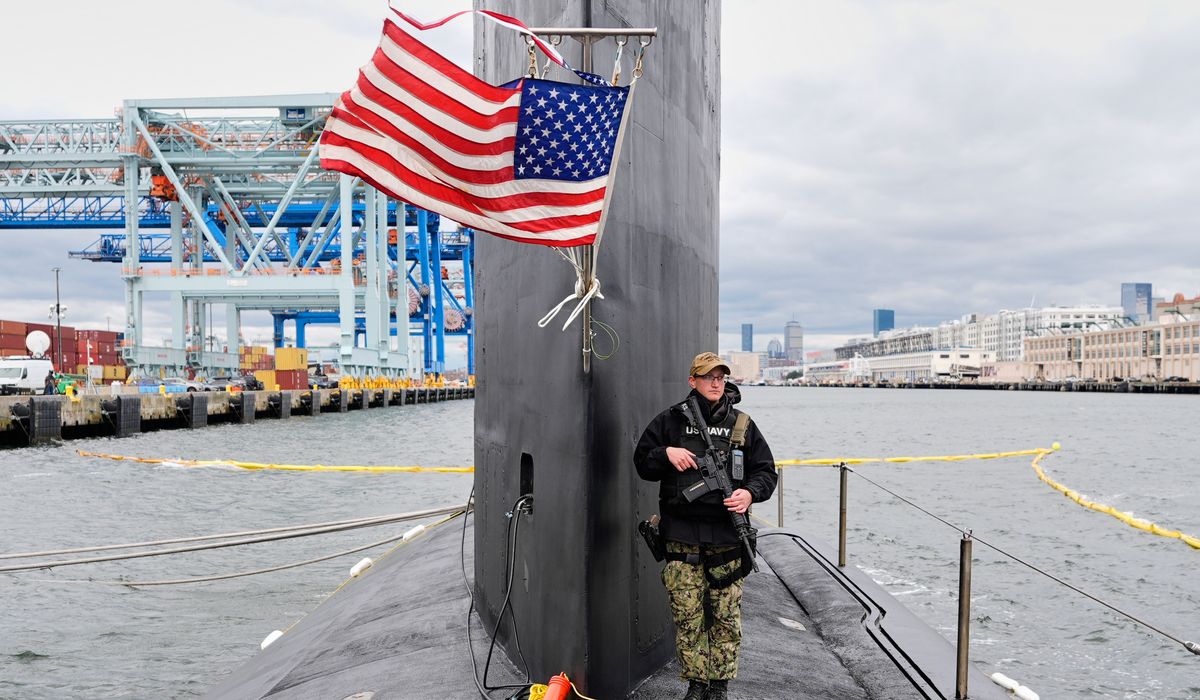
U.S. naval power is undergoing its greatest transformation in a generation, and the nation’s status as the top global military superpower may hinge on the outcome.
That transformation and all the challenges that come with it — including advanced technology integration, shipbuilding labor shortages and budgetary tensions — will be at the center of a special event to be hosted Wednesday by The Washington Times’ Threat Status national security team at the U.S. Navy Memorial in Washington.
A key topic will be the Trump administration’s Golden Fleet, an ambitious plan to build dozens of new vessels with $65.8 billion earmarked in the proposed fiscal 2027 budget.
The administration says the plan will help restore America’s naval edge and shipbuilding capacity, which have diminished over the past decade amid major investments and advances by China, which views the sea as perhaps the decisive domain in any future clash with the U.S.
Even as the Pentagon looks to jump-start shipbuilding and invest in traditional assets, a revolution in sea drones and other unmanned systems is changing naval power in real time.
Adm. Daryl Caudle, U.S. Navy chief of naval operations, described how modern warfare scenarios would rely on both traditional ships and unmanned assets deployed at scale.
In a recent exclusive video with Threat Status, he argued for a “tailored set of unmanned forces” deployable to areas such as the Strait of Hormuz or the Taiwan Strait in the event of an enemy offensive.
The unmanned assets would cause maximum damage to enemy forces while giving U.S. and allied forces time to position traditional ships.
“A Taiwan scenario is not the only place where that type of capability would be needed. You might think of that in any choke point. That may be a capability I’d want in the [strait] there at the end of the Red Sea or in the Strait of Hormuz or anywhere else,” Adm. Caudle said.
The evolution of American naval power will be the focus of “IndoPac 2026 | Naval Dominance: Shipbuilding, Autonomy & C2,” the title of the Threat Status-sponsored event.
Key military and Trump administration officials, lawmakers, and defense industry leaders will speak at the event, with fireside chats and panel discussions moderated by members of the Threat Status team. Purdue University is the official education partner of the event.
The forum will be held at a pivotal moment for American naval strategy and the dawn of what some industry leaders say is a new era of U.S. leadership in maritime technology.
Key military officials see all of those pieces coming together to reaffirm and cement America’s status as the world’s leading naval power.
“It’s rebuilding our … maritime assets as a whole, and it’s revitalizing our place as a maritime superpower. That has been such a huge part of our history,” Mike Frank, deputy chief technology officer at the Department of the Navy, said in a recent exclusive interview on the “Threat Status” podcast.
The Pacific challenge
America’s naval capabilities are central to missions around the world, including the Iran war and the special operations forces mission that captured Venezuelan President Nicolas Maduro from his Caracas compound in January.
Yet nowhere are they more important than in the Pacific, where China’s investments in its own navy and its aggressive posture toward its neighbors, especially the island democracy of Taiwan, have fueled questions about whether the U.S. is ready to fight and win a naval battle in the theater.
In recent years, China has surpassed the U.S. in total ship numbers, with an estimated 370 Chinese naval ships compared with roughly 295 American ships, though the U.S. still has far superior power projection. It also has a Navy and Marine Corps filled with combat-experienced troops, unlike China’s People’s Liberation Army.
Still, the gap in raw numbers is troubling. To close the gap, the Trump administration has proposed $65.8 billion in its fiscal 2027 budget for the Navy to build new ships while modifying and repurposing existing ones.
The Navy’s annual shipbuilding budget is projected to eclipse $60 billion in four of the next five years, according to exclusive analysis provided to Threat Status by Obviant, a Virginia-based, artificial-intelligence-driven data intelligence company and the official data partner of Wednesday’s event.
Virginia-class and Columbia-class submarines make up the largest line items through 2031, with projected expenditures of $66 billion for 10 Virginia-class boats and $64 billion for five Columbia-class boats.
They are followed by billions of dollars for warships, Arleigh Burke-class guided-missile destroyers, the Navy’s aircraft carrier replacement program and other key maritime budget items.
To meet its lofty shipbuilding goals, analysts say the U.S. must change the dynamics of domestic shipbuilding by opening competition, including with foreign companies that have demonstrated the ability to build ships faster and cheaper.
That might mean allowing foreign companies to own and operate U.S.-based shipyards and, if Congress should allow it, even contracting to have Navy ships built in foreign yards.
“This really requires going to different yards that already do it right. We’re not going to be able to, in my mind, kind of incentivize the current five or six U.S. private yards into changing their behavior overnight,” retired Rear Adm. Mark Montgomery, former policy director for the Senate Armed Services Committee and now a senior fellow at the Foundation for Defense of Democracies, told the “Threat Status” podcast in a recent interview.
“They’ll change their behavior, but they’ll change it because it’s a competitive environment where they’re having to compete with Japanese and Korean companies that are kicking their backside,” he said.
The competition with China also extends to the commercial shipbuilding industry. A bipartisan bill, introduced last year, would provide tax credits and investments for shipbuilding.
Sen. Todd Young, Indiana Republican, co-sponsored that bill. He will be on stage at the Wednesday event.
As a former Marine Corps officer and Naval Academy graduate, Mr. Young sees shipbuilding and the U.S. maritime industry as critical to national security.
The Shipbuilding and Harbor Infrastructure for Prosperity and Security Act, known as the SHIPS Act, also establishes a goal of expanding the U.S.-flag international fleet by 250 ships in 10 years.
The commercial vessels would be “commercially operated, U.S.-flagged, American crewed, and domestically built merchant vessels,” said an announcement from Mr. Young’s office.
A 25% tax credit for shipyard investments would apply to military and commercial shipbuilders. China controls more than 50% of the global shipbuilding industry, and its commercial fleet has grown to more than 5,500 vessels. The U.S. has fewer than 100 vessels with commercial flags.
The uncrewed revolution
In the administration’s budget, funding for sea drones and other unmanned maritime assets is rising rapidly. The Pentagon is seeking $54.6 billion for its Defense Autonomous Warfare Group, the umbrella initiative overseeing the effort to produce and field drones in large numbers.
The 2027 budget request includes major funding increases for aerial and ground drones, but the largest percentage increases would go to medium unmanned surface vessels and other unmanned systems, such as the Navy’s remotely operated vehicle that is launched and recovered from a torpedo tube.
Those two initiatives would see funding increases of 584% and 183%, reaching $270 million and $76 million, respectively, according to Obviant data. The Navy intends to deploy more than 30 medium unmanned surface vessels, along with thousands of smaller USVs, in the Indo-Pacific by 2030.
Those vehicles would be a crucial component of the “Hellscape” envisioned by Adm. Samuel J. Paparo, the head of U.S. Pacific Command, who has detailed a plan to use massive numbers of aerial and sea drones to crowd the theater and slow down a possible Chinese attack on Taiwan.
In a recent report to Congress obtained by Threat Status, Adm. Paparo said he wants at least $2.3 billion specifically for maritime, underwater and ground-based drone weapons in the Pacific.
Yet uncrewed systems could carry out a host of other missions beyond strikes.
Earlier this month, a 24-foot Corsair autonomous surface vessel made by the Texas-based company Saronic helped rescue two Army crew members whose AH-64 Apache helicopter was shot down by Iran near the Strait of Hormuz.
Industry leaders say the mission clearly demonstrated how uncrewed maritime systems, especially small unmanned surface vessels, will have a huge impact on future battles.
“These boats are so affordable, and they can have such a massive impact. I feel like we’re at the dawn of a new era here with the potential of these small USVs,” said Barry Hinckley, president of Blue Ops, the maritime division of leading drone and robotics company Red Cat.
“USVs fill a gap, or a mission, that is incredibly important,” Mr. Hinckley recently told the “Threat Status” podcast in an exclusive interview.
• Guy Taylor, John T. Seward, Vaughn Cockayne and Bill Gertz contributed to this report.