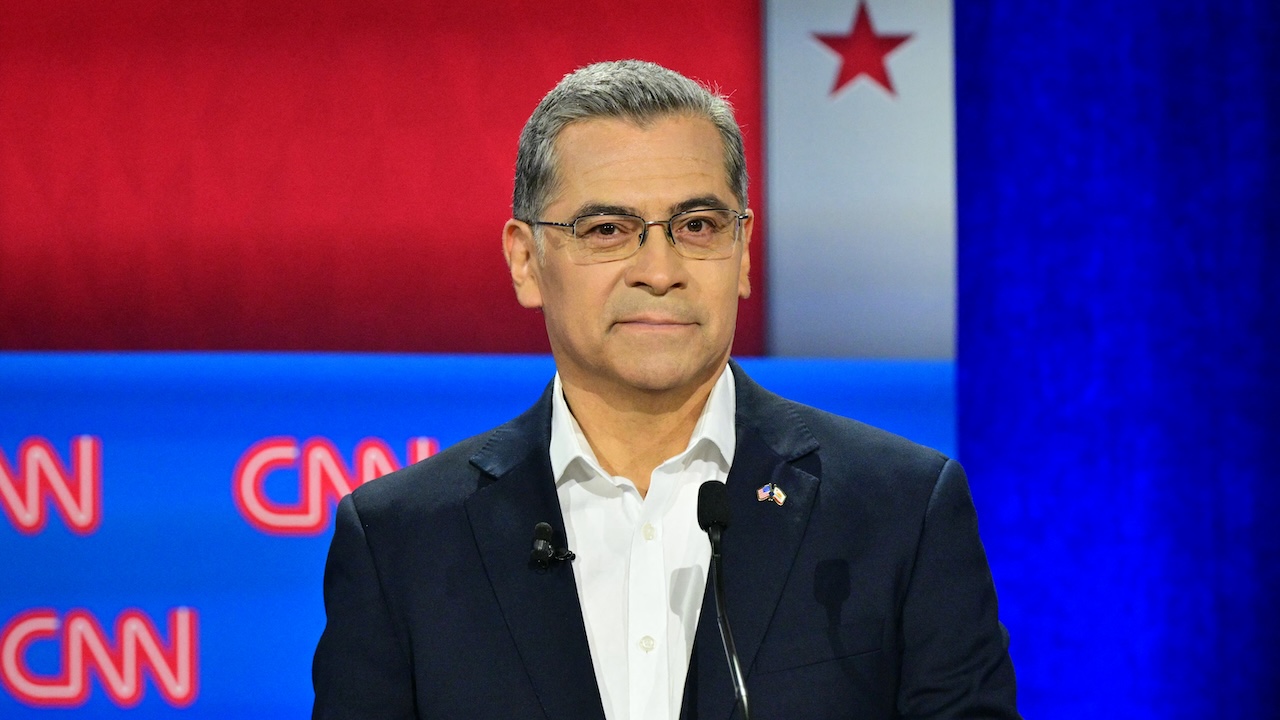
Xavier Becerra is the embodiment of the modern California Democrat: a career politician who climbed from longtime congressman to state attorney general to Biden’s secretary of Health and Human Services without ever demonstrating medical expertise, executive talent, or a serious record of solving any difficult problems.
What he has always possessed in spades, however, is partisan reliability and a reflexive instinct for power—an instinct on full display during the recent California gubernatorial primary debate.
Confronted with California’s collapsing homeowner insurance market—carriers fleeing, premiums soaring, entire regions left uninsured—Becerra offered a simple solution: declare a “state of emergency” and freeze rates by decree.
When pressed on the legality of such a move, he showed open contempt for constitutional limits. Republican gubernatorial candidate Steve Hilton asked Becerra incredulously if he had even read the statute governing gubernatorial emergency powers. Those powers exist for earthquakes, raging wildfires, and genuine catastrophes—not for the predictable consequences of years of bad policy.
Becerra’s answer was frightening in its candor. “When you declare a state of emergency, you have extraordinary powers,” he replied, as though uttering the phrase magically suspends the rule of law.
Becerra promised to haul insurance executives into his office, impose a freeze, launch investigations, and dare the courts to stop him. This was not a policy proposal; It was a declaration of intent to rule by fiat whenever democratic deliberation proves inconvenient.
California has in recent memory experienced the consequences of such a tyrannical mindset. During the pandemic, emergency declarations were stretched far beyond any reasonable definition of crisis, allowing California Gov. Gavin Newsom to bypass the legislature on schools, businesses, and basic civil liberties.
Becerra, then attorney general, defended those expansions. Now he pledges to broaden the precedent. An insurance rate dispute becomes an “emergency.” Tomorrow it could be gas prices, housing shortages, or any other outcome that resists progressive will. Each new declaration further erodes the separation of powers, weakens the legislature, and normalizes government by proclamation.
Becerra does not merely accept this path—he celebrates it. And it’s a pattern visible throughout his career of failure.
As attorney general, Becerra repeatedly used the power of the state against the vulnerable and the dissenting. He sued the Little Sisters of the Poor, trying to force Catholic nuns who care for the dying to provide abortifacient coverage in violation of their faith. He defended a law compelling pro-life pregnancy centers to advertise abortion services—both efforts rejected by the U.S. Supreme Court. He demanded donor lists from conservative organizations while shielding his own allies.
Under the governance he championed, California watched homelessness explode into tent cities and open squalor, businesses and middle-class families flee in record numbers, and disorder spread through once-great cities. Results never seemed to matter. Ideological enforcement always did.
At HHS, these same habits produced national consequences. The department lost track of more than 85,000 unaccompanied migrant children sent to sponsors amid the border surge. Internal warnings about rushed vetting were ignored. Some of those children ended up in exploitative labor or worse. Becerra’s response was bureaucratic deflection: they weren’t truly lost—sponsors just weren’t answering the phone.
The same rigid adherence to ideology extended to youth gender medicine. His department aggressively promoted puberty blockers, cross-sex hormones, and surgeries for minors even as Finland, Sweden, Britain, and the Cass Review documented weak evidence, serious comorbidities, risks of infertility and bone loss, and growing numbers of detransitioners. While Europe turned toward caution grounded in emerging evidence, Becerra clung to affirmation as dogma.
This was not mere error; It was willful indifference to harm in service of a political creed—an amorality that placed activist orthodoxy above the bodies and futures of troubled adolescents.
He also drew Hatch Act scrutiny for using his official position to campaign for Democrats.
Now seeking the governorship, Becerra offers continuity with an added authoritarian edge. California’s insurance crisis is genuine, fueled by wildfire danger, a predatory litigation culture, heavy regulation, and decades of poor land management. Credible solutions would focus on tort reform, better forest maintenance, mitigation incentives, and restoring market discipline.
Becerra’s instinct is cruder and more dangerous: threaten companies, impose price controls, and call it compassion. History is clear that such freezes drive out providers, create deeper shortages, and ultimately hurt the very homeowners they purport to help.
In the end, Becerra perfectly embodies what one-party California has become: a system that rewards ethnic pedigree, ideological zeal, and machine loyalty while punishing competence, results, and any meaningful attachment to constitutional limits.
A thoroughly ordinary lawyer and reliable cog in the machine now seeks the state’s highest office primarily to wield the extraordinary powers the Founders deliberately withheld from men of his temperament.
Voters should take him at his word. A Becerra governorship would mean perpetual emergencies whenever reality defies progressive wishes—driving out more businesses and families, eroding public trust, and replacing self-government with one-man rule by decree.
California does not need another unextraordinary man desperate for extraordinary power. It needs leaders who respect the Constitution, face hard truths, and govern through persuasion rather than coercion. Becerra’s debate performance was no gaffe; it was a warning. Californians ignore it at their peril.