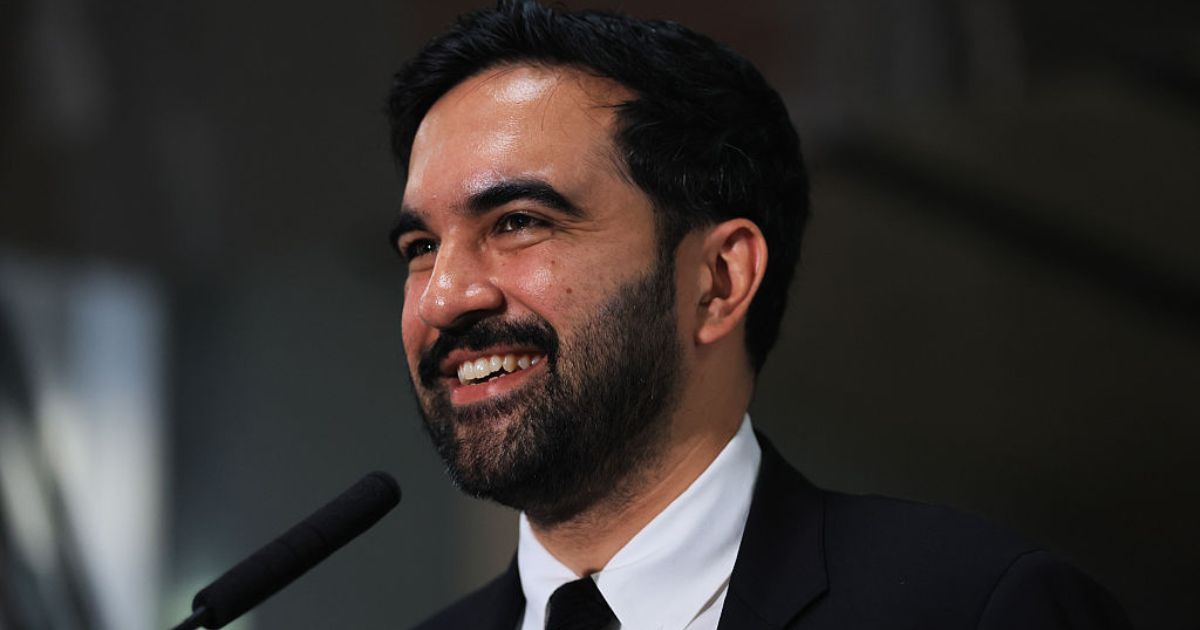
New York City socialist Mayor Zohran Mamdani would not rule out issuing cash reparations for the descendants of slaves living in the Big Apple, should a city commission currently reviewing the matter decide in favor of it.
The Root’s Charles M. Blow, in a podcast episode released this week, read, in part, a written statement then-mayoral candidate Mamdani had submitted to one of those groups studying the issue, saying, “New York City participated actively in the slave trade and furthered its legacy through racist institutions, policies and laws. The city should reconcile and repair this legacy of slavery, stolen wealth and discrimination.”
Blow noted one of the commission’s findings is due out next summer.
“If a commission studying reparations in this city recommended cash reparations for people impacted by slavery in New York City, would you support that recommendation? he asked.
Mamdani responded that he stood by his statement made as a candidate: “It’s the truth; it’s not a personal assessment.”
“We often think about slavery and the complicity in slavery as being exclusively to certain geographic areas of the country. Here in New York City, we were very complicit, and so I look forward to whatever those findings are,” the mayor elaborated.
“I can’t give you an answer in advance of them, but I can tell you that this is critically important, because this is also what it looks like to acknowledge what history truly was,” Mamdani added.
As I argued on a recent Western Journal podcast and in the new edition of my book “We Hold These Truths,” about the influence of the beliefs found in the Declaration of Independence throughout U.S. history, America’s record regarding slavery is actually commendable when measured against the backdrop of human history.
The Founders took the first steps in the modern era to bring an end to the institution, which had gone on for thousands of years and lamentably continues in the world to this day.
Pennsylvania voted to end slavery during the Revolutionary War in 1780, and Benjamin Franklin, a former slave owner, became the president of the Pennsylvania Abolition Society, whose mission was to have other states follow Pennsylvania’s lead.
By 1804, during President Thomas Jefferson’s first term, all the states north of Maryland had voted to phase out or end slavery. Again, it should be noted that no other governments around the world were doing so at this time, including the former mother country, Great Britain, which did not outlaw slavery in its empire until 1833.
The founders also banned slavery in the Northwest Territory in 1787 — preventing slavery from spreading to the future states of Ohio, Michigan, Indiana, Illinois, and Wisconsin — and made provision in the Constitution for ending the importation of African slaves, but not sooner than 1808 as a compromise with the Southern states.
In March 1807, President Thomas Jefferson signed the legislation into law so it could take effect on the earliest possible date, Jan. 1, 1808. The U.S. later fought the Civil War in the 1860s, which resulted in the emancipation of all the slaves, making it among the first nations in the world to do so.
I go into more of this history in my book and in the podcast below.
Evanston, Illinois, is the first city in the U.S. to enact reparations for its black residents, but the move has run into some legal challenges.
ABC affiliate WLS-TV reported last month that six non-black residents sued to block the city from paying $25,000 in reparations for 20th-century race-based housing discrimination.
“The city has already distributed over $7 million — using revenue from a local tax on legal marijuana sales — to hundreds of people in $25,000 increments to be used for home repairs, down payments on property, and interest or late penalties on property in the city,” the news outlet said.
The Trump Justice Department intervened in the suit last month, describing the program as “racially discriminatory.”
Assistant Attorney General Harmeet K. Dhillon of the DOJ’s Civil Rights Division said, “There are sound ways for a city to remedy past discrimination or direct resources to its most vulnerable citizens and neighborhoods. Simply handing out money based on race, however, is not the answer. It is race discrimination, pure and simple. And it is illegal.”
U.S. Attorney Andrew S. Boutros for the Northern District of Illinois added, “The Constitution demands that the government treat citizens as individuals, not as members of a racial class. Distributing public funds based on an individual’s ancestry or race divides the citizenry and establishes the very hierarchy the Equal Protection Clause was designed to dismantle.”
If Mamdani would like me, a white New Yorker who never owned slaves, to pay a black New Yorker who never was a slave, then I propose:
Every Muslim in NYC starting with Mamdani, should pay us for 9/11.
Please explain why the latter makes no sense but the former does. pic.twitter.com/wvPF9CFvEC
— Shabbos Kestenbaum (@ShabbosK) July 29, 2026
The 14th Amendment’s Equal Protection Clause, ratified in 1868, immediately following the Civil War, provides that no state [or local government] shall “deny to any person within its jurisdiction the equal protection of the laws.”
So if Mamdani were to go forward with trying to pay reparations, expect there will be a Constitutional challenge that will likely make its way to the U.S. Supreme Court. And if the justices rule in fidelity with the Constitution, reparations will be struck down.
Advertise with The Western Journal and reach millions of highly engaged readers, while supporting our work. Advertise Today.