Conservatives do not move in mindless lockstep the way woke liberals do. We can have our disagreements, even on important points of principle and policy.
Nonetheless, we should assume good faith debate and try not to talk past one another. This holds true especially in what we might call the “creed” vs. “culture” debate.
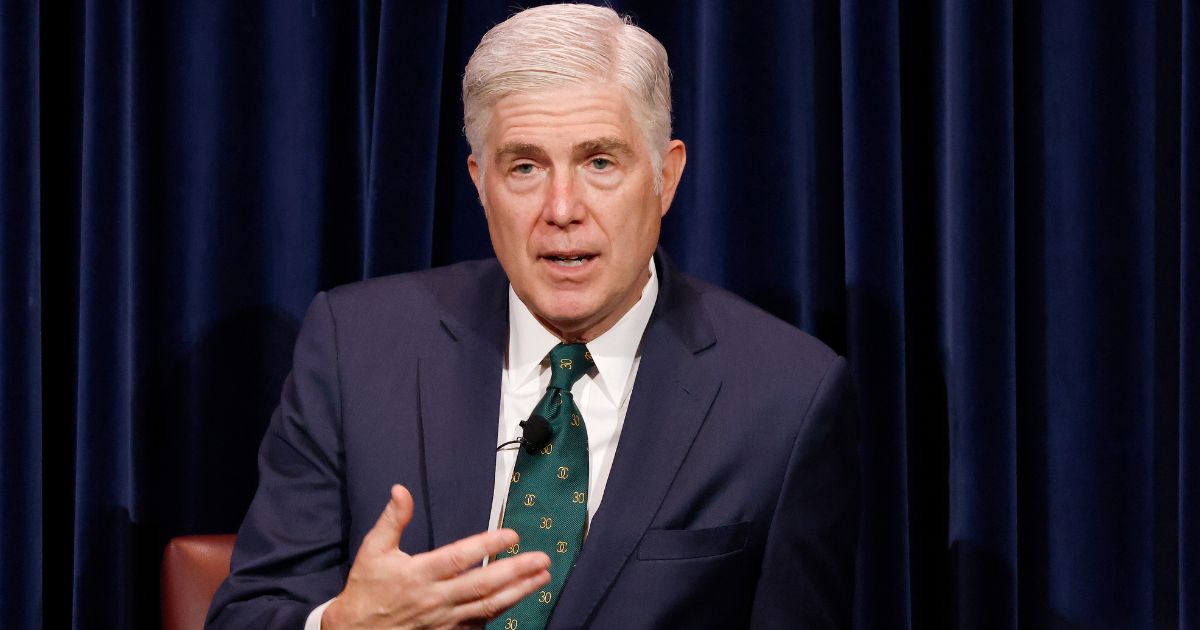
In a recent interview with the libertarian-minded Reason Magazine, conservative Supreme Court Justice Neil Gorsuch characterized the United States as a “creedal nation,” rooted in the principles of the Declaration of Independence, thereby prompting outrage from some conservatives on the social media platform X, including one former advisor to President Donald Trump, who worried about Gorsuch potentially “‘prepping’ us for an absurd Birthright Citizenship ruling.”
“The Declaration of Independence had three great ideas in it: that all of us are equal; that each of us has inalienable rights given to us by God, not government; and that we have the right to rule ourselves,” Gorsuch said in a clip posted to X.
Indeed, Thomas Jefferson penned those words — or at least a version of them — in 1776.
“We hold these truths to be self-evident, that all men are created equal, that they are endowed by their Creator with certain unalienable Rights, that among these are Life, Liberty and the pursuit of Happiness. — That to secure these rights, Governments are instituted among Men, deriving their just powers from the consent of the governed,” Jefferson wrote in the Declaration of Independence.
So far, so good. In fact, no American patriot could quarrel with Jefferson’s words.
What came next, however, got Gorsuch into trouble with some “culture” conservatives.
“Our nation is not founded on a religion,” he added. “It’s not based on a common culture even, or heritage. It’s based on those ideas. We’re a creedal nation.”
“Our nation is not founded on a religion. It’s not based on a common culture, even, or heritage. … We’re a creedal nation,” Justice Neil Gorsuch tells @nickgillespie on The Reason Interview podcast. pic.twitter.com/wfdkSbrVUX
— reason (@reason) May 6, 2026
Gorsuch’s “creedal” remark spawned a controversy involving three important questions.
First, does “being an American” mean assenting to the principles of equality, natural rights, and government by consent?
Second, does “being an American” involve common culture or heritage?
This is the “creed” vs. “culture” debate.
Third, if we answer the first question in the affirmative, then must the Fourteenth Amendment confer citizenship on the children of illegal immigrants?
In short, conservatives have presented one another with a false choice. After all, we can and must answer the first two questions in the affirmative. Having done so, we can still answer the third question in the negative.
Alas, one senses that the third question — involving citizenship and illegal immigration — informs some conservatives’ views of the first two questions. And it makes sense that it should, for SCOTUS has heard arguments on that Fourteenth Amendment question of birthright citizenship.
“Amazing how wrong Gorsuch is here,” former Trump advisor Steve Cortes wrote on X. “We are clearly a Christian nation founded on the principles of Western Civilization, with the culture and mores of Europe. Seems like he’s ‘prepping’ us for an absurd Birthright Citizenship ruling???”
Amazing how wrong Gorsuch is here.
We are clearly a Christian nation founded on the principles of Western Civilization, with the culture and mores of Europe.
Seems like he’s “prepping” us for an absurd Birthright Citizenship ruling??? https://t.co/zHL5tYGxSj
— Steve Cortes (@CortesSteve) May 7, 2026
Another X user posted a famous quote from Founding Father John Jay, co-author of the Federalist Papers.
“With equal pleasure I have as often taken notice that Providence has been pleased to give this one connected country to one united people — a people descended from the same ancestors, speaking the same language, professing the same religion, attached to the same principles of government, very similar in their manners and customs, and who, by their joint counsels, arms, and efforts, fighting side by side throughout a long and bloody war, have nobly established general liberty and independence,” Jay wrote in Federalist No. 2.
The Founding Fathers disagree with Gorsuch on that one https://t.co/fVJlNjBxvH pic.twitter.com/aDlfSVVHla
— Will Tanner (@Will_Tanner_1) May 7, 2026
To the weight of this evidence, we must add that Trump himself has come down on the “culture” side.
Moreover, when we consider the fact that former President Joe Biden called America an “idea,” we instinctively recoil from it. After all, if Biden supports the “creed” side of the debate, then we should regard the “creed” side with immediate suspicion.
There is a problem, however. Namely, Biden does not actually believe in that creed. Can any observer of his administration honestly conclude that he believes in equality, natural rights, or consent of the governed? Biden oversaw the most tyrannical regime in U.S. history. To him, the “creed” is nothing but a prop, a convenient excuse for flooding the country with illegal immigrants.
Thus, the real question involves citizenship.
“Give us the precise creed, and let us know the consequences citizenship-wise for rejecting it,” Sean Davis of The Federalist wrote on X.
Give us the precise creed, and let us know the consequences citizenship-wise for rejecting it.
It is fitting that the author of Bostock is as incoherent on what it means to be a nation as he is on biological sex. https://t.co/LanvX38HjU pic.twitter.com/TOjuyemTGV
— Sean Davis (@seanmdav) May 7, 2026
Timothy HJ Nerozzi of the Washington Examiner agreed.
“If we’re a creedal nation, show me the required creed and explain to me the consequences for someone who refuses to follow it,” Nerozzi wrote on X.
If we’re a creedal nation, show me the required creed and explain to me the consequences for someone who refuses to follow it. https://t.co/V7KQgZ9vWF
— Timothy HJ Nerozzi (@TimothyNerozzi) May 7, 2026
Unfortunately, we can identify the consequences of rejecting the creed Gorsuch described.
In March 1861, Confederate Vice President Alexander Stephens took Jefferson to task for the Declaration’s absurd assertions.
“The prevailing ideas entertained by [Jefferson] and most of the leading statesmen at the time of the formation of the old constitution,” Stephens said in his famous “Cornerstone” speech “were that the enslavement of the African was in violation of the laws of nature; that it was wrong in principle, socially, morally, and politically. It was an evil they knew not well how to deal with, but the general opinion of the men of that day was that, somehow or other in the order of Providence, the institution would be evanescent and pass away. This idea, though not incorporated in the constitution, was the prevailing idea at that time.”
In other words, Jefferson and his contemporaries recognized that slavery violated natural rights, part of Gorsuch’s three-pronged creed.
“Our new government is founded upon exactly the opposite idea; its foundations are laid, its corner-stone rests, upon the great truth that the negro is not equal to the white man; that slavery subordination to the superior race is his natural and normal condition,” Stephens added moments later.
Confederates, according to the Confederacy’s vice president, rejected the doctrines of equality and natural rights. Thus, Confederates had no choice but to renounce their U.S. citizenship. That is a profound consequence.
Moreover, if culture and heritage alone dictate nationhood, then what do we make of Jefferson’s many comments to the contrary?
“[I]n truth the ultimate point of rest & happiness for them is to let our settlements and theirs meet and blend together, to intermix and become one people, incorporating themselves with us as citizens of the US,” President Jefferson wrote of the American Indians in 1803.
Likewise, in his 1801 Annual Message to Congress, President Jefferson asked for a liberalization of naturalization laws.
“[S]hall we refuse the unhappy fugitives from distress that hospitality which the savages of the wilderness extended to our fathers arriving in this land? Shall oppressed humanity find no asylum on this globe?” Jefferson wrote.
Perhaps we might settle the matter with the following distinctions:
A Frenchman may become an American, but an American may never become a Frenchman. This is the unique power of the American creed, as Gorsuch described it.
At the same time, a Frenchman does not earn U.S. citizenship by sneaking across the U.S. border.
Neither should others who break our immigration laws, and neither should their children.
Advertise with The Western Journal and reach millions of highly engaged readers, while supporting our work. Advertise Today.