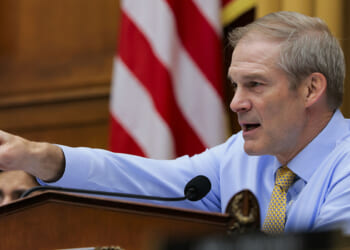

The legislative process is often messy and suspenseful, but in the end, House Speaker Mike Johnson’s razor-thin Republican majority is passing bills that conventional Washington had written off as long shots.
That dynamic was on full display last week as House Republicans proved the doubters wrong and advanced three key priorities: reauthorizations of the Farm Bill and a foreign surveillance law, and a budget resolution that tees up a filibuster-proof process for increasing immigration enforcement funding.
Mr. Johnson, Louisiana Republican, capped off those victories with a surprisingly anticlimactic end to the record 76-day shutdown of the Department of Homeland Security.
The House quietly cleared a Senate-passed funding bill for the department by voice vote, after the speaker and his Republican conference had held it up for weeks because it zeroed out the budgets of immigration enforcement agencies.
“The equations that we solved on legislation … were virtually impossible,” Mr. Johnson told reporters after a series of delayed votes and an acknowledged “ugly process” of resolving complaints from rank-and-file lawmakers.
“Many of you said it couldn’t be done,” he said. “But we got it done because ultimately, we just used patience, and frankly, a prayer. We get a lot of people together, and we listen to their concerns, and we try to get through disparate priorities.”
Dozens of House Republicans had been critical of Mr. Johnson and his leadership team for packing the legislative schedule last week with bills that had not yet earned the full conference’s support.
By the end of the week, however, his loudest critics were coming to his defense.
“Speaker Johnson’s in a tough spot,” Rep. Lauren Boebert, Colorado Republican, told The Washington Times. “Obviously, there’s been frustrations from a lot of us. And I think that he still handled it the absolute best that he could.”
“He kept his patience the entire time. His door was open. He was answering calls and texts,” she said. “Anytime we wanted to speak with him, he made himself available.”
Ms. Boebert is a member of the House Freedom Caucus, a conservative hard-liner group that is often critical of the speaker.
Yet it was Freedom Caucus members defending Mr. Johnson against negative headlines that persisted after House Republicans passed the bills that Washington observers said they could not.
“I think it is pretty evident that the problem isn’t @SpeakerJohnson. It is on the other end of the building,” Rep. Eric Burlison, Missouri Republican, posted on social media in response to a Politico story alleging “GOP groaning over Mike Johnson reaches a fever pitch.”
Rep. Chip Roy, Texas Republican, publicly defended the speaker for advancing Republican priorities with a narrow majority that has fluctuated throughout the Congress, but has never allowed more than a few defections on party-line bills.
That includes the Republicans’ sweeping tax cut and welfare overhaul law enacted last summer and appropriations bills that held discretionary spending flat, said Mr. Roy, blaming the Senate and “swamp spenders” for preventing Republicans from doing more.
Mr. Roy was among the Republicans who had started last week, disgruntled as he left a Monday evening conference meeting, demanding “improvements” to the legislation the House was considering.
“They’re trying to make a hard pitch to just move everything as it is,” he said of leadership. “We’ll see where the mood of the conference is.”
The conference was not happy, so Republican leaders got to work trying to appease factions with varying demands. The House has 217 Republicans, 212 Democrats, and one independent, with five vacancies.
A top priority for the House Freedom Caucus was to ban the Federal Reserve from ever issuing a central digital bank currency, or CDBC, that could be used to surveil Americans through their financial transactions.
The conservative hard-liners wanted the CDBC ban to be added to a bill reauthorizing Section 702 of the Foreign Intelligence Surveillance Act for three years. They also sought other changes to that law to ensure Americans’ data caught in foreign spying would be protected.
The CDBC ban passed the House last summer with only two Democrats joining Republicans in support. Adding it to the FISA bill risked turning off Democrats whose votes Republican leaders needed to prevent the surveillance authority from expiring.
Mr. Johnson and his team found a workaround. They tucked a provision into the procedural rule that said when the FISA reauthorization passed, the CDBC ban would automatically be added to the bill before it was sent to the Senate.
House Democrats always vote against procedural rules, so they could oppose the CDBC ban while supporting the FISA reauthorization.
The measure stalled in the Senate, where Democrats hold the filibuster power and oppose a permanent CDBC ban. Congress ultimately cleared a short-term extension of the surveillance authority to buy more time for negotiations on a multiyear reauthorization.
The result drew criticism from centrist lawmakers who said the speaker eschewed bipartisan negotiations to appease a minority of Republicans.
“It spells dysfunction,” Rep. Don Bacon, Nebraska Republican, told The Times. “You’ve got to work with the Democrats. Don’t tie yourself in pretzels. … We’re playing like a game of Twister to get to 218 [Republicans], and we got a clear majority who support this.”
He said the same bipartisan approach would have made passage of the Farm Bill easier as well.
Mr. Johnson almost pulled the Farm Bill from the floor last week amid “irreconcilable demands” in the conference. Some Republicans, such as Ms. Boebert, were frustrated because the leadership-controlled Rules Committee blocked their amendments from getting floor votes.
“Our ’leadership’ is not letting me do my job,” Ms. Boebert posted on social media, saying she would oppose the procedural rule.
She ultimately voted in support after “hard-fought, good-faith negotiations” with Mr. Johnson and leaders of the agriculture authorizing and appropriations committees.
Ms. Boebert said some of her amendments were included in the agricultural appropriations bill approved by the committee, and others she would fight to include in the final version of the Farm Bill. Mr. Johnson promised her a seat on the farm bill conference committee that would negotiate with the Senate.
The procedural rule still might have failed, as eight Republicans had voted no at one point. The vote was held open for two hours, but Republican leaders ultimately swayed all the defectors.
Key to that resolution was a promise to delay consideration of the farm bill until concerns over that and a related biofuel measure were resolved.
Republicans from oil-producing states were upset with leadership for including language in the rule to tie the biofuel bill to the farm bill after both passed the House.
Proponents of the biofuel bill to allow year-round sales of E15, an ethanol-gasoline fuel blend, thought marrying the two measures before they were sent to the Senate would force a bicameral negotiation to resolve an issue they have been fighting for years.
Mr. Johnson called a “family meeting” with lawmakers on both sides of the issue and worked out a compromise to decouple the measures while still allowing a vote on the E15 bill.
“This is the single most important thing for farm states across the country,” said Rep. Zach Nunn, Iowa Republican, whose state is a leading producer of corn, the base of most ethanol.
He said he is happy with the compromise, saying decoupling the E15 bill from the farm bill would give the Senate more options to process it.
“I actually personally think this is a huge win for us,” Mr. Nunn said. “Don’t tell Chip Roy.”
Mr. Roy and other Republicans oppose the E15 bill because of changes to renewable fuel standards they say could shut down smaller refiners.
The speaker heard an earful from members of his conference — “there was a lot of emotion and frustration,” he said — but his patience paid off.
He attributed his success to never asking Republicans to abandon their core principles while persuading them to abandon some personal preferences for the greater goal of passing legislation.
“Don’t doubt the House Republican majority,” Mr. Johnson said in his victory lap press conference. “We always deliver for the American people. We did it again, in spite of the challenges.”
“We will continue to do that the remainder of the year,” he said. “And that is a large reason why we are going to win the midterms, so that the grown-ups will stay in charge here.”