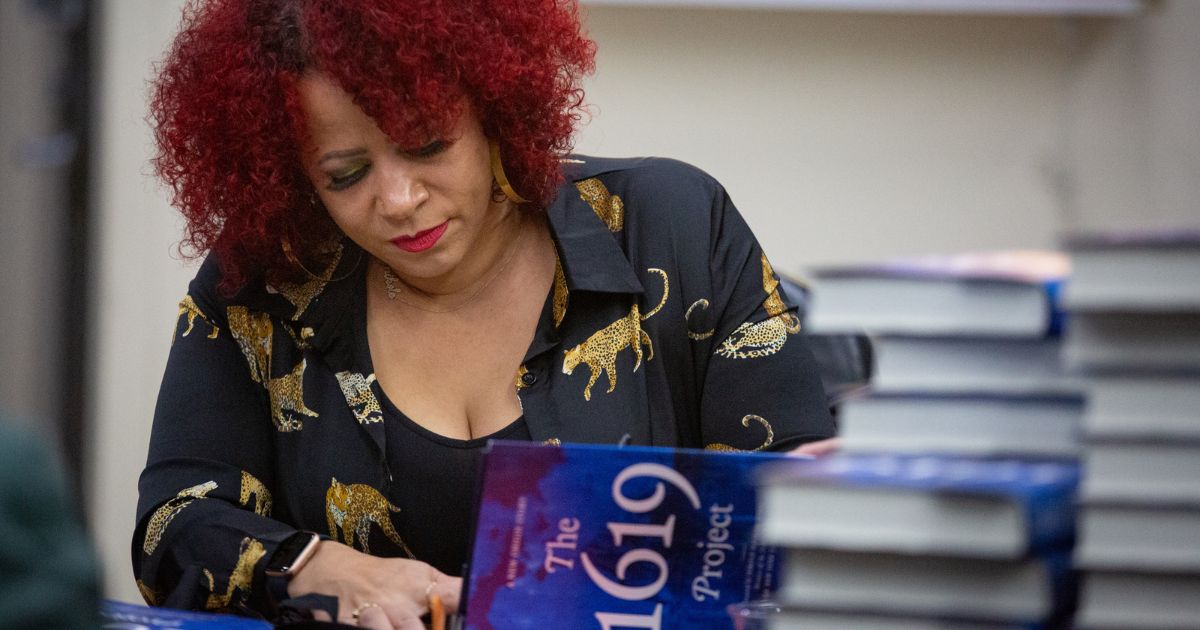
Nikole Hannah-Jones is perhaps one of the best-known columnists for The New York Times. If not prolific (she’s only published three pieces in the paper this calendar year, including the one we’re going to talk about), she’s profoundly influential, particularly in the development of what Alexandria Ocasio-Cortez now playfully calls “Woke 1.”
Her “1619 Project” — in which she basically retcons American history to start when slaves were brought over to the English colonies and revises it from there — is part of the reason why people like AOC are laughingly declaring that “Woke 1 was crazy.”
It still isn’t crazy to Hannah-Jones, who was busy defending the legacy radical Black Panther cop-killer Assata Shakur shortly after she lamented those who mourned for Charlie Kirk in her 2025 columns –which came only slightly more frequently than her 2026 work has. Apparently, dying in Cuba on the run from the law for a murder you almost certainly committed and were convicted of makes you more of a martyr than a guy who died simply because he had opinions that some guy with a trans furry homosexual lover didn’t like, according to prosecutors.
Moreover, Hannah-Jones continues to defend the “1619 Project” — even though, at this juncture, everyone with sense knows that it’s riddled with errors in both fact and logical judgment. She can do all of this because all these things are theoretical to her. She hasn’t met any of the relatives of the cop Assata Shakur was convicted of killing, nor Charlie Kirk’s children. She refuses to seriously intellectually engage with anyone who has pointed out the numerous failings of her “1619 Project.” Those things are all abstractions to her. They will remain abstractions, because we now know how she deals with the concrete, inescapable facts of life, the kind of things that punditry does not prepare you for.
As you may perhaps have heard, Hannah-Jones is going bad viral because she ran a decade-long experiment on her kid in which she and her husband subjected their daughter to their abstract ideas. Sure, they had enough money to send her to a good school, public or private. But to fight what she called the “segregated city” of New York, they were going to send their daughter to a school that had an underperforming reputation — even though she had better options.
“I’d be lying if I said I didn’t feel pulled in the way other parents with options feel pulled. I had moments when I couldn’t ignore the nagging fear that in my quest for fairness, I was being unfair to my own daughter. I worried — I worry still — about whether I made the right decision for our little girl. But I knew I made the just one,” she wrote in 2016.
And, indeed, justice was at the top of her mind. Why should her child get a better education than a poorer child did? Because that was at the heart of all the problems in the New York City public school system, to hear her tell it. That 2016 article mentioned “segregation” 35 times, “segregated” 34 times, and “segregate” once, for a grand even total of 70 mentions of words that begin with that pernicious root. Hannah-Jones clearly believed that this was the root of all educational outcomes, and by sending her child into a school that had a history of less-than-stellar outcomes, she would be a beacon of light, a ray that would break through the wall of what she saw as 21st century Jim Crow.
Are you surprised Jones helped wreck her daughter’s life?
I know you won’t believe this, but this worked out exactly how you might think, given that she wrote about it a decade later in a Sunday article headlined thusly: “In Fighting for Every Black Child, Did I Betray My Own?”
Spoiler alert: In defiance of Betteridge’s law of headlines, yes, she did! Quite badly, in fact!
The lede, which, to be fair to Hannah-Jones, is far more honest than anything I’ve seen her write:
I could feel her looking at me. Her body slung in adolescent impertinence against the front passenger seat door, shoulders turned so she could face me fully. Usually when I picked up my daughter, Najya, from middle school, she’d tumble into the car and bombard me with the day’s escapades, chattering nonstop about her friend group or complaints about an annoying teacher or her wonder at the test she’d aced despite thinking she’d failed it. But not this day.
“Did you know my school was bad like this when you decided to put me here?” she asked.
My hands tightened on the steering wheel as I worked to keep my face neutral, buying a few moments to gather my thoughts.
As they neared the end of her seventh-grade year, Najya and her closest girlfriends were thinking about their futures. Honors students, they searched the nation’s top colleges, and that led to a curiosity about New York City’s highest ranked public high schools.
Wondering about their chances of getting in, they decided to Google their own school and its ratings. And in doing so, Najya and her tight trio of Black girl nerds confronted not only the reality of the city’s deeply segregated educational landscape but also that the Brooklyn school they all attended existed firmly on the wrong side of the divide.
And that turns out to not be the worst part. She actually changed schools a number of times, just not to those pernicious “segregated” ones that performed well. The test scores showed it. That’s why she was angry.
Glancing between her and the road, I told her everything that I had said a hundred times on stages, in interviews, in discussions since I had made her a symbol of how the choices we make can help sustain — or dismantle — educational inequality. I talked about the deep inequality in New York’s schools and how, like those Black families who came before us, we had an obligation to be part of the struggle of our larger community. Even if her schools were not academically the strongest, I explained, her father and I knew that we could provide for her tutoring and any other assistance to make up for what her school may have lacked.
“So you had money to send me to one of the best schools, and you chose not to?” she said, hurling her words. “Because other kids are disadvantaged, you didn’t want to put me in a great school?”
Yeah, that’s how your mom thinks, Najya!
So, as a TL;DR to what happened, the school that Hannah-Jones initially selected went to hell after the high-energy principal left; her teachers didn’t grade her homework when it was actually given, switching schools didn’t really help because she got sent to woke schools where administrators spent most of the time dealing with the troublemakers, and when she finally got sent to a good school, she underperformed because she’d never been taught basic stuff like algebra or punctuation, not to mention self-starting or initiative.
Tutoring mostly fixed that, which her mother’s socioeconomic status certainly afforded her. But do you know what could have also fixed it? Staying away from schools that chronically underperform. It turns out they don’t do that because they’re segregated, but because wokeistas who believe in equity and desegregation and activism run them, and neglect the children in the process. This is basically what she described.
Nikole Hannah-Jones’ defense to this was basically that, sure, her child was underserved by the poor schools she chose, but she experienced microaggressions for being black in the largely white high school she eventually got into, like someone joking that she was “ghetto.” High school bullying does stink, but you know what’s worse? Not being able to academically perform to the level where you’ll be successful.
The social media backlash ranged from accusing her of child sacrifice (true) to pointing out that the failing school she sent her kid to was actually very well funded with small class sizes (also true), and that Nikole Hannah-Jones is still a terrible person for patting herself for admitting she screwed up by subjecting her kid to a social experiment after patting herself on the back for said social experiment (morally above my pay grade to sort out what’s in her heart, and I try to extend even New York Times writers some grace, but it certainly felt that way):
The rest of her account of that conversation:
“I acknowledge to you that I didn’t do the best for you, and I am so sorry.”
But also: “I am kind of happy that you are seeing this.” pic.twitter.com/JaNK7N8tzY
— Steve McGuire (@sfmcguire79) September 20, 2026
This is the per-pupil funding for the elementary school Nikole Hannah-Jones sent her daughter to.
If you subscribe to the funding theory of education, how much would have been enough? It’s already crossed the average per capita annual income threshold. Maybe $100k? $200k? https://t.co/AC0EyRab4q pic.twitter.com/Y9gQActCyo
— Jack (@tracewoodgrains) September 20, 2026
This act of self-exposure by Jones may seem ruefully honest but what it exposes is just how colossal a fool she is and how her behavior as a parent —. Using her child as a testing ground for theory— parallels her misuse of our country’s history. She has been blessed to be an…
— John Podhoretz (@jpodhoretz) September 20, 2026
These are pretty obvious takeaways from the Hannah-Jones piece, and ones that it was (I fear) designed to elicit.
One salient point that got missed, or at least didn’t get talked about enough: For someone whose rhetoric and theories have had an outsized impact on American society for the last decade and a half, Nikole Hannah-Jones’ package of ideas result in amazingly poor outcomes when put into practice.
Sure, a lot of this could already be gleaned by the chief proponent of “Woke 1” declaring that “Woke 1 was crazy” and dismissing it with an “lol, let’s talk about something else” kind of vibe. That’s effectively what most of the left wants to do — because ideas like defunding the police and excusing political violence if you don’t mind who that violence is directed toward don’t work out well in everyday life. AOC has to deal with the fact that she’s a front-runner for the Democratic presidential nomination in 2028.
Hannah-Jones still works (albeit sparingly) inside the steel bubble of the Gray Lady, where Woke 1 still lives loudly and proudly. She didn’t have to deal with any of the consequences of her bad ideas, after all — until, of course, they come home with her daughter, who has every reason to be enraged with her mother for selfish, ethically reprehensible actions.
Finally, after running her dim experiments on her child, mom realized — sorta — that the public school system isn’t failing because of “segregation” or a lack of funds, but because it’s designed to fail students and designed that way not by some vast right-wing conspiracy, but her confederates on the left.
In an interview with a Times editor that accompanied the piece on Sunday, Hannah-Jones said her daughter thinks she still doesn’t get it: “She’s angry about the choices that my husband and I made, and she wanted to have her say. Did she really want people to know she had failed algebra after middle school? Her answer impressed me: ‘Well, it’s true.’ But when I showed her a draft, she didn’t feel I was hard enough on myself.”
Which, fact. Every parent makes mistakes. Few publish theirs preemptively, then publish a follow-up 10 years on in which they congratulate themselves for very publicly failing their daughter by treating her as if she were a rat in a cage and running social experiments on her. There isn’t language strenuous enough to condemn an otherwise legal parental act the obloquy it deserves.
However, there is some justice, as the Times editor did her no favors with the headline on the interview: “Reality Bites.” Tell me about it, and harder than Nikole Hannah-Jones ever could have imagined.
Advertise with The Western Journal and reach millions of highly engaged readers, while supporting our work. Advertise Today.