
With U.S. bombs still falling on Iran, Congress is barreling toward a constitutional confrontation with President Trump — and lawmakers on both sides of the aisle are demanding a reckoning over who has the authority to take the country to war.
Democrats and a small but vocal group of Republicans are pushing for an emergency vote on bipartisan war powers resolutions that would force the Trump administration to seek congressional approval before continuing military operations against Tehran. The House is not expected to return until Wednesday, with the Senate reconvening Monday — but calls to cut recess short are growing louder by the hour.
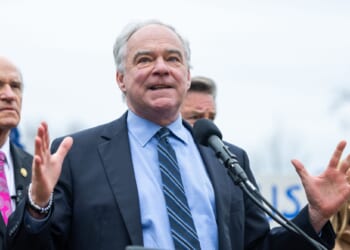
“The Senate should immediately return to session and vote on my War Powers Resolution to block the use of U.S. forces in hostilities against Iran,” said Sen. Tim Kaine, Virginia Democrat, adding: “Every single senator needs to go on the record about this dangerous, unnecessary, and idiotic action.”
Rep. Ro Khanna, California Democrat, and Rep. Thomas Massie, Kentucky Republican — who had already been preparing a House vote on such a resolution before Saturday’s strikes — are among those demanding Congress convene Monday. “Congress must convene on Monday to vote to stop this,” Mr. Khanna said in a video posted on X. Mr. Massie did not mince words, saying the strikes were “acts of war unauthorized by Congress” — and invoking the president’s own slogan: “This is not ’America First.’”
A companion measure in the Senate is expected to be sponsored by Mr. Kaine and Sen. Rand Paul, Kentucky Republican. Because such resolutions are privileged, they are guaranteed a floor vote — meaning Republicans, not just Democrats, will have to go on the record.
The constitutional stakes are significant. Article I of the Constitution gives Congress, not the president, the power to declare war. While presidents have historically exercised broad unilateral authority as commander in chief, the Iran strikes represent the most sweeping American military operation in the Middle East since the 2003 invasion of Iraq — one explicitly aimed at regime change. By contrast, President George W. Bush spent months seeking congressional authorization before the Iraq War began.
The White House notified members of the Gang of Eight shortly before Saturday’s strikes were launched, but did not seek formal authorization. Secretary of State Marco Rubio also briefed House Speaker Mike Johnson before the operation began, according to press secretary Karoline Leavitt.
Mr. Johnson said the Gang of Eight had been briefed earlier in the week that military action was imminent, and defended the president’s decision. Iran, he said, is facing “the severe consequences of its evil actions.”
Senate Majority Leader John Thune, South Dakota Republican, commended the strikes, saying Iran’s nuclear ambitions, missile program and support for terror groups posed “a clear and unacceptable threat” to U.S. interests.
Sen. Lindsey Graham, South Carolina Republican, called the operation “well-planned” and predicted success. “As I watch and monitor this historic operation, I’m in awe of President Trump’s determination to be a man of peace — but at the end of the day, evil’s worst nightmare,” he wrote on X.
But even if a war powers resolution were to pass a narrowly divided Congress, Mr. Trump could veto it — and a two-thirds majority to override would be nearly impossible to assemble. A similar resolution to curtail U.S. intervention in Venezuela failed in the Senate earlier this year. Still, supporters argue the votes serve a vital accountability function, forcing members to take a public stand and keeping pressure on the White House.
Sen. Andy Kim, New Jersey Democrat, said he was ready to return to Washington immediately. “We should have Congress go back into session for the War Powers vote to reassert the American people’s will,” he told CNN Saturday. “They don’t want to be at war.”
The next week will test whether the constitutional guardrails around presidential war-making still hold — or whether Congress, as it has so many times before, ultimately defers to a president who has already pulled the trigger.
This article is written with the assistance of generative artificial intelligence based solely on Washington Times original reporting and wire services. For more information, please read our AI policy or contact Steve Fink, Director of Artificial Intelligence, at sfink@washingtontimes.com
The Washington Times AI Ethics Newsroom Committee can be reached at aispotlight@washingtontimes.com.