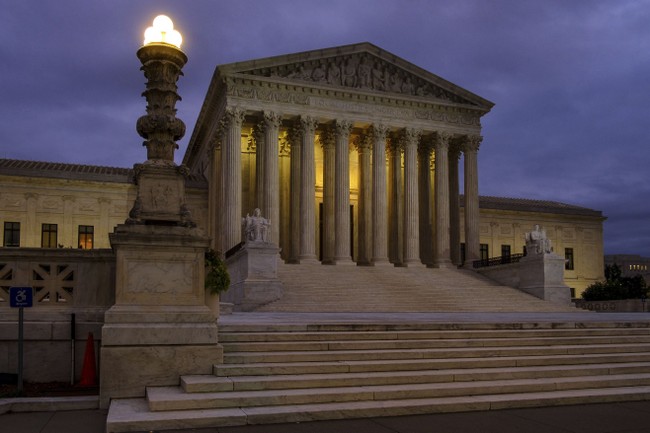
It should go without saying, but I’ll say it. I’m not a lawyer, so some of what I heard during yesterday’s oral arguments at the U.S. Supreme Court (SCOTUS) on birthright citizenship may as well have been in Japanese. I’m a word guy, and so what I listened for mainly was continuity from the Trump administration’s attorney, Solicitor General D. John Sauer.
His brilliance was obvious in his ability to respond in milliseconds to complex questions from eight of the nine members of the bench, and stupid questions from one member. To be sure, the sheer intelligence of most of the members of the court is sometimes astounding when you think about it and you take the time to listen to them do their thing.
The words of the day it seemed were “domicile,” “allegiance,” and “temporary sojourner,” — what each means, should mean, used to mean, does not mean, and might mean — all in a legal context.
The discussion was enlightening, but it didn’t reveal anything to me about how the case will be decided this summer. Sometimes you can tell by the court’s line of questioning where a case might go. If you’re a person with an average IQ, you can pretty much follow along, unless of course you’re Kentanji Brown Jackson, the Biden-appointed justice who famously couldn’t define what a woman is during her confirmation hearings. My colleague Matt Margolis is somewhat of a KBJ aficionado and always has something interesting to say about Brown’s intellectual heft, as he did right after the birthright citizenship arguments.
During the course of the Court’s questioning of Sauer, the exchange bounced around, focusing on things like what the Constitution’s framers intended on some issues, what the authors of the 14th Amendment were thinking in 1868, what lawmakers were thinking in 1940 and 1952, and what previous Supreme Court justices were thinking in earlier landmark cases.
Keep in mind, Sauer and the Trump administration had taken on the daunting task of trying to dramatically redefine the common interpretation of birthright citizenship as addressed in the 14th Amendment, in the Citizenship Clause. That clause says, “All persons born or naturalized in the United States and subject to the jurisdiction thereof, are citizens of the United States and of the state wherein they reside.”
In other words, if you’re born on U.S. soil, by accident or intent (with very few exceptions), you are an American citizen.
Sauer’s case keyed in on what is meant by “the jurisdiction thereof.” As I followed the court’s questioning, I did notice a pattern that may determine the case’s outcome. Justice after justice seemed to want to know what has changed so much that it requires them to pretty much turn the country’s immigration law and policy on its head.
They seemed to be telling Sauer, “If I’m going to change the common interpretation of the Constitution, tell me what I need to tell everyone who is impacted by this. Why do this, and why now?”
Early on, when Chief Justice John Roberts was questioning Sauer, he raised the issue of “birth tourism,” where foreign nationals travel to the U.S. solely to give birth here, and then they return to their home countries, U.S. citizen-babies in tow.
Sauer told Roberts, “We’re in a new world now,” inferring that when the 14th Amendment was written, it did not anticipate the creative ways people might abuse America’s immigration laws.
Roberts then remarked, “It’s a new world. It’s the same Constitution.” Ouch.
If the Trump administration has any hope of winning this case, it needs at least Roberts or Justice Amy Coney Barrett. It can’t win without at least one of them deciding in favor of the White House.
Barrett didn’t seem any more excited about Sauer’s arguments than Roberts. When talking about President Donald Trump’s executive order at the center of this case, she told Sauer, “I can imagine it being messy on some applications… So, what would you do with what the common law called foundlings?”
She was referring to abandoned babies, because much of Sauer’s justification for changing the interpretation of the 14th Amendment is tied to parental status and “allegiance.” To be sure, when using a word like “allegiance,” Sauer made the point that it’s not a loyalty you feel, but rather a primary obligation you owe to the country where you are a citizen. One of your obligations as a citizen, for example, is to obey your country’s laws.
“The thing about this is, and then you have to adjudicate, if you’re looking at parents, and if you’re looking at parents’ domicile, then you have to adjudicate both residents and intent to stay,” Barrett said. “What if you don’t know who the parents are?”
Her point was that if you don’t have one or two parents involved, you can’t make assumptions about an infant’s allegiance to America, or the child’s eventual intent as to whether to stay in America or leave. While such an example would be very rare and unlikely, it’s examples like this that the justices use to expose the flaws in a legal argument.
Sauer’s response: “I think there are marginal cases. He said that scenario would likely be addressed in Section 1401(f), where it says that children under the age of five of ‘unknown parentage’ who are found in the U.S. are granted citizenship, unless it is somehow proven that they were not born in the U.S.”
Barrett wasn’t having it. She said, “Yeah, yeah, yeah, yeah, but what about the Constitution?”
She raised many logistical and practical issues: “How would it work? How would you adjudicate these cases? You’re not gonna know at the time of birth, for some people, whether they have the intent to stay or not… Including U.S. citizens, by the way… I mean, what if you have someone who is living in Norway with their husband and family, but is still a U.S. citizen, comes home and has her child here and goes back? How do we know whether the child is a U.S. citizen because the parent didn’t have an intent to stay?”
Objectively, Sauer seemed to give a sound response, saying, “I make two points, one practical, one legal. The practical point is, under the terms of this executive order, you don’t have to, because the executive order turns on objectively verifiable things, which is immigration status. Are you lawfully present, but temporarily present, or do you have an illegal status? So taking evidence, so to speak, under subjective attempt wouldn’t be done.”
Nothing from justices Clarence Thomas, Samuel Alito, Neil Gorsuch, or Brett Kavanah gave any indication that Sauer had strong advocates on the bench in this case.
That said, because of the legal issues involved and what appeared to be a pretty good defense of the president’s executive order, it wouldn’t surprise me if the Court does ultimately decide in favor of Trump. His executive order has forced the country to consider the tough questions and essentially put a Century-old immigration tradition on trial. The justices wouldn’t have taken this case if they weren’t up for it.
That’s why I sensed some disappointment in the voices of the conservatives on the bench when they asked their questions. They wanted more than the Trump administration was providing. They wanted better cover if they were going to upend the common understanding of the 14th Amendment.
They seemed to be asking Sauer to tell them to find a way to frame it better. They wanted an obvious connection to be made between how birthright citizenship as currently interpreted runs afoul of the 14th Amendment. They needed cases. They needed Sauer to tell them what’s changed, and how to bring it all back to the Constitution and its intent.
Did Sauer achieve that? I honestly don’t know. I do know this: It wouldn’t be a bad time to start looking at ways Republicans can come up with new legislation on birthright citizenship. One executive order can’t do all of the heavy lifting on this.
Related: Germany’s Friedrich Merz Plans to Repatriate Nearly One Million Syrian Migrants
Find out what you’re missing behind the members-only wall. It’s time for you to take advantage of the full catalogue of common-sense thinking that comes with a PJ Media VIP membership. You’ll get access to content you didn’t even know you wanted, and you’ll be hooked. The good news is, PJ Media VIP memberships are on sale! Get 60% off an annual VIP, VIP Gold, or VIP Platinum membership! Use promo code FIGHT to get 60% off a VIP membership!