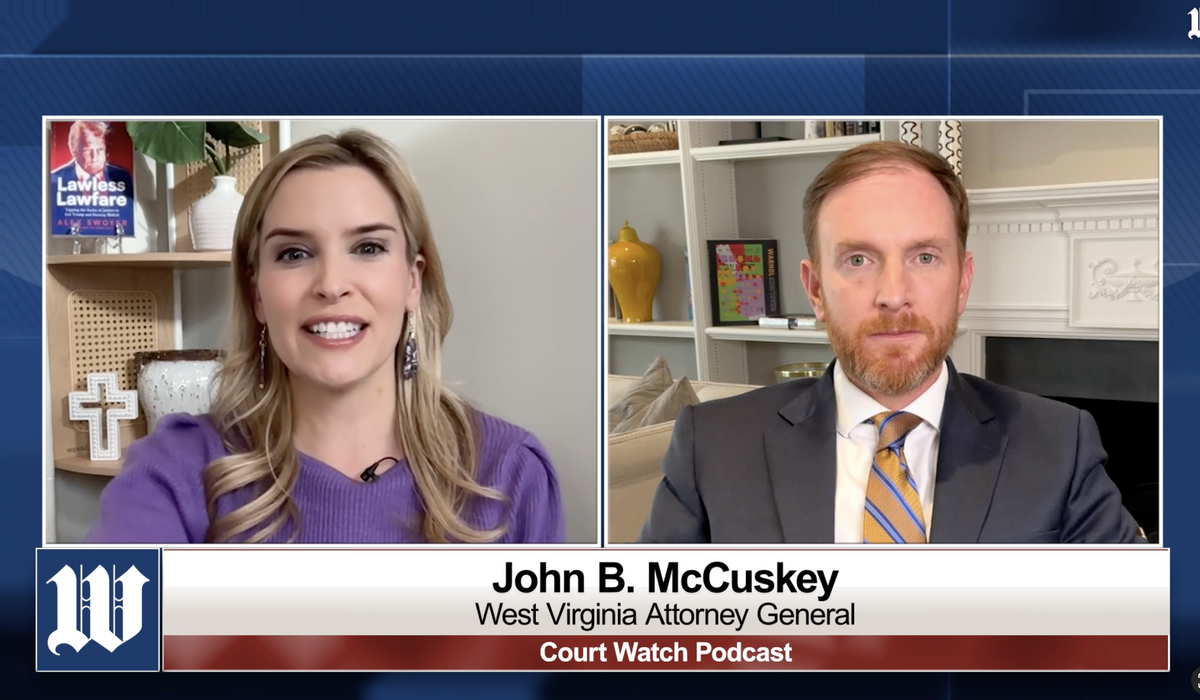
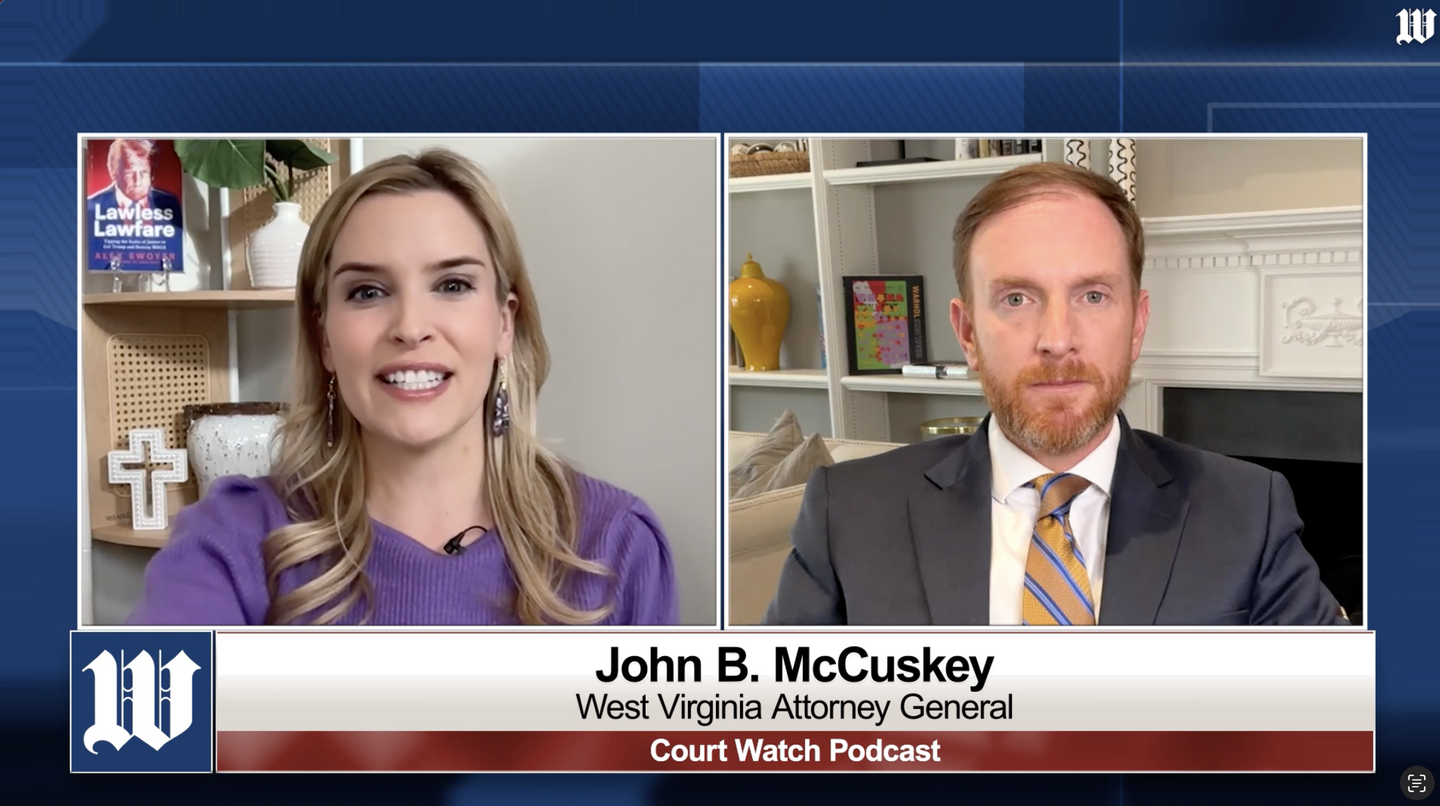
Hello, this is Court Watch with Alex Swoyer, and I’m excited to bring you the latest episode of my podcast, where I am joined by West Virginia Attorney General J.B. McCuskey.
The justices heard oral arguments Tuesday over his state law that bans transgender athletes from competing in biological girls’ sports. The case came before the court after a transgender girl challenged the state law, arguing it violated the constitutional Equal Protection Clause and Title IX.
The state says, however, that Title IX specifically protects women’s sports by giving biological girls opportunities to compete.
The High Court also heard a similar dispute out of Idaho, concerning its law banning transgender athletes from girls’ sports
The lower courts both ruled against the state laws, which are now before the justices.
[SWOYER] Attorney General McCuskey, thank you so much for joining me. I was in the courtroom, and I jotted down a few takeaways that I had. And I want to get your reaction about some of the things that stood out to me.
Whenever I go into the arguments, I like to write which justice I think is going to fall where along the line, okay? So I had more names next to your state than I did the other side. One of the people who surprised me…
[McCUSKEY] Then I think the interview’s over. We’re good.
[SWOYER] One of the things that surprised me somewhat was Justice Gorsuch. He brought up a long line of discrimination about against transgender people, even citing cross-dressing statutes. It kind of surprised me. Did you read anything? He was one I could not read. What was your takeaway?
[McCUSKEY] My takeaway with Justice Gorsuch is always that he is incredibly thorough. It could probably be said that, amongst the nine justices, he’s the one that looks at these cases from the widest swath. And so I think it was very in character for him to try to elicit as many answers as he could to answer as many hypotheticals that he had in his mind as possible. And I read that as he was working on justifying what I believe is his belief that we won the day. And he wants to make sure that his reasoning and his writing covers every base possible.
[SWOYER] One of the things that I captured in our coverage was there was this back and forth about do we need to define sex. There was pushback from the other side. I forget the exact attorney’s name, but representing the transgender athlete that, you know, you don’t have to define race to know racial discrimination. I thought that was curious. There seemed to be a lot of justices that are uncomfortable if they don’t go ahead and define sex here. My question, too, is how important is that? And is that something, you know, that would relate to equal protection or Title IX? Could you win on both or just one of those?
[McCUSKEY] We’re going to win on both. And what I found really interesting is that the ACLU was really burying the lead there. They don’t want sex non-defined. They want sex undefined. And so sex is defined within Title IX. And so it is, I think, kind of ridiculous to make the statement that the typical dictionary definition of sex as it was in 1975 isn’t what was meant. That’s how we do every other statutory construction under the law in this country. And so while they were saying they don’t want sex defined, what they don’t want is for them to define sex to what it is, right? They don’t want the justices to say that sex means what you were assigned at birth. But that is what it is now. And so for them to say that they don’t want the justices to define sex is really their way of saying they want to leave the term as it is in the statute and continue to blur what the traditional definition of that word means.
[SWOYER] I usually think that Justice Roberts, Justice Kavanaugh tend to be in the middle of the court, and I had jotted down questions that I thought stuck out to me during oral arguments. I’m looking at my notes right now that went to your favor. One, I thought, was we know Chief Justice Roberts was in the majority with the Bostock ruling, the one that was basically pro a transgender employee in an employment discrimination context. I thought it was interesting that he actually brought up how Title VII in that case is different than Title IX. I thought that was an interesting line of questioning showing that he might be leaning towards making a difference there. I didn’t know if you read anything into that.
[McCUSKEY] Yeah, I think the distinctions between Bostock in this case are really important. And I think it’s borderline offensive to even draw the corollaries because what we know is that under Title VII, it is impermissible to discriminate against trans people when the issue that is in front of you is something that doesn’t have anything to do with your immutable physical characteristics. And Title IX, particularly as it relates to the Equal Protection Clause, does the exact opposite of that. The language of the statute, that is an issue, is definitionally to ensure that women specifically have spaces in athletic and academic competition. I think it actually makes our point when the ACLU tries to draw conclusions where they’re similar.
Watch the video for the full conversation.
Read more: Supreme Court open to transgender sports bans, but some justices are grappling with issue for states