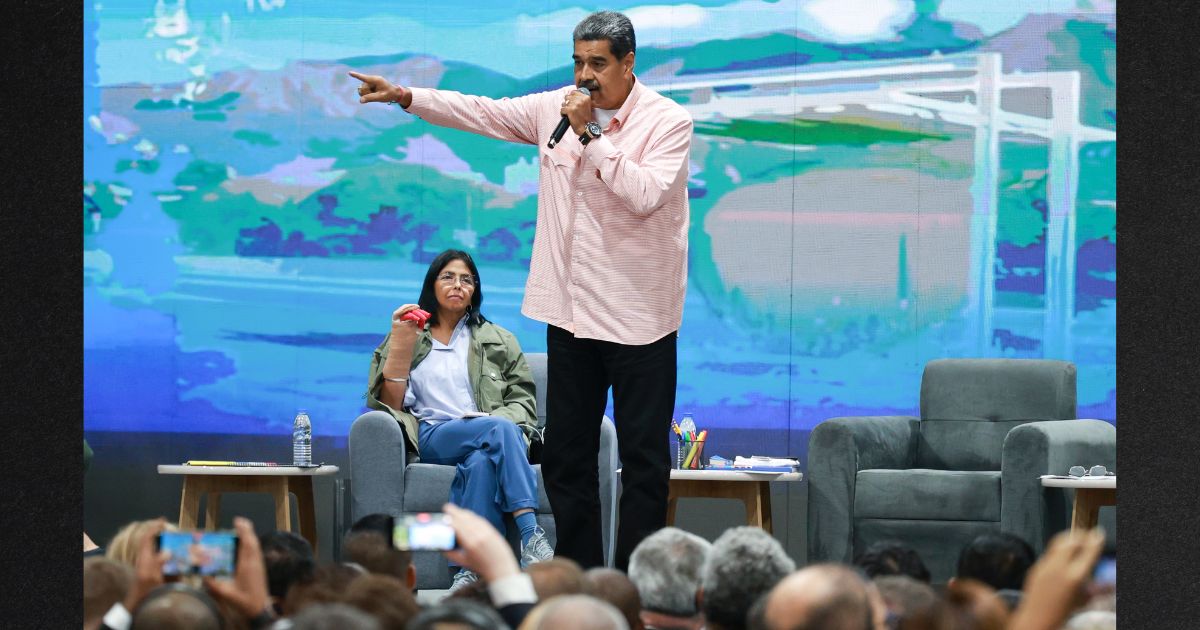
When a daring early morning raid successfully captured alleged narco-terrorist Nicolas Maduro Saturday, many wondered what was next for the Venezuelan strongman.
It appears to be nothing good.
But as Maduro was charged with a litany of serious charges, including narco-terrorism conspiracy and cocaine importation conspiracy, many others naturally began to wonder what the remnants of his Venezuelan regime would do in response.
Again, it appears to be nothing good.
According to a blistering report from Reuters, the state of emergency declared on Saturday, shortly after Maduro’s capture, includes a decree to “immediately begin the national search and capture of everyone involved in the promotion or support for the armed attack by the United States.”
While the state of emergency has been in effect since Saturday, the full text of it was only published Monday.
It’s unclear what charges could be levied against those arrested, but regardless, the move appears to fly directly in the face of stern warnings issued by President Donald Trump in the aftermath of Maduro’s capture.
At first, Trump appeared to imply that Venezuela’s interim leader, Vice President Delcy Rodriguez, would be willing to cooperate with the U.S.
When her first comments after the fact condemned the U.S. raid, Trump didn’t mince words.
“If she doesn’t do what’s right, she is going to pay a very big price, probably bigger than Maduro,” the president said.
Trump also spoke about how he seemingly had additional military responses lined up in the event that Rodriguez doesn’t play ball.
“No, if Maduro’s vice president — if the vice president does what we want, we won’t have to do that,” Trump said when asked if the U.S. military would have to be more directly involved in Venezuela’s day-to-day operations post-Maduro.
“We’re prepared,” he added. “You know, we have a second wave that’s much bigger than the first wave.”
As Fox News notes, Rodriguez has long been a backer and supporter of Maduro, who is deeply unpopular with Venezuelans across the globe.
And the Reuters report seems to imply that Rodriguez hasn’t changed her stance.
What comes next, then, looks less like a transition and more like a test of wills. Rather than signaling reform or cooperation, the regime Maduro leaves behind appears to be defaulting to the only playbook it’s accused of knowing: repression, retaliation, and defiance.
A sweeping manhunt aimed at anyone accused of “supporting” the U.S. operation suggests the post-Maduro government is more interested in consolidating power than stabilizing a country already hollowed out by corruption and economic collapse.
That posture carries real risk, given how explicit Trump’s warnings were.
If Venezuela’s interim leadership continues down a confrontational path, it may soon learn that Maduro’s capture was not the end of American involvement, but the opening move in a far larger and far more consequential confrontation.

Advertise with The Western Journal and reach millions of highly engaged readers, while supporting our work. Advertise Today.