President Trump returns to the House chamber tonight to deliver his 2026 State of the Union address, and the guest gallery is again part of the show. Among the expected guests: Sierra A. Burns, a foster-care advocate, and Everest Nevraumont, a 10-year-old student and AI-education advocate, both seated with Mrs. Trump in her box, according to the White House.
Democrats are also bringing statement-makers. Reps. Suhas Subramanyam and Jamie Raskin announced they would host Sky and Amanda Roberts, brother and sister-in-law of the late Virginia Roberts Giuffre, a survivor of Jeffrey Epstein’s trafficking ring, according to a joint press release. Rep. Subramanyam said in the release that her presence is intended to “be a visible reminder to Trump that we’re not giving in or giving up.”
After the Milan-Cortina Olympics, Mr. Trump invited the U.S. hockey teams. The U.S. women’s team declined due to prior commitments, while the U.S. men’s team accepted and traveled to attend.
Ahead of his address, here are 15 of Mr. Trump’s most memorable “guestbook” picks from his past State of the Union speeches. They’re memorable gallery moments designed to put a human face on policy and, at times, steal the spotlight.
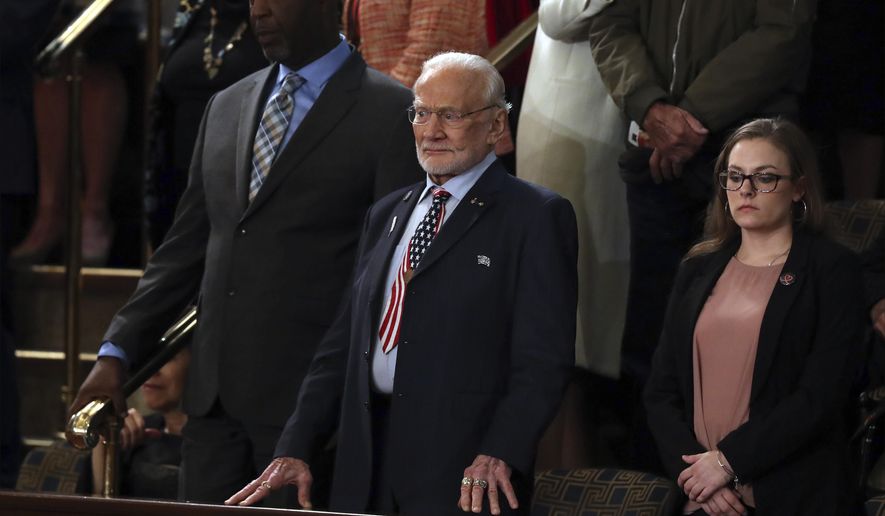
Astronaut Buzz Aldrin arrives for President …
more >
1. Buzz Aldrin (2019)
Apollo 11 astronaut Buzz Aldrin, the second man to walk on the moon, appeared on the 2019 guest list as Mr. Trump commemorated the 50th anniversary of the historic moon landing. “In 2019, we also celebrate 50 years since brave young pilots flew a quarter of a million miles through space to plant the American flag on the face of the moon,” Mr. Trump said, according to the official White House transcript. “Half a century later, we are joined by one of the Apollo 11 astronauts who planted that flag: Buzz Aldrin.” The 89-year-old Mr. Aldrin saluted as he received a standing ovation.
Mr. Aldrin served as lunar module pilot on the Apollo 11 mission, landing on the moon with Neil Armstrong on July 20, 1969, while Michael Collins remained in lunar orbit.
Why it mattered: Space-race nostalgia paired with future moon-and-Mars ambitions as Mr. Trump promoted his administration’s push to return Americans to space and marked a milestone anniversary of American achievement.
2. Matthew Charles (2019)
Mr. Charles became the first prisoner released under the First Step Act criminal justice reform legislation. Sentenced to 35 years in prison in 1996 for selling crack cocaine, he found faith while incarcerated, completed more than 30 Bible studies, became a law clerk, taught GED classes and mentored fellow inmates. “Matthew is the very first person to be released from prison under the First Step Act,” Mr. Trump said, according to the White House transcript. He was released Jan. 3, 2019.
Why it mattered: A bipartisan reform narrative in prime time that gave human dimension to Mr. Trump’s signature criminal justice achievement.
3. Grace Eline (2019)
The 10-year-old from Long Hill, New Jersey, raised more than $40,000 for cancer research before being diagnosed with a brain tumor herself. “Every birthday since she was 4, Grace asked her friends to donate to St. Jude’s Children’s Hospital,” Mr. Trump said, according to the White House transcript. She did not know that one day she might become a patient herself. “Last year, Grace was diagnosed with brain cancer. Immediately, she began radiation treatment. At the same time, she rallied her community and raised more than $40,000 for the fight against cancer,” Mr. Trump said. “When Grace completed treatment last fall, her doctors and nurses cheered,” according to the White House transcript. Mr. Trump looked directly at her during his speech and said, “Hi Grace,” drawing a standing ovation. “Grace, you are an inspiration to us all,” Mr. Trump said.
Why it mattered: A heartwarming story of childhood courage that showcased cancer research advocacy and survival, resonating across partisan lines.
4. Juan Guaidó (2020)
The Venezuelan opposition leader and head of the Venezuelan National Assembly attended as Mr. Trump’s guest. The White House said the United States became the first country to recognize Mr. Guaidó following the National Assembly’s declaration that Venezuela’s dictator was illegitimate, according to White House archives.
Why it mattered: A live-action endorsement of the administration’s stance against Nicolás Maduro that brought international intrigue into the House chamber.
5. Officer Ryan Holets (2018)
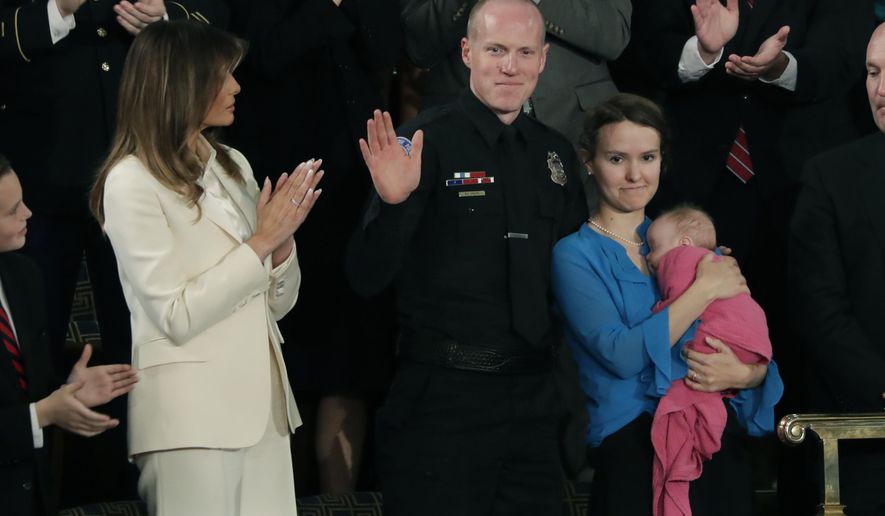
FILE – In this Jan. 30, …
more >
Officer Ryan Holets of the Albuquerque Police Department encountered a pregnant homeless woman preparing to inject heroin while on duty. When he told her she would harm her unborn child, she wept and said she wanted a safe home for her baby. “In that moment, Ryan said he felt God speak to him: ’You will do it — because you can,’” Mr. Trump said, according to the transcript. Officer Holets and his wife Rebecca adopted the baby and named her Hope.
Why it mattered: The opioid epidemic framed through personal compassion rather than statistics, showing one family’s extraordinary response to the crisis.
6. Alice Johnson (2019)
Ms. Johnson’s life sentence for a nonviolent drug offense was commuted by Mr. Trump following advocacy by reality TV star Kim Kardashian West. “In 1997, Alice was sentenced to life in prison as a first-time non-violent drug offender,” Mr. Trump said, according to the transcript. “Over the next two decades, she became a prison minister, inspiring others to choose a better path. She had a big impact on that prison population, and far beyond.” When Mr. Trump acknowledged her presence, ABC News reported that Ms. Johnson wiped away tears as lawmakers from both parties gave her a standing ovation. “Alice, thank you for reminding us that we always have the power to shape our own destiny,” Mr. Trump said.
Why it mattered: A human face on criminal justice reform and the First Step Act that transcended partisan divides and sparked bipartisan applause.
7. Rush Limbaugh (2020)
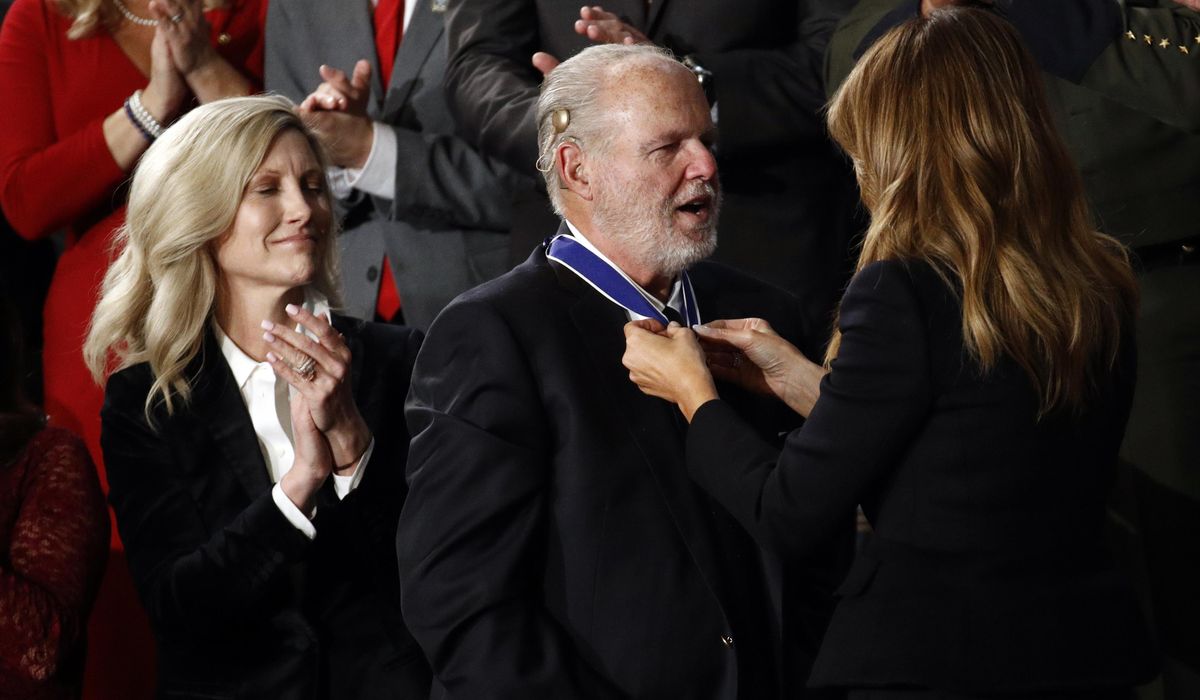
In one of the most talked about moments of Mr. Trump’s State of the Union history, the president awarded the Presidential Medal of Freedom to conservative radio host Rush Limbaugh, who had announced his advanced lung cancer diagnosis just one day earlier. “Here tonight is a special man, beloved by millions of Americans who just received a Stage 4 advanced cancer diagnosis. This is not good news, but what is good news is that he is the greatest fighter and winner that you will ever meet,” Mr. Trump said, according to the transcript. “Rush Limbaugh, thank you for your decades of tireless devotion to our country,” Mr. Trump continued. Fox News reported that Mr. Limbaugh appeared visibly stunned and teared up as Mrs. Trump placed the medal around his neck in an unprecedented presentation during the joint session. Mr. Limbaugh died in February 2021.
Why it mattered: A culture-war flashpoint staged in real time that drew sharp partisan reactions, with Republicans offering a standing ovation while many Democrats remained seated or boycotted the address entirely.
8. Agent Celestino “CJ” Martinez (2018)
The Homeland Security Investigations special agent served 15 years in the Air Force before becoming an ICE agent fighting gang violence. MS-13 leaders ordered his murder, but he did not cave to threats, Mr. Trump said. In May 2017, he commanded an operation to track down gang members on Long Island. “His team has arrested nearly 400, including more than 220 from MS-13,” Mr. Trump said, according to the CBS News transcript.
Why it mattered: Immigration enforcement personified through a law enforcement officer who risked his life to combat gang violence.
9. Retired Brig. Gen. Charles McGee (2020)
Mr. Trump recognized 100-year-old Brig. Gen. Charles McGee, one of the last surviving Tuskegee Airmen, along with his great-grandson, Iain Lanphier. According to the White House, Gen. McGee flew 409 combat missions during World War II, Korea and Vietnam, and had his stars pinned to his uniform the day of the address after participating in the Super Bowl LIV coin toss.
Why it mattered: A patriotic through-line spanning World War II to the present that honored African American military excellence.
10. Carl and Marsha Mueller (2020)
The parents of Kayla Mueller, a humanitarian aid worker who was kidnapped by ISIS and murdered, attended as Mr. Trump highlighted the U.S. operation that killed ISIS leader Abu Bakr al-Baghdadi. “Kayla was held captive and tortured by the leader of ISIS, Abu Bakr al-Baghdadi, before being murdered,” according to the White House description. “On October 26, 2019, President Trump ordered a successful U.S. Special Forces raid” that led to the death of al-Baghdadi.
Why it mattered: Counterterror policy framed through personal loss, connecting Mr. Trump’s military actions to American victims of terrorism.
11. Staff Sgt. Justin Peck (2018)
Near Raqqa in November 2017, Staff Sgt. Peck and Chief Petty Officer Kenton Stacy were clearing buildings rigged with explosives when Mr. Stacy was severely wounded. “Immediately, Justin bounded into the booby-trapped building and found Kenton in bad shape. He applied pressure to the wound and inserted a tube to reopen an airway. He then performed CPR for 20 straight minutes during the ground transport and maintained artificial respiration through 2 hours of emergency surgery,” Mr. Trump said, according to the transcript. Mr. Stacy would have died without Staff Sgt. Peck’s actions. Mr. Trump noted that Staff Sgt. Peck was wearing his new Bronze Star with a “V” for valor.
Why it mattered: Military valor front and center during the campaign against ISIS, illustrating American sacrifice in the fight against terrorism.
12. Judah Samet (2019)
The Holocaust survivor also survived the October 2018 Pittsburgh synagogue shooting at the Tree of Life synagogue. Mr. Trump also recognized Pittsburgh Police officer Timothy Matson, who was wounded during the SWAT response to the attack.
Congress interrupted that State of the Union address to sing “Happy Birthday” to Mr. Samet.
“They wouldn’t do that for me, Judah,” Mr. Trump said afterwards.
Why it mattered: A solemn moment cutting across party lines that addressed both historical atrocities and contemporary antisemitic violence.
13. Preston Sharp (2018)
The 12-year-old from Redding, California, started a movement after noticing veterans’ graves were not marked with flags on Veterans Day. “He decided to change that, and started a movement that has now placed 40,000 flags at the graves of our great heroes,” Mr. Trump said, according to the transcript. “Preston: a job well done.”
Why it mattered: Civic pride as a closing-note sentiment, showcasing youth patriotism and respect for veterans.
14. Joshua Trump (2019)
Delaware sixth-grader Joshua Trump was invited after the White House said he had been bullied because of his last name. “Unfortunately, Joshua has been bullied in school due to his last name,” the White House stated. “He is thankful to the first lady and the Trump family for their support.” The invitation aligned with first lady Melania Trump’s “Be Best” anti-bullying initiative. The sixth-grader became one of the most talked-about guests when he fell asleep during the lengthy address.
Why it mattered: A culture clash turned into a gallery storyline that provided one of the evening’s most viral moments.
15. The Williams Family (2020)
Amy Williams attended the 2020 address as a military spouse and mother of two stationed at Fort Bragg, North Carolina. “Amy works full time for the Army and devotes hundreds of hours to helping military families, all while raising her two children as her husband—Sergeant First Class Townsend Williams—serves on his fourth deployment,” according to the White House. During the speech, the family was reunited when Sgt. Williams surprised them by appearing in the gallery.
Why it mattered: A surprise military reunion — a perennial applause line that highlighted military family sacrifice and delivered an emotional television moment.
This article is written with the assistance of generative artificial intelligence based solely on Washington Times original reporting and wire services. For more information, please read our AI policy or contact Steve Fink, Director of Artificial Intelligence, at sfink@washingtontimes.com
The Washington Times AI Ethics Newsroom Committee can be reached at aispotlight@washingtontimes.com.