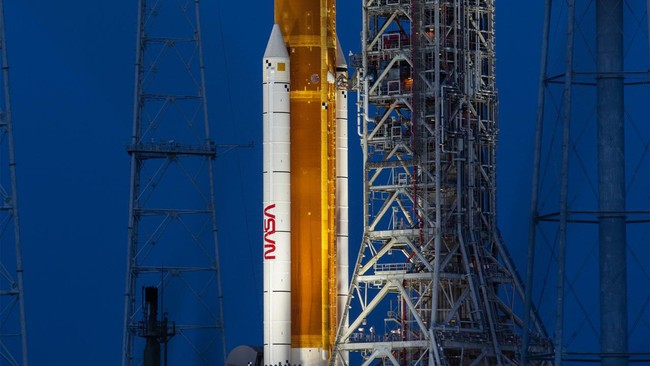
NASA Administrator Jared Isaacman announced sweeping changes to the eight-year-old Artemis lunar program on Friday morning, a program that to date has launched just one unmanned mission — way back in 2022 — and its first manned launch just suffered another monthlong (at least) delay.
“NASA must standardize its approach, increase flight rate safely, and execute on the President’s national space policy,” Isaacman said. “With credible competition from our greatest geopolitical adversary increasing by the day, we need to move faster, eliminate delays, and achieve our objectives.”
The streamlining effort includes cancelling the Exploration Upper Stage (EUS) and Block IB upgrade for the SLS rocket. Future Artemis missions will use what Isaacman called a “standardized” upper stage, which should reduce costs and development time. I suspect that SLS upgrades got the axe because SLS will get the axe, too, “just as soon as politically feasible,” as space policy expert Rand Simberg posted yesterday.
No changes to Artemis II, which NASA now hopes will launch in early April. However, Artemis III will no longer land on the Moon as originally planned. Instead, in 2027, an Orion capsule will launch on SLS and dock with Starship and/or Blue Moon landers in low-Earth orbit as a test mission. Artemis IV — set for 2028 — is now the first manned landing mission.
“If I recall, the timing between Apollo 7 and 8 was nine weeks,” a high-ranking (but anonymous) NASA official told space reporter Eric Berger. “Launching SLS every three and a half years or so is not a recipe for success. Certainly, making each one of them a work of art with some major configuration change is also not helpful in the process, and we’re clearly seeing the results of it, right?”
“This is just not the right pathway forward,” Isaacman said, referencing the low flight rate of SLS-based Artemis missions. Well — mission, singular, at least until Artemis II finally takes flight with its crew of four to essentially perform a repeat of the Apollo 8 flight around the moon in 1968. That’s the year before I was born, and I turn 57 in not many weeks from now.
Isaacman said that NASA expects to start launching Artemis missions at a rate of at least one per year, and that the agency is working with both SpaceX and Blue Origin to accelerate development of commercial lunar landers for 2028 and future missions.
Two problems I see include Boeing’s (and other venerable “Old Space” contractors like Northrop Grumman, ULA, and Aerojet Rocketdyne) well-established lobbying operations on Capitol Hill. They’ll fight tooth and nail to keep SLS and EUS alive. But we can’t afford the former (leading to that second problem), and we don’t require the latter.
So that other tiny little problem is that at an astronomical $4-plus billion per SLS rocket, we simply can’t afford to fly them that often. Less often, of course, and we don’t have a viable way of establishing a permanent lunar presence.
But thanks to our pork-addicted Congress and contractors, NASA is stuck with SLS at least through Artemis V — and taxpayers are stuck with another $12-plus billion worth of SLS rockets that never launch on time.
Recommended: We Need to Talk About Artemis