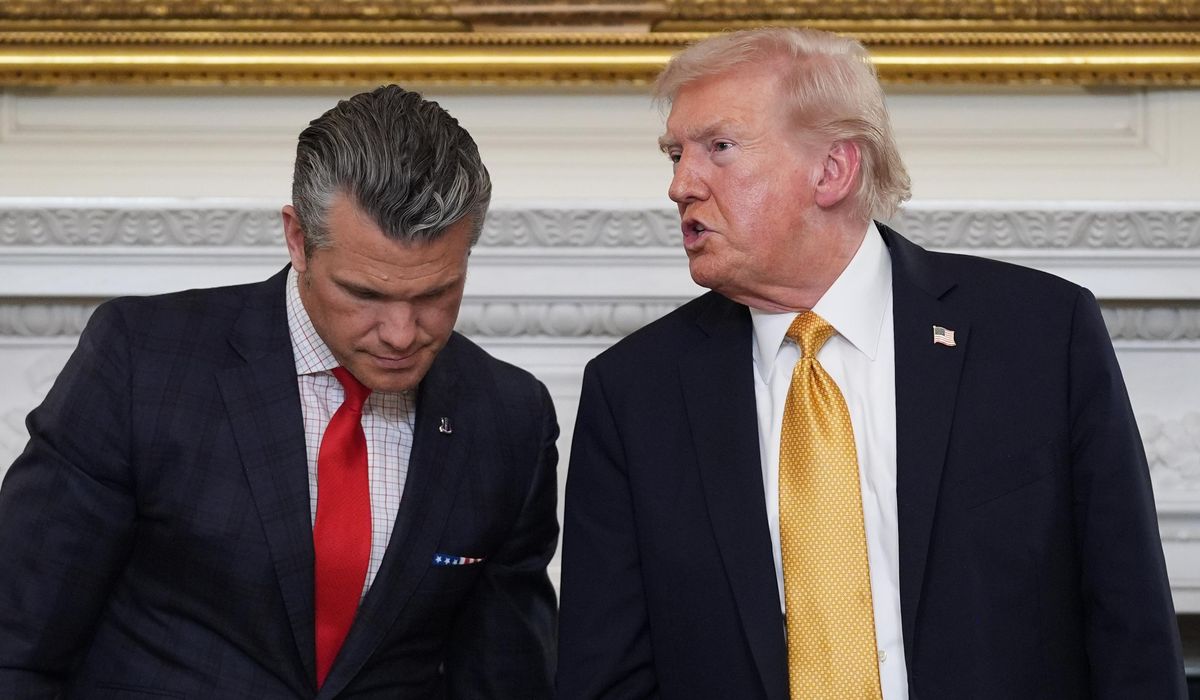
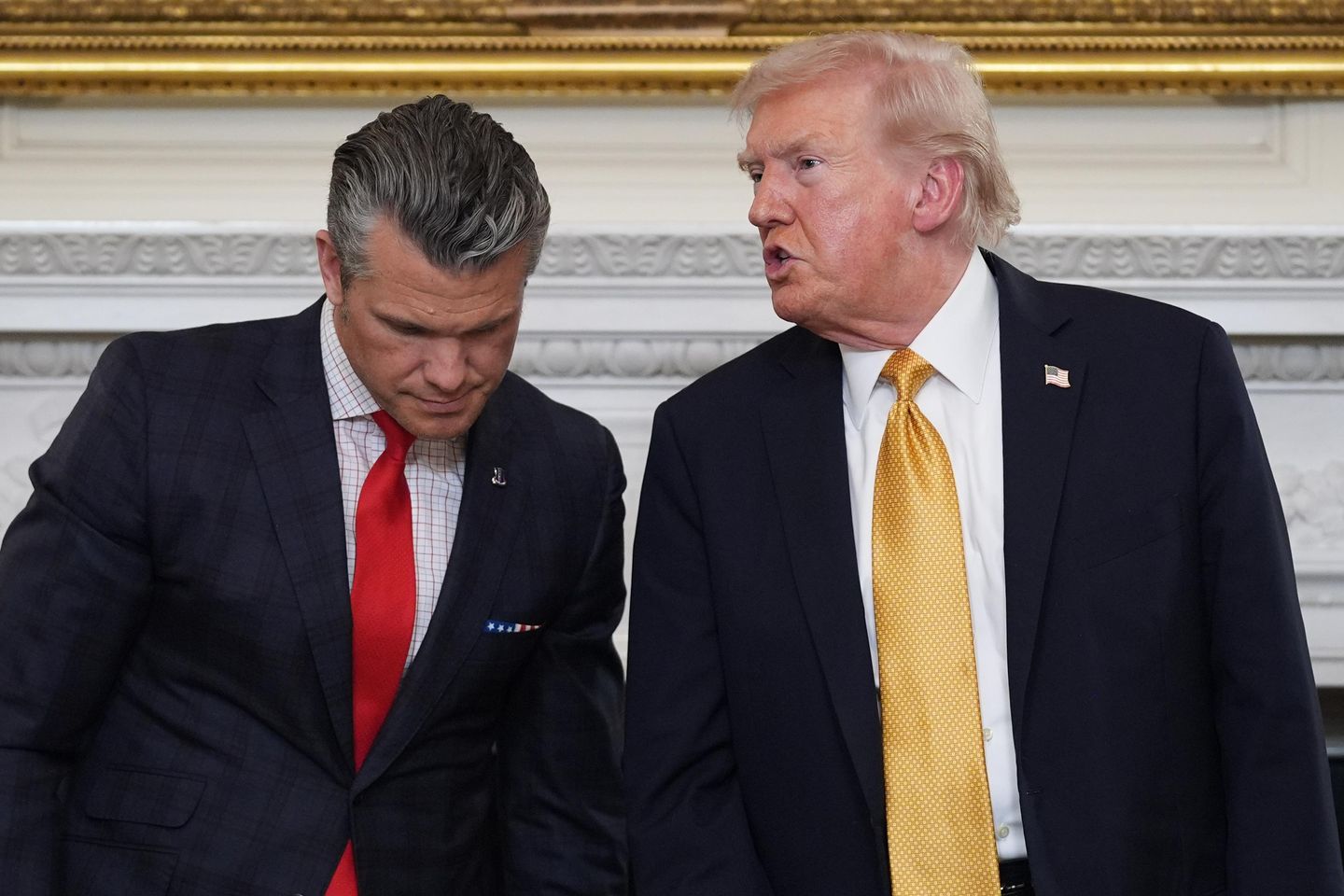
President Trump huddled with his national security team Monday evening at the White House amid a growing firestorm about a deadly “follow-on strike” by U.S. forces on a Venezuelan boat suspected of carrying drugs through international waters on Sept. 2.
The White House said Adm. Frank M. “Mitch” Bradley, the head of U.S. Special Operations Command, issued the order for that second strike. The Trump administration has argued that the second strike, which some lawmakers say could constitute a war crime, was fully justified.
White House press secretary Karoline Leavitt said Adm. Bradley “was well within his authority” to order the second attack during one of the first U.S. military operations targeting alleged drug-carrying boats in the waters off Central and South America.
“[Defense] Secretary [Pete] Hegseth authorized Adm. Bradley to conduct these kinetic strikes,” she said. “Adm. Bradley worked well within his authority and the law, directing the engagement to ensure the boat was destroyed and the threat to the United States of America was eliminated.”
The White House comments effectively distanced Mr. Hegseth from the controversy, though the Pentagon chief issued a vehement defense of the strike over the weekend. He said the U.S. attacks on suspected drug boats were always designed to be lethal.
Congressional lawmakers in both parties want a full accounting of the episode, in which the military appeared to conduct a second strike to eliminate two boatmen who survived the initial strike. They are worried the incident could amount to a war crime.
SEE ALSO: White House says commander, not Pete Hegseth, gave ‘second strike’ order on Venezuelan boat
The initial strike almost surely would have stopped the boat from moving drugs to American shores, which is the publicly stated goal of U.S. military operations in the region.
In at least one other instance, the U.S. picked up two survivors of an American military strike on an alleged drug boat and repatriated them to their home countries. It’s not clear why that wouldn’t have been done after the Sept. 2 strike unless explicit orders were given to kill everyone on the boat.
Mr. Trump this year designated Venezuelan drug traffickers as narco-terrorists subject to lethal force, resulting in a series of strikes on boats in the Caribbean and the Pacific Ocean. The military has conducted nearly two dozen strikes against those boats in recent months, and more than 70 people have been killed in those operations.
The Trump administration has insisted it has intelligence proving that all those on the boats were drug traffickers moving narcotics from countries such as Venezuela to America. Still, it has provided little public evidence backing up those assertions.
The Sept. 2 incident is apparently the only operation in which a second strike is alleged to have occurred. Ms. Leavitt rejected the accusation that Mr. Hegseth ordered the second strike, as reported by The Washington Post. She repeatedly said the strike was in accordance with the Law of Armed Conflict, which governs warfare to limit suffering and protect victims.
Mr. Trump said late Sunday that Mr. Hegseth denied giving the order for a second strike. The president said he believed him.
Gen. Dan Caine, chairman of the Joint Chiefs of Staff, spoke over the weekend with the four bipartisan lawmakers leading the Senate and House armed services committees. He reiterated “his trust and confidence in the experienced commanders at every echelon,” his office said in a statement.
The statement said the call focused on “addressing the intent and legality of missions to disrupt illicit trafficking networks which threaten the security and stability of the Western Hemisphere.”
Those conversations are noteworthy. The Republican chairs of the Senate and House armed services committees — Sen. Roger F. Wicker of Mississippi and Rep. Mike Rogers of Alabama, respectively — said in statements over the weekend that they expect a full accounting from the Pentagon regarding the incident.
Other key Republicans have joined Democrats in saying a second strike would have been illegal.
“Congress does not have information that that had occurred. … But obviously, if that occurred, that would be very serious, and I agree that that would be an illegal act,” Rep. Michael Turner, Ohio Republican, told CBS’s “Face the Nation” program Sunday.
The U.S. has significant military resources stationed in the Caribbean to conduct strikes against alleged drug boats. According to a growing expectation in national security circles, Mr. Trump will soon order strikes against Venezuela, which is considered one of the primary countries responsible for the flow of drugs into the U.S.
It wasn’t immediately clear Monday whether direct military action against Venezuela was discussed in the White House national security meeting.
• This article is based in part on wire service reports.