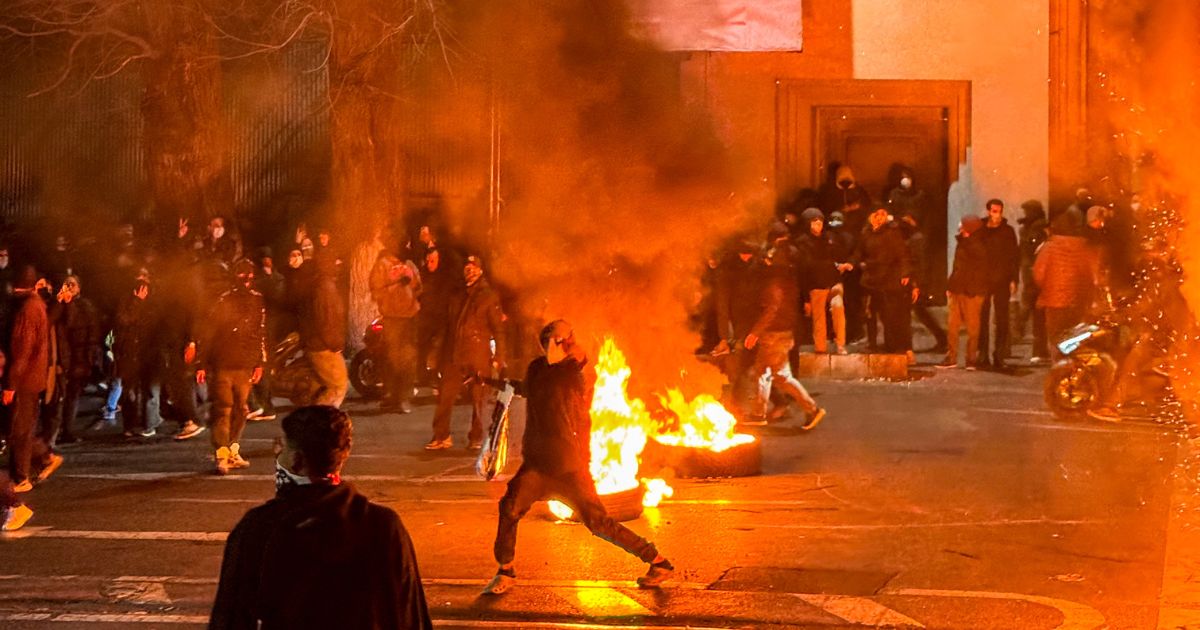
President Donald Trump has told Americans in Iran to leave the country, warning that things “may turn violent.”
While things have turned violent already — over 500 have been confirmed dead in recent protests, although this is considered a very low estimate due to the censorship coming out of the Islamic Republic — the security alert, issued by the U.S. Virtual Embassy Iran, signals that violence from both within and outside the country is expected to take place over the coming days.
The country is in a near-total blackout, with internet and telephone services disabled. Reports of mass killings are rampant, particularly out of Fardis, a city west of Tehran.
Graphic footage on social media showed bloodied bodies and chaos in the streets, a clear sign the regime was intensifying a pushback against the anti-governmental protesters.
There is persistent gunfire in Fardis near Tehran, according to footage shared this evening.
“I’m filming. I’m filming so it can be seen, look at what’s happening… Look at the bullets… look at how many there are”, the person filming says pic.twitter.com/wrmZIXWwJx
— Faytuks News (@Faytuks) January 9, 2026
“Protests across Iran are escalating and may turn violent, resulting in arrests and injuries. Increased security measures, road closures, public transportation disruptions, and internet blockages are ongoing. The Government of Iran has restricted access to mobile, landline, and national internet networks. Airlines continue to limit or cancel flights to and from Iran, with several suspending service until Friday, January 16,” the communique from the embassy read.
“Leave Iran now. Have a plan for departing Iran that does not rely on U.S. government help. If you cannot leave, find a secure location within your residence or another safe building. Have a supply of food, water, medications, and other essential items. Avoid demonstrations, keep a low profile, and stay aware of your surroundings.”
The message advised that “U.S.-Iranian dual nationals must exit Iran on Iranian passports” if they are to leave the country, as Iran “does not recognize dual nationality and will treat U.S.-Iranian dual nationals solely as Iranian citizens. U.S. nationals are at significant risk of questioning, arrest, and detention in Iran. Showing a U.S. passport or demonstrating connections to the United States can be reason enough for Iranian authorities to detain someone.”
Switzerland handles U.S. consular affairs inside the country of Iran, as Washington does not have diplomatic relations with Tehran.
While the number of Americans in Iran at present is low — estimates range from a few hundred to a thousand — they’ll likely be among the most vulnerable populations if the government does collapse.
Given the situation, American intervention could be a fait accompli — although the president left the door open to some kind of resolution that did not involve military conflict.
“The leaders of Iran, they want to negotiate,” he told reporters, according to CNN. “I think they’re tired of being beat up by the United States. Iran wants to negotiate with us.”
He added that the leaders had called him about the protests and that his concern was the Iranian protesters.
“There seem to be some people killed that aren’t supposed to be killed. These are violent, if you call them leaders. I don’t know if their leaders are just they rule through violence, but we’re looking at it very seriously,” Trump said.
“I’ve made the statement very strongly that if they start killing people like they have in the past, we will get involved,” Trump said during a meeting with oil executives.
“And that doesn’t mean boots on the ground, but it means hitting them very, very hard where it hurts.”
CNN reported that the Trump administration is weighing several military options in Iran if the regime continues oppressive measures.
Plans would include targeting the regime’s security services, sources said. Military strikes could worsen the situation and undermine the protests, which have been ongoing since Dec. 28, by pinning the unrest on foreign forces.
“Trump is also considering a number of options intended to target Iran’s regime that stop short of military strikes, officials said, as he looks to follow through on a vow to help protesters in the country,” the outlet noted.
“The options include cyber operations going after the Iranian military or regime targets, a step that could disrupt efforts to crack down on protests, an official said.”
Iran, meanwhile, has threatened retaliation against U.S. shipping vessels.
“If the U.S. takes military action towards Iran or the occupied territories, the U.S. military and shipping centers will be considered legitimate targets,” said Mohammad Baqer Qalibaf, the country’s hardline parliamentary speaker.

Advertise with The Western Journal and reach millions of highly engaged readers, while supporting our work. Advertise Today.