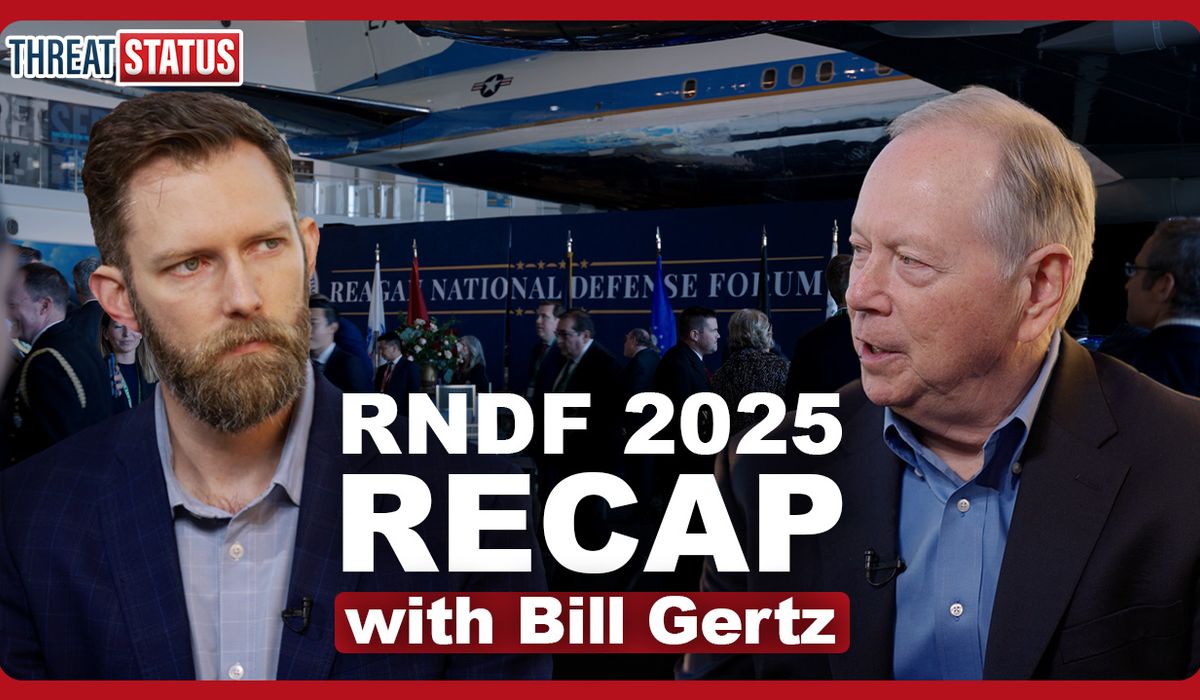
National Security Correspondents John T. Seward and Bill Gertz break down the key takeaways from the 2025 Reagan Defense Forum, highlighting the push by Adm. Sam Paparo, head of U.S. Indo-Pacific Command, to integrate AI across U.S. warfighting — from information and drone operations to precision-strike capabilities.
The pair also analyzes Defense Secretary Pete Hegseth’s forceful critique of neoconservatives and his defense of recent Caribbean counter-narcotics strikes, along with his caution that the administration may be softening its posture toward China.
John and Bill close with new details on the Trump administration’s ambitious “Golden Dome” missile-defense initiative, aimed at rapidly deploying layered protection by 2028 despite persistent procurement hurdles.
[SEWARD] We’ve been at the Reagan Defense Forum for the entire day-to-day for 2025. How’s it gone so far?
[GERTZ] This is a great conference, really intense, top officials from the U.S. government, U.S. military here. For me, one of the big takeaways was the talk by Admiral Sam Paparo, the commander of the U.S. Indo-Pacific Command, where he talked about how his command is leading the way within the U.S. military for adopting and adapting artificial intelligence. He had a fascinating talk, which I’ve written up for the Washington Times, and it looks at the three factors, what he called metatrends of information warfare, drone warfare, and then precision strike weapons. And basically, all of those are being integrated and made more lethal by masses of data, high-performance computing power, and algorithms that allow that to be used to create a more lethal force.
[SEWARD] I’ve noticed that, along with the Admiral, it seems like General George on the Army side, he’s also in this same vein, talking about actually integrating AI into the decision cycle, into the kill chain, still having a human in the loop. I think all of them agree they still want a human in the loop, but they’re talking about trying to make the decision cycle faster. That’s the next phase of warfare is, we’re taking in all of this sensor data, AI is going to be able to help us crunch it down and make these decisions at a faster pace.
Watch the video for the full conversation.
Read more: Indo-Pacific Command admiral set to wage AI-powered warfare
For more on the Reagan National Defense Forum
Click here to receive the daily Threat Status newsletter delivered directly to your inbox.