The crisis in the Strait of Hormuz showed no signs of easing Thursday as Iran’s new supreme leader declared his country would continue to block the vital oil route and attack ships attempting to navigate it in retaliation for U.S. and Israeli strikes.
Two fuel tankers, the Marshall Islands-flagged Safesea Vishnu and the Malta-flagged Zefyros, were attacked by explosive-laden drone boats on Thursday. At least one person was killed, while another 25 crew members were rescued from the tankers by the Iraqi navy.
The Japanese-flagged container vessel ONE Majesty also sustained minor damage from an unidentified projectile while traveling northwest of the United Arab Emirates.
Iran has not claimed responsibility for Thursday’s attacks after admitting the previous day to attacking two oil tankers traveling through the strait.
This week’s strikes and Ayatollah Mojtaba Khamenei’s comments on Thursday further destabilized global energy markets, with crude oil prices reaching above $95 a barrel as of Thursday afternoon.
The International Energy Agency reported Thursday that the Iran war has created the “largest supply disruption in the history of oil markets,” even as the agency agreed this week to release more than 400 million barrels of oil from national stockpiles.
U.S. President Trump, for his part, did little to assure the world that oil prices would come down soon, saying that destroying Iran’s ability to get a nuclear weapon was more important and that the U.S. might stand to profit from the strait’s closure.
In addition to targeting shipping vessels, Iran continued its attacks on ground targets around the Middle East. The Kuwaiti government said its international airport was damaged by an Iranian drone attack early Thursday. The Erbil International Airport in Iraq also experienced three strikes in what has been described by officials as some of the most intense attacks since the start of the war.
Oman also announced the closure of one of its most important oil export terminals, the Mina Al Fahal port, citing the possibility of Iranian strikes.
Bahrain, Saudi Arabia and the UAE also testified to intercepting new waves of Iranian ballistic missiles and drones.
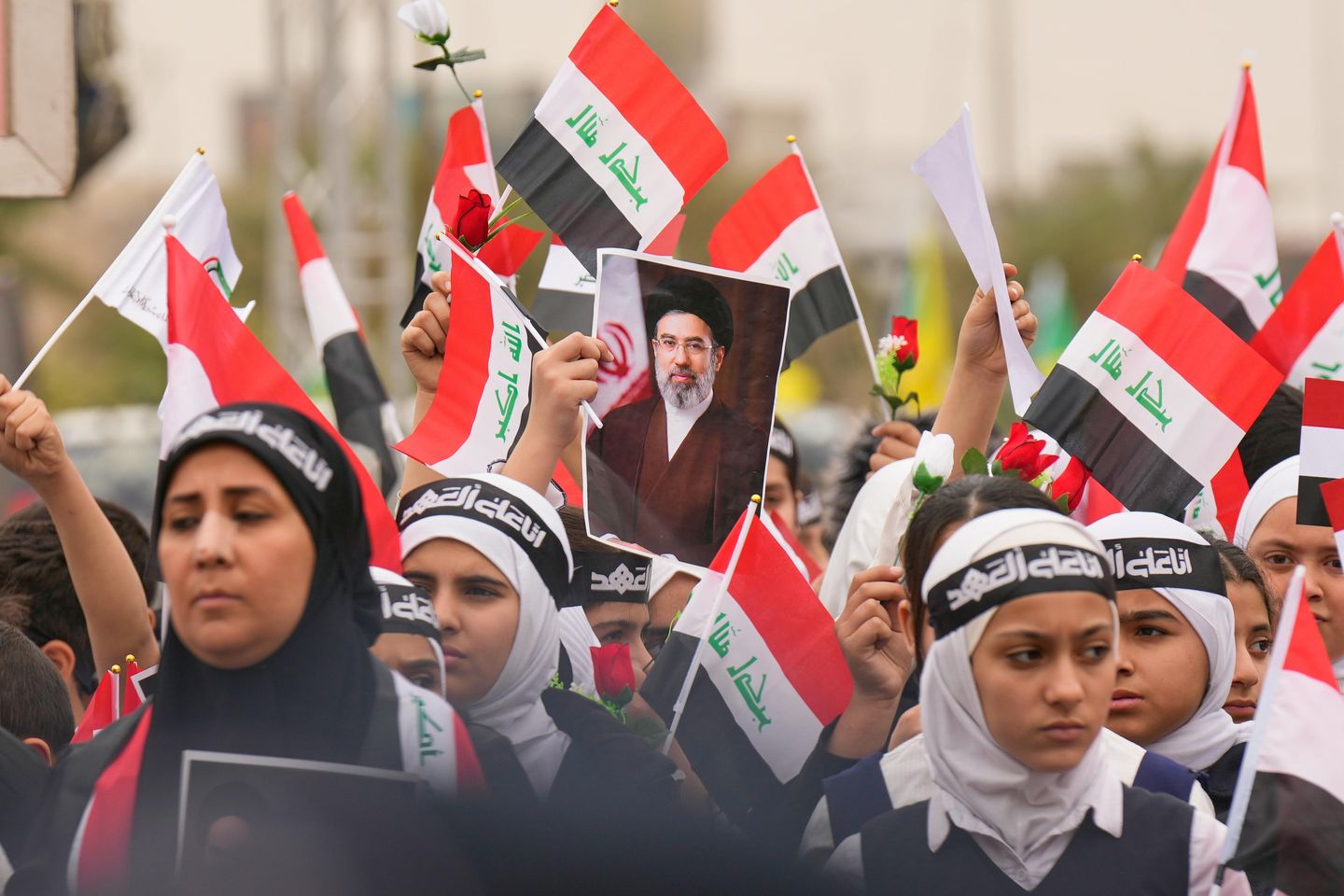
Iran’s new leader, the son of the supreme leader killed in U.S.-Israeli airstrikes on the first day of the war, said attacks on its Gulf neighbors are intended to prove that hosting U.S. bases is not in their best interests.
“I recommend that they shut down those bases as soon as possible, because by now they must have realized that America’s claim of establishing security and peace has been nothing more than a lie,” Mr. Khamenei said.
Despite Iran’s escalatory efforts, U.S. and Israeli military operations against the Islamic republic seem to be continuing without issue. Israel launched drone strikes in Tehran on Thursday targeting Islamic Revolutionary Guard checkpoints. The attacks killed at least 10 people, according to Iranian state media.
U.S. Central Command released an updated overview of Operation Epic Fury that said American forces have struck approximately 6,000 targets across Iran with a focus on IRGC command and control centers, ballistic missile and drone sites and Iran’s navy.
The CENTCOM report also indicated that U.S. forces have destroyed or damaged over 90 Iranian vessels since the start of the war. Officials said Wednesday that U.S. attacks had destroyed over a dozen Iranian mine-laying ships after reports that Tehran was preparing to lay explosives in the Strait of Hormuz.
Over 1,300 Iranian civilians have been killed since the start of the conflict, according to Iran’s United Nations representative Amir Saeed Iravani.
Israel also continued its offensive in Lebanon on Thursday, with airstrikes blasting Beirut in the early morning hours. The city, long seen as a stronghold of the Iran-backed Hezbollah, has been bombarded repeatedly over the past several days after pro-Iran militants fired hundreds of rockets into Israeli territory.
The Lebanese government said Israel’s recent attacks killed at least seven people and injured dozens. So far, Israel’s attacks on Hezbollah have killed more than 600 people and displaced nearly 800,000, according to Lebanese estimates.
• Tom Howell Jr. and Mike Glenn contributed to this story.