When a tornado warning sounds, where you are standing and what surrounds you may matter more than almost anything else. A body of peer-reviewed research on tornado injuries, survivor behavior, and housing vulnerability offers a clearer picture of what actually keeps people alive when a violent storm arrives.
The single clearest finding across multiple studies: get underground, or into a purpose-built storm shelter, if at all possible.
A Centers for Disease Control and Prevention analysis of 1,398 adult patients treated at 39 Alabama hospitals following the April 27, 2011 tornado outbreak found no severe injuries among people in tornado shelters; among the study’s survey participants, no injuries were reported in storm shelters. The same study, published in PLOS ONE, found that mobile home residents faced nearly seven times the odds of injury compared to those in permanent residences, making mobile homes among the most dangerous residential settings in the study.
For the majority of people who have no underground shelter available, the research still offers practical guidance. Within a permanent home, basements reduced the odds of injury by 87% compared to living rooms, kitchens, and family rooms. Bathrooms cut the risk by 78%, closets by 75%, and interior hallways by 69%.
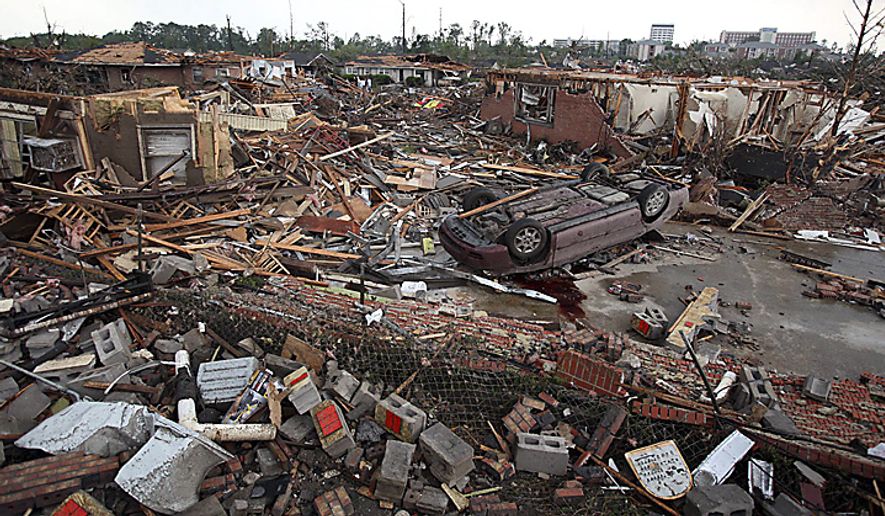
A car lies overturns and buildings …
more >
The pattern is consistent with long-standing preparedness advice: get to an interior room on the lowest floor, away from windows.
Head injuries were among the most deadly in the Alabama data. They accounted for 71.4% of deaths among hospitalized patients and the majority of intensive care unit admissions. The study authors noted that helmets reduce head injuries in high-impact motorcycle crashes and may offer similar protection during tornadoes, though only eight survey participants indicated helmet use and all remained uninjured — too small a group to draw firm conclusions.
Warning systems also proved meaningful. People who received advance warnings through television, the internet, National Oceanic and Atmospheric Administration (NOAA) weather radio, or sirens had significantly lower odds of injury. Those who heard sirens and responded by seeking more information before acting fared better than those who did not. People who estimated they heard tornado sirens more than five times per year showed slightly lower odds of injury on the day of the event, suggesting familiarity with warnings does not necessarily breed indifference.
The warnings themselves, however, can only help people who have somewhere safe to go. For millions of Americans in rural areas, that is far from guaranteed.
A separate study published in the International Journal of Disaster Risk Reduction examined mobile and permanent home locations across Alabama and found that distances and travel times from mobile homes to potential shelters were significantly greater than those from permanent homes. In southern Alabama, mean and median automobile travel times to the nearest community-designated tornado shelter ranged from about 29 to 33 minutes. That’s more than double the roughly 13-minute average tornado warning lead time cited by the study’s authors.
Researchers concluded that many residents in rural southern Alabama would need to leave well before a warning was ever issued to reach safety in time. It is worth noting that community-designated shelters in the study were not required to meet any specific wind load or structural construction standard; they were simply locations that local counties publicly identified as places residents could go.
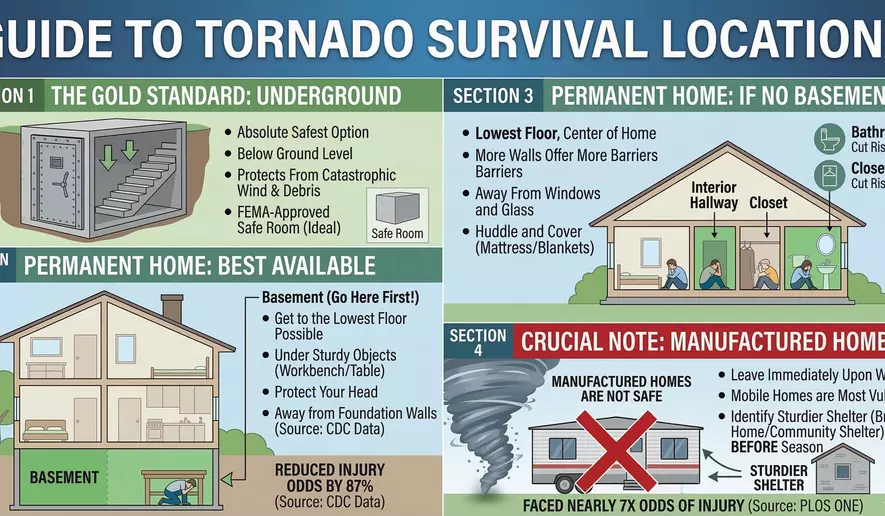
Studies say the basement or a …
more >
That gap has a human face. A 2022 study published in the Bulletin of the American Meteorological Society sent researchers to conduct in-person interviews with 23 survivors of two deadly EF3 tornadoes that struck southern Georgia in January 2017 — one overnight, one in the afternoon — killing 16 people combined, including 11 in manufactured home parks that had no storm shelters. To protect participants’ identities, the study used pseudonyms throughout.
The researchers found that nearly every person interviewed had been actively monitoring weather forecasts, tracking storms on phone apps, and attempting to respond. What many lacked was a safe destination. Several interviewees, when asked where they could go if a tornado threatened again, drew a blank.
One mobile home resident in Adel, Georgia, described her situation after noting the tornado had destroyed large and small homes alike in the area: “There’s nowhere to really go. We would have went to the same spot” — meaning the center of her mobile home. Another Adel resident said her husband would take her to a nearby ditch in a future storm, “because I don’t know where any shelter is around here.” In Albany, Georgia, when an interviewer asked one man where he would have gone if he had known the tornado was coming, he replied: “Wherever there was a shelter. There ain’t no shelter around here.”
Another Albany resident, a woman the study calls Donna, described how a television meteorologist’s unusually direct language finally moved her to leave her manufactured home. In her own words as recorded by the researchers, she recalled the broadcast this way: “Albany, Georgia, mobile homes, trailer park — he even said trailer park — mobile homes, trailer parks, get to your safe zone in one hour.” She told the interviewers: “He didn’t say ’might hit’, he said, ’it will hit.’ And I told my husband, I said, ’baby, it’s time to go.’” She and her family drove to a friend’s brick home in a neighboring county and survived. When researchers asked where she would have gone if that friend had not been home, she said: “Sweetheart, I don’t even know.”
The BAMS researchers argued that framing low shelter rates as a product of public complacency misses the point. Most people in their study were paying close attention and trying to protect themselves. The obstacle was structural: they simply had nowhere adequate to go.
Building stronger homes in the first place is one long-term answer. A Texas Tech University study published in 2025 in Advances in Wind Engineering modeled the financial effects of 12 enhanced building code requirements adopted by Moore, Oklahoma, after a violent tornado struck the city in May 2013. The upgrades included stronger roof sheathing nails, hurricane straps on roof-to-wall connections, and wind-rated garage doors, adding roughly $10.75 per square meter to construction costs.
Over a projected 50-year period without factoring in a discount rate, the researchers found that the code modifications produced a benefit-cost ratio of 0.88 when measuring construction losses alone. That means the codes came close to paying for themselves even before accounting for other savings. When the researchers expanded their model to include home contents, injuries, and deaths, that ratio rose to 1.8. The paper also noted that a 2015 tornado that struck Moore, the first to hit after the new codes took effect, caused only minor, quickly repaired damage to homes built under the revised standards.
The practical guidance drawn from all four studies points in a consistent direction. An underground shelter or FEMA-approved safe room appears to offer the strongest protection in these studies. If that is not available, the lowest interior room of a permanent structure — basement, bathroom, closet, or hallway — substantially reduces injury risk compared to common living areas. Anyone in a mobile home should identify a sturdier destination and plan to reach it well ahead of any warning, because in much of rural America, the time available to act safely is far shorter than most people assume.
This article was constructed with the assistance of artificial intelligence and published by a member of The Washington Times’ AI News Desk team. The contents of this report are based solely on The Washington Times’ original reporting, wire services, and/or other sources cited within the report. For more information, please read our AI policy AI policy or contact Steve Fink, Director of Artificial Intelligence, at sfink@washingtontimes.com
The Washington Times AI Ethics Newsroom Committee can be reached at aispotlight@washingtontimes.com.