Senate Republicans on Thursday flipped just enough votes to kill Democrats’ war powers resolution that sought to block President Trump from further military action against Venezuela without congressional approval.
The procedural vote to defeat the resolution was successful after Mr. Trump and Secretary of State Marco Rubio made personal appeals to the five GOP senators who voted with Democrats last week to advance it.
Two of them — Sens. Josh Hawley of Missouri and Todd Young of Indiana — changed their positions, creating a 50-50 tie that Vice President J.D. Vance then broke in the administration’s favor.
Mr. Young said he switched his position after Mr. Rubio assured him that the president would seek authorization from Congress if he were to pursue “major military operations in Venezuela.”
Mr. Rubio also committed to testify before the Senate Foreign Relations Committee in the coming weeks to update lawmakers on the situation in Venezuela.
“We used this moment to shine a bright light on Congress’ shortcomings as it relates to war powers in recent history,” Mr. Young said, noting that the debate will continue when Mr. Rubio testifies.
Republican Sens. Rand Paul of Kentucky, Susan M. Collins of Maine and Lisa Murkowski of Alaska maintained their support for the war powers resolution despite the administration’s pressure campaign.
“I had a spirited conversation last week with him,” Mr. Paul said of Mr. Trump.
Mr. Paul called it “a disservice to the people who put their lives on the line” that the Trump administration refuses to acknowledge the military strikes against Venezuelan drug boats and the operation to capture President Nicolas Maduro was a war.
“This is an elaborate ruse that’s being perpetrated on the American people: ‘Oh, it’s a drug bust. Oh, we’re going for drugs. Oh, it’s not really drugs now it’s oil.’ So see, the bait and switch has already happened,” Mr. Paul said.
After the initial procedural vote last week, Mr. Trump said the five Republicans who voted to limit his authority “should never be elected to office again.”
The president also went out of his way to call the senators “real losers” while delivering an economic speech in Detroit on Tuesday. He called out each one individually, except for Mr. Hawley, who had already started to change his thinking after being assured ground troops would not be used in Venezuela.
Sen. Tim Kaine, the Virginia Democrat who led the war powers resolution, said the Republicans who voted for it were not rebuking Mr. Trump, despite the president taking it that way.
“They voted to uphold a basic constitutional principle that we should not be waging offensive hostilities without a debate and vote in Congress,” he said.
Mr. Kaine had hoped more Republicans, not fewer, would support the war powers resolution this week to reassert Congress’ constitutional authority rather than “just vote their own irrelevance.”
Democrats said the measure is needed to prevent Mr. Trump from unilaterally following through on his threats to take further military action against Venezuela if the interim leaders do not cooperate with U.S. efforts to stop drug trafficking and rebuild its oil infrastructure in the country.
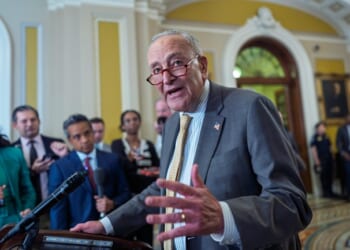
“Trump is saying that we may be stuck in Venezuela for years, [that] he’s not afraid to put troops on the ground there,” said Senate Minority Leader Charles E. Schumer, New York Democrat. “That’s not what Americans want. That’s not what he campaigned on.”
Senate Majority Leader John Thune, South Dakota Republican, dismissed Democrats’ push as another sign that “their anti-Trump hysteria knows no bounds.”
He argued the war powers resolution, which directs the president to “terminate the use of United States Armed Forces for hostilities within or against Venezuela, unless explicitly authorized by a declaration of war or specific authorization for use of military force,” is unnecessary.
“We have no troops on the ground in Venezuela. We’re not currently conducting military operations there,” he said.
Mr. Thune accused Democrats of hypocrisy for decrying the Jan. 3 “isolated special forces raid” to arrest Mr. Maduro after having long called for his ouster and criticizing Mr. Trump during his first term for not going far enough to achieve that goal.
He also said “it’s funny” that Democrats did not stand up for congressional war powers when presidents from their party took “far more extensive military action that involved thousands of troops or airstrikes over weeks and months in Libya, Bosnia, Serbia and Haiti.”
“Most recently, in 2024, they locked arms and voted to turn a blind eye toward a monthslong deployment of troops for President Biden’s disastrous floating aid pier to Gaza, even while Biden’s own Defense Department called it an active war zone and the pier was fired upon twice,” he said.
“They said those troops were not engaged in hostilities and therefore not subject to the War Powers Resolution,” Mr. Thune recounted.
However, that’s also the argument Republicans now deployed to defeat the Venezuela war-powers resolution.
“The objective of this resolution is to stop something that is not happening,” said Senate Foreign Relations Chairman James E. Risch, Idaho Republican. “Currently there are no U.S. forces engaged in hostilities in Venezuela.”
Mr. Paul, a staunch war powers supporter, accused both parties of hypocrisy.
He pointed back to the 2024 vote when Republicans argued there was a need for congressional intervention when “a few soldiers were shot at in Gaza trying to build a pier” as evidence it also exists on his side of the aisle.
“It’s somewhat boggling to the mind” that Republicans who supported that war powers resolution are now opposing the one for Venezuela, Mr. Paul said.
“We have a situation in Venezuela where hundreds of troops were sent in, dozens and dozens of pilots and planes were sent in, you bombed the nation’s capital, you had extraordinary rendition of the nation’s president, and now we have a blockade involving hundreds of ships and thousands of sailors,” he said. “But that’s not a war?”