NEAR THE FRONT IN EASTERN UKRAINE — In a dusty basement somewhere along Ukraine’s southeastern front, Ukrainian team leader Ihor is sitting at a table, staring intently at a laptop. On the screen, there is an aerial view of a barren treeline demarcating two desolate, snow-covered fields. A man is cautiously moving among the leafless trees, an automatic rifle slung over his shoulder.
Ihor is monitoring another Ukrainian unit’s impending attack on the enemy soldier.
“They’re trying to assault our positions there,” Ihor says, pointing out a line of trenches criss-crossing the treeline to a watching Washington Times reporter.
Within seconds, a Ukrainian drone races into the frame, hitting the man low and detonating against his legs.
As night falls on the frontline …
more >
“Yes! Bullseye!” Ihor cheers, clapping his hands.
A cloud of black smoke blooms, then thins. The enemy soldier is down, but not dead. “Damn it, he’s still moving,” Ihor mutters as he lights a cigarette.
The injured man starts crawling deeper into the treeline. Another Russian soldier manages to reach him and they take cover in a trench. Moments later, a second drone flies straight at them.
For two Russian soldiers, the war ends in the cold mud of an anonymous trench.
The gruesome snapshot serves as a reminder that the four years of conflict in Ukraine have upended the nature of warfare — not just on the battlefields of Eastern Europe, but around the world.
Gone are the days of massive, armored assault vehicles and single-file columns of tanks and armored personnel carriers. Ukrainian drone pilots proved early on in the war that those kinds of Russian targets were sitting ducks.
The Russians have since adapted their tactics, says Ihor, whose full name and the names of the men in his crew are withheld for this article. The Ukrainian team leader says the Russians now move in small squads on foot or on motorcycles to either bypass or assault Ukrainian defenses.
Asked about the number of drones and ammunition expended per target, Ihor and his crew acknowledge the cost of any particular strike can vary greatly, depending on the type of drone, the type of explosive charge and the defensive capabilities of the target itself.
“One time, it took 13 [drones] to kill one soldier,” says Oleksandr, whose hometown, a leafy suburb of Kyiv, became in 2022 a byword for Russian atrocities in Ukraine.
Ihor, the team leader, and Oleksandr are part of the 423rd Unmanned Systems Battalion — a top Ukrainian drone unit.
Formed in 2024 as part of Kyiv’s rapid expansion of drone warfare, the unit specializes in reconnaissance, battlefield interdiction and first-person-view strike drones. The unit operates primarily along the eastern and southern fronts.
Ihor and his men specialize in operating the “Perun,” a heavy quadcopter drone named after the Slavic god of thunder and war.
They carry out three main types of missions.
Deliveries involve resupplying frontline positions with food, ammunition and equipment, an approach that has become commonplace in a war where any movement can be deadly and where units routinely find themselves stranded for days or weeks at a time.
The second mission is area denial — dropping explosive charges to mine key approaches or positions.
The third is direct strike operations using different types of munitions tailored to the target.
Among the various shells, bombs and mines stored in the building above, some are produced by the battalion itself, including artisanal “bunker busters,” designed to penetrate fortified positions.
Unlike standard fragmentation charges, these warheads are built to punch through roofs, sandbags or reinforced cover before detonating inside after a few seconds.
Ihor’s bunker busters have become a must-have, considering that the war is largely static and soldiers are hunkering down in trenches, basements and dugouts on both sides of the frontline.
Made up largely of veteran drone pilots — many transferred from artillery and infantry — the 423rd has acquired a reputation for its high tempo, decentralized operations and its role in turning low-cost drones into precision weapons that blunt Russian assaults before they reach Ukrainian lines.
The battalion’s commander, Vitaliy Hersak, has told Ukrainian media that his battalion is among the 20 best-performing units in terms of the efficiency of using UAVs and is the best of all individual battalions. His men, he said, eliminated over 700 Russian soldiers over the course of the month of November.
As the war has hardened into a high-intensity grind, driven by drones, glide bombs and relentless small-unit assaults, outfits such as the 423rd have become vital cogs of Ukraine’s defense, making up what they lack in manpower with cheap, mass-produced improvised explosives or repurposed shells.
While the main pressure point remains the Pokrovsk axis, in Ukraine’s eastern Donetsk region, Ukrainian defenders on the southeastern front, too, have to contend with constant Russian probes and assaults.
Here, the Russians have managed, at a great cost in manpower, to creep forward, incurring staggering casualties in the process.
Western intelligence estimates put Russian casualties in the hundreds of thousands in 2025 alone, for limited territorial gains.
Back in the basement hideout of Ihor and his crew, the rhythmic thud of explosions in the distance picks up pace as night falls. New coordinates come in from headquarters.
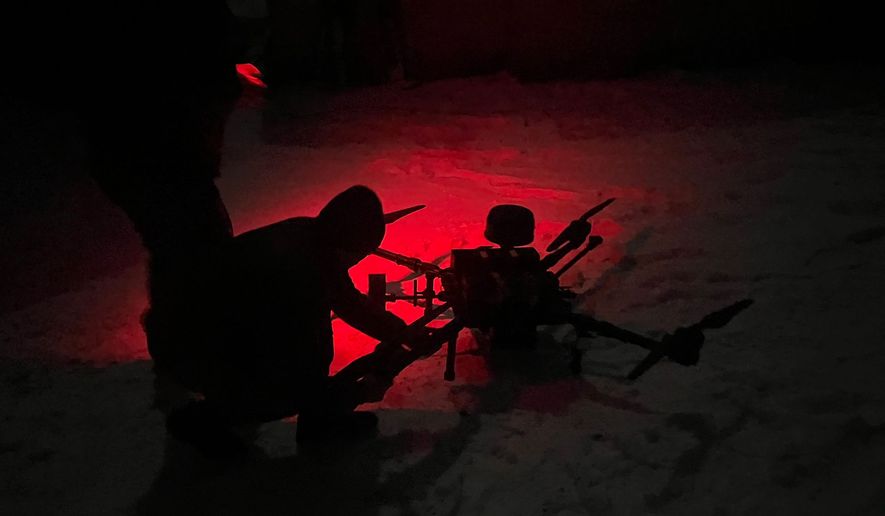
Under the red glow of headlamps, Oleksandr and fellow crew member Dima arm one of the heavy drones, carefully fastening the oblong charge beneath its frame before carrying it outside.
The rotors scream to life, kicking up snow. The drone lifts and hovers a few seconds in the air before vanishing into the dark.
Inside, with Dima sitting alongside, Ihor flies almost entirely by GPS, switching to the camera only at the last moment. “This way, the drone is less susceptible to having its frequency detected and exploited by the Russians,” he explains.
After less than 10 minutes of flight, the Perun is in position. Ihor tries to stabilize it long enough to drop the explosives, but a strong wind complicates the process. Time seems to stretch. The men hold their breath. The bomb finally drops, landing just meters from the target. A miss. Barely.
Ihor lights another cigarette. Everyone here smokes. Everyone coughs. The fine, pernicious dust coating the floor works its way into everything — guns, clothes, lungs. Over the course of the day and night, five sorties are flown: two mining runs, three strikes. Between each mission, the bunker falls quiet.
Faces are drawn, eyes heavy with exhaustion. The men stare at their phones, the silence only broken by a few words exchanged between teammates or the music of Instagram reels. The team has held this position for six days, and tonight is their last night before being rotated out. After midnight, the men try to get some sleep while Ihor stands watch, until Oleksandr takes over.
The next morning, the men pack their bags, clean the basement for the next team and don their protective gear before heading upstairs.
A few minutes later, a pickup truck loaded with soldiers, ammunition and equipment enters the garage. The new arrivals are helped by Ihor and his crew, who seem eager to leave both the area and the biting cold.
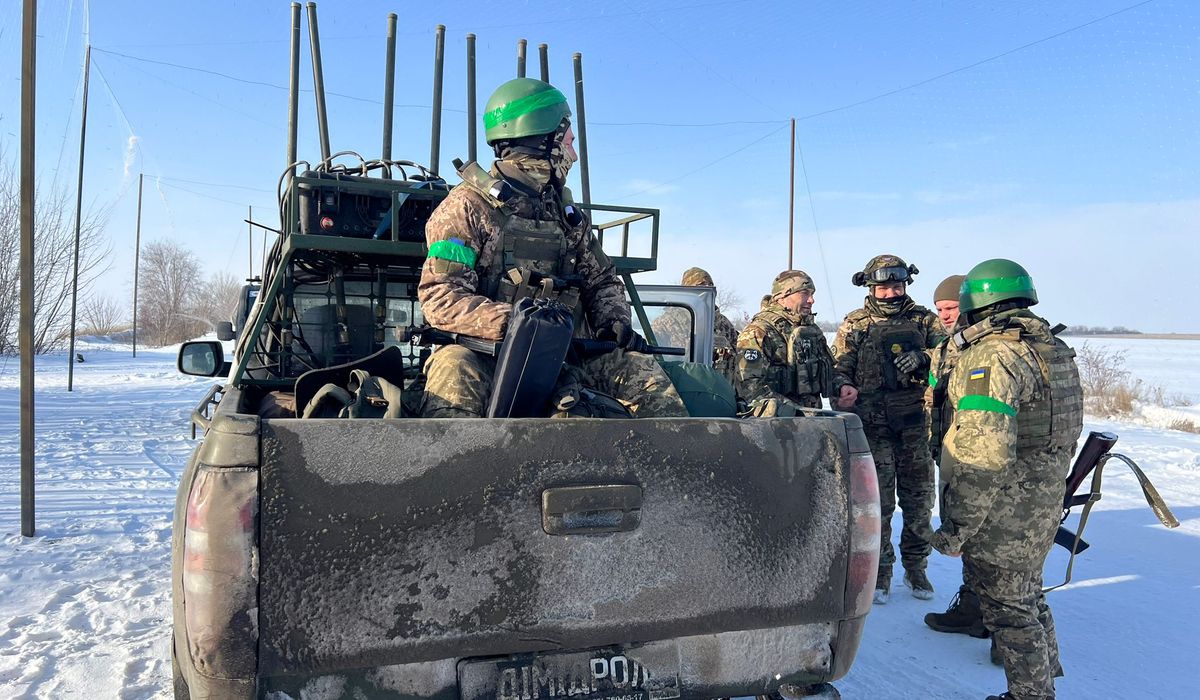
Everyone stakes out a spot on the truck. Ihor sits on the flatbed, shotgun in hand, ready to shoot down any incoming FPV.
“Getting in and out of position is the most dangerous,” explains Maliy, another of Ihor’s team. “About two weeks ago, we were chased by two FPV drones. We managed to shoot down the first one and the second took off.”
Once loaded, the truck pulls out, AK-74s pointing out the windows, aimed towards the cerulean blue sky. After a short trip through snow-covered fields and dirt roads, the truck reaches the relative safety of the highway and the miles of anti-drone netting strung over the roadway.
In the suburbs of Zaporizhzhia, the scars of a recent Shahed strike are still visible: broken windows, shopfronts lacerated by shrapnel and a burned-out car. After dropping off team members at an apartment, the men in the truck suddenly hear the ominous buzz of an approaching Shahed drone growing louder.
The Iranian-designed aircraft — a key part of the Russian arsenal — slowly cuts across the blue sky over Zaporizhzhia, drawing bursts of Ukrainian air-defense fire.
Another reminder that for Ihor, his crew and millions of fellow Ukrainians, the war doesn’t stop at the frontline.