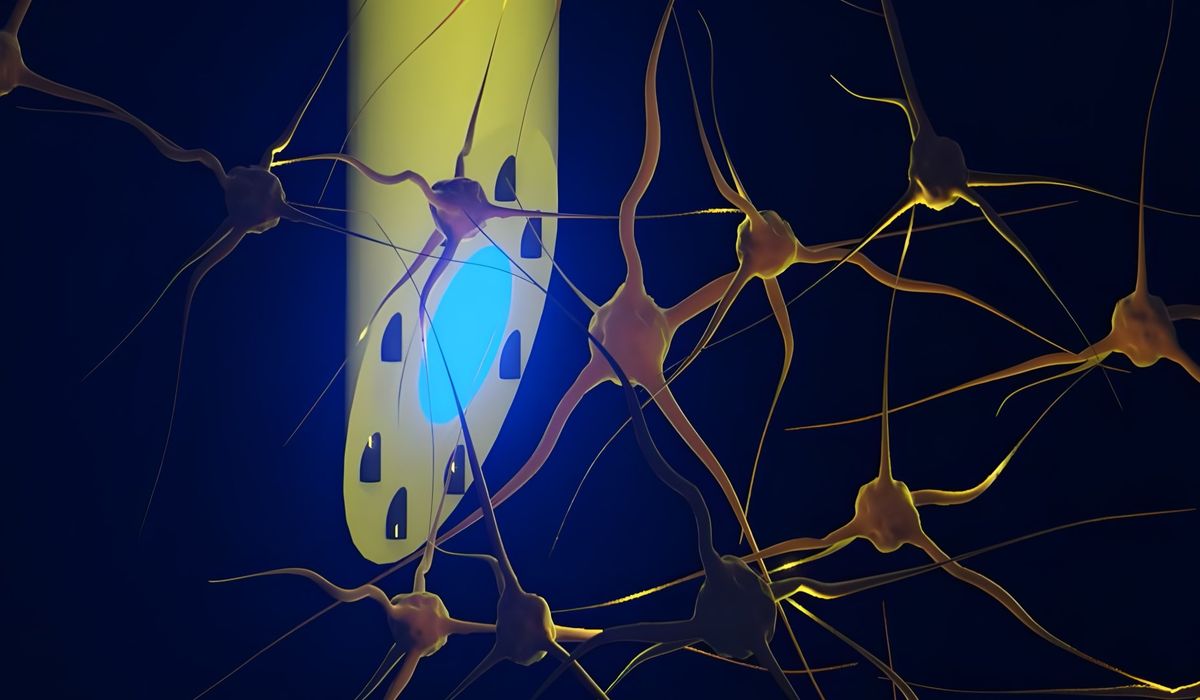
An international team of researchers has built a brain implant thinner than a sewing needle that can deliver light, record electrical activity and inject medication into different layers of the brain, all through a single device. The technology could reshape how scientists study conditions such as epilepsy, and it may eventually open new doors for treating neurological diseases.
The device, called the microfluidic Axialtrode, or mAxialtrode, was developed by researchers from the Technical University of Denmark, the University of Copenhagen, University College London and other institutions. It packs several tools into a single flexible fiber less than half a millimeter wide, roughly the thickness of about half a dozen human hairs.
Today, scientists who want to study the brain often rely on separate instruments for each task: one to stimulate nerve cells with light, another to measure electrical signals and yet another to deliver drugs. That approach adds complexity, requires multiple insertions and can damage delicate tissue. The mAxialtrode, described in a paper published in the journal Advanced Science, rolls all three capabilities into one probe, which the researchers say makes experiments less invasive and more precise.
Mr. Kunyang Sui, a postdoctoral researcher at the Technical University of Denmark who led the development of the device alongside Associate Professor Christos Markos, said many existing implants pose a basic material problem.
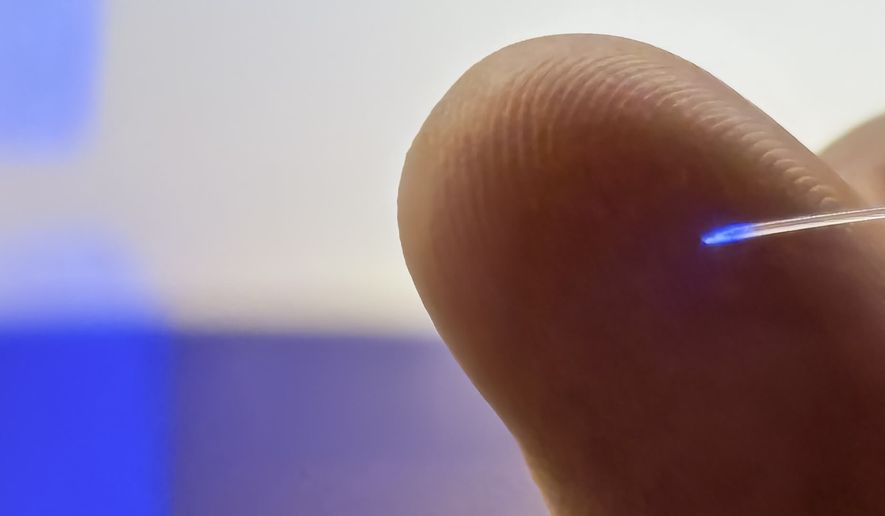
The fiber in the brain implant …
more >
“Most current brain implants are based on hard materials such as silicon, which can irritate the brain and trigger inflammatory reactions in the tissue. The new implant differs in that it is made of soft, plastic-like optical fibers and has a specially angled tip that makes it smaller and reduces the damage caused when it is placed in the brain,” Mr. Sui said in a statement.
That softness matters. Hard implants press against the brain, and over weeks the body treats them like foreign invaders, wrapping them in scar tissue that degrades their performance. Because the mAxialtrode is made from flexible polymers, it bends with the brain rather than cutting through it. In testing, the researchers found it appeared to trigger less inflammation than a conventional flat-end fiber of the same diameter.
The manufacturing process, called thermal drawing, works something like pulling taffy, but far more precisely. A thick polymer rod is heated and drawn into a very thin fiber. At its center runs a core that carries light. Surrounding that core are eight microscopic channels, each just 20 millionths of a meter wide, that can carry fluid or hold hair-thin metal wires for recording electrical signals.
A key innovation is the angled tip. Traditional brain fibers have a flat end, so all their activity takes place at a single point at the very tip. The mAxialtrode’s tip is cut at a sharp angle, which spreads its electrodes and drug channels across different depths. That lets researchers interact with several brain layers at once rather than just one, which is important because many brain functions, including seizure networks, involve signaling between areas stacked on top of one another.
In tests on mice, the team showed the implant could stimulate nerve cells with blue and red light, record electrical signals simultaneously from the cerebral cortex (the brain’s outer layer) and the deeper hippocampus region, and inject different substances at different depths up to about 2.7 millimeters apart. Mice carried the lightweight device without obvious signs of discomfort.
The in vivo experiments were carried out with Mr. Rune W. Berg, an associate professor at the University of Copenhagen, and Mr. Rob C. Wykes, an associate professor at University College London, who brought expertise in neural circuit analysis and epilepsy models.
The technology was built primarily to help with basic research, giving scientists a better way to watch how electrical signals travel across layers of the brain during processes such as memory formation and decision-making. But the researchers say the device could also point toward future treatments. A doctor might one day use a similar implant to deliver a drug to a precise brain region while simultaneously monitoring its effect with electrical recordings and light-based stimulation.
Mr. Sui cautioned that extensive testing, further development and regulatory approvals are still needed before the technology can be used in patients. The researchers are in the process of patenting the underlying technology and exploring the possibility of clinical trials.
The study was funded in part by the Lundbeck Foundation and the European Innovation Council.
This article is written with the assistance of generative artificial intelligence based solely on Washington Times original reporting and wire services. For more information, please read our AI policy or contact Steve Fink, Director of Artificial Intelligence, at sfink@washingtontimes.com
The Washington Times AI Ethics Newsroom Committee can be reached at aispotlight@washingtontimes.com.