Sen. Marsha Blackburn has been working for more than a decade to establish federal privacy and safety standards for protecting consumers, especially children, in the digital age.
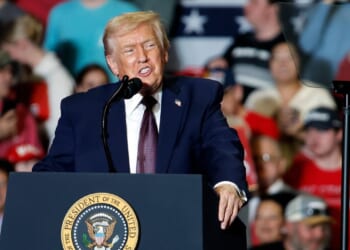
The Tennessee Republican hopes that this year, which may be her last in Congress as she runs for governor, will be the year when something is accomplished, as President Trump is pushing for lawmakers to act.
“I do think 2026 is going to be the year that we get this across the finish line,” Ms. Blackburn said in an interview with The Washington Times. “You need the ability for people to protect what I term their virtual you.”
In the coming weeks, Ms. Blackburn will introduce a bill to create federal rules for artificial intelligence and online platforms to protect what she calls the “four C’s” from exploitation, abuse and censorship.
“It puts in place protections for children, for creators and innovators, for consumers and communities, and also for conservatives, because we all know the chatbots and AI, they’re biased against conservatives,” she said.
The legislation would require AI platforms to conduct regular risk assessments of how their algorithms, engagement mechanics and data practices contribute to psychological, physical, financial and exploitative harms.
It would impose a “duty of care” provision to ensure AI developers mitigate against foreseeable harms to users as they design and operate their platforms.
The Federal Trade Commission would be tasked with enforcing these protections and others in the legislation, which Ms. Blackburn is floating as a “discussion draft” to solicit feedback and improvements.
Individuals would also have some personal recourse under the bill, such as the ability to sue technology companies that use their personal data or browsing history for AI training without their explicit consent.
Ms. Blackburn said federal guardrails are needed to preempt a patchwork of state laws that have made it difficult for AI and emergency technology companies to navigate a complex regulatory landscape.
President Trump issued an executive order in December that directs executive agencies to take all necessary steps, including withholding federal funds, to prevent “excessive state regulation.” He acknowledged that a “carefully crafted” law is needed to ensure that the U.S. wins the AI race.
“My administration must act with the Congress to ensure that there is a minimally burdensome national standard — not 50 discordant state ones,” the president said. “The resulting framework must forbid state laws that conflict with the policy set forth in this order. That framework should also ensure that children are protected, censorship is prevented, copyrights are respected, and communities are safeguarded.”
It is no coincidence that Mr. Trump’s executive order used Ms. Blackburn’s “four C’s.”
The senator had discussed drafting a national framework with the president along those lines. Mr. Trump recommended that she work with David Sacks, the White House’s AI and crypto czar, which she did.
The suggestion was made after Ms. Blackburn defeated an effort by Sen. Ted Cruz, Texas Republican, to add a 10-year moratorium on state AI regulation to the Republicans’ One Big Beautiful Bill Act.
Mr. Cruz, chairman of the Senate Commerce, Science and Transportation Committee, which has jurisdiction over the issue, told The Times he had not seen Ms. Blackburn’s new AI framework and therefore could not comment on it.
Ms. Blackburn said that prohibiting states from enforcing laws they have on the books while waiting on Congress to act was a “really bad idea.” She said she desperately wants federal standards but knows from firsthand experience that the process is slow.
“I have been an advocate for federal preemption going back to 2012 when [Sen.] Peter Welch and I, both in the House [at the time], filed the first online privacy, consumer privacy bill,” she said. “That would have exercised federal preemption to give us one set of rules for the entire ecosystem with one regulator, the FTC. That’s the way it ought to be.”
More than a decade later, Ms. Blackburn is still working toward that goal, as Big Tech continues to lobby against her and other lawmakers’ efforts.
For example, companies such as Meta, which owns Instagram and Facebook, have lobbied against Ms. Blackburn’s Kids Online Safety Act, or KOSA, which would impose requirements on social media companies to protect children on their platforms, including default safety and privacy settings and enhanced parental controls.
KOSA passed the Senate by a 91-3 vote last Congress but stalled in the House. One of the sticking points was a duty of care provision, similar to the one Ms. Blackburn is now proposing in her AI framework. House Republicans have since floated a version of the bill that excludes it.
Ms. Blackburn acknowledges that the duty of care will likely again be a contentious topic, but she considers it necessary for the legislation to have any teeth.
At the same time, the senator acknowledges that “tech policy has to be light touch” so regulations do not stifle innovation while providing “rules of the road” for everybody to play by the same set of rules.
Ms. Blackburn released a five-page summary last month of the provisions she plans to include in the coming discussion draft, which will be called the TRUMP AMERICA AI Act.
It will include some aspects of KOSA to protect children and her bill to protect creators, the NO FAKES Act. The bill’s key provisions, which hold individuals or companies liable for distributing unauthorized digital replicas of an individual’s voice or visual likeness, will be included in the AI legislation.
To protect conservatives and prevent discrimination based on political affiliation, as well as other legally protected characteristics, Ms. Blackburn is proposing that AI systems undergo regular bias audits. Federal agencies that use AI would also be required to provide ethics training to protect against potential discrimination.
On the community front, the legislation requires data center operators to fund any necessary energy and water infrastructure for their operations, thereby ensuring that taxpayers are not burdened. It also requires quarterly labor reports on AI-related layoffs and job replacements.
Ms. Blackburn said her discussion draft will just be the “first stab” at creating federal standards but won’t be the last word.
“Of course, it’s going to get debated and picked apart and pulled apart, and you’ll see different pieces and different bills,” she said. “But we have to have a starting point.”