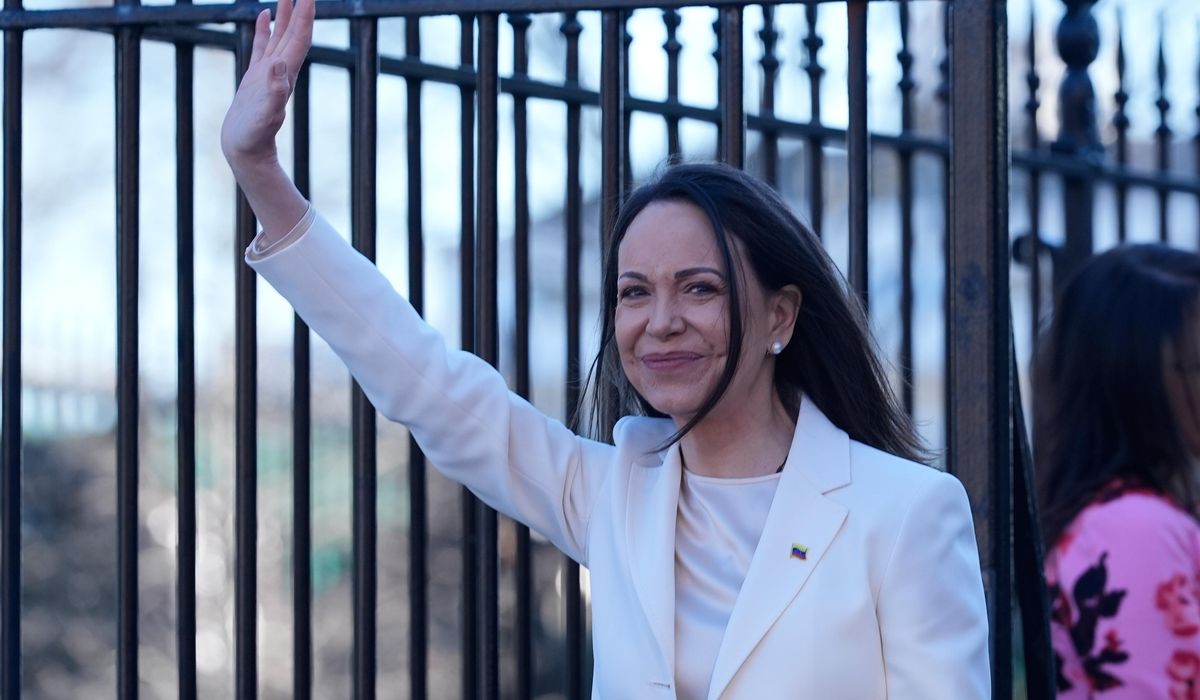
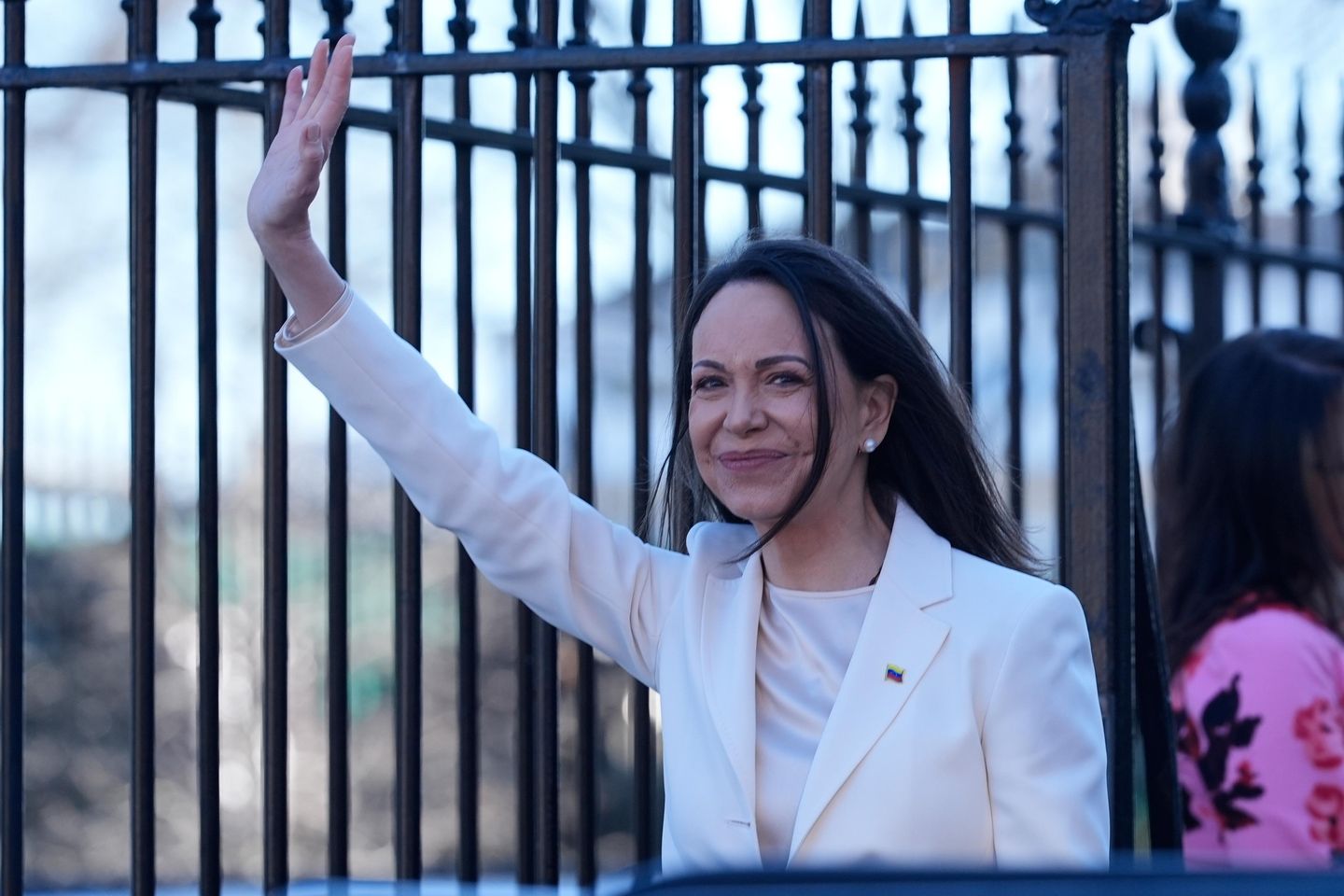
Venezuelan opposition leader Maria Corina Machado presented President Trump with her Nobel Peace Prize on Thursday during a meeting to discuss her country’s future following President Nicolas Maduro’s ouster.
Ms. Machado, who won the prestigious prize last year, confirmed the handover after her closed-door lunch at the White House.
“I presented the president of the United States the medal, the Nobel Peace Prize,” she told supporters.
The Nobel committee says the prize is nontransferable. Yet Mr. Trump has openly coveted the honor, saying he deserved the prize for his role in helping other nations resolve their armed conflicts.
Ms. Machado said her gesture closed the loop on an anecdote from 200 years ago, when Gen. Marquis de Lafayette of France, who assisted the Continental Army against the British in the American Revolution, gave Latin American statesman Simon Bolivar a medal with George Washington’s face on it.
“Two hundred years in history, the people of Bolivar are giving back to the heir of Washington a medal, in this case, the medal of the Nobel Peace Prize, as a recognition for his unique commitment [to] our freedom,” Ms. Machado said.
SEE ALSO: Machado says Venezuelans can ‘count on’ Trump after White House meeting
Ms. Machado is a natural ally to the U.S. as it tries to move Venezuela beyond Mr. Maduro, the strongman who was captured by the U.S. military and flown to New York to face narco-terrorism charges.
Mr. Trump does not think she can lead the country right now, though Ms. Machado called him a reliable partner.
“We [can] count on President Trump for the freedom of Venezuela,” she told the supporters while sharing warm embraces with the throng.
The pair met for lunch at the White House, prompting curiosity about whether Ms. Machado would share her prize with Mr. Trump. The White House did not say much about the meeting or prize, other than brief remarks at the daily press briefing.
Ms. Machado is “a remarkable and brave voice for many of the people of Venezuela,” said White House press secretary Karoline Leavitt, adding the president was “expecting it to be a good and positive discussion.”
The pair met for lunch at the White House, prompting curiosity about whether Ms. Machado would share her recent Nobel Peace Prize with Mr. Trump. She has offered to do so.
Ms. Machado mounted an aggressive campaign as a legitimate contender against Mr. Maduro in 2024, but the regime barred her from running and she went into hiding. After the Maduro raid, Mr. Trump said that Ms. Machado did not have the required support in Venezuela to lead the country right now.
“It was a realistic assessment based on what the president was reading and hearing from his advisers and national security team,” Ms. Leavitt said. “At this moment in time, his opinion on that matter has not changed.”
Instead, the U.S. administration is relying on acting President Delcy Rodriguez, a longtime leader who served as vice president under Mr. Maduro.
The U.S. is trying to limit political chaos and tap into Venezuela’s oil reserves. Mr. Trump said he had a productive midweek call with Ms. Rodriguez.
“We are making tremendous progress as we help Venezuela stabilize and recover. Many topics were discussed, including Oil, Minerals, Trade and, of course, National Security,” Mr. Trump said on social media. “This partnership between the United States of America and Venezuela will be a spectacular one FOR ALL.”
Ms. Rodriguez criticized the raid to oust Mr. Maduro, though her government released political prisoners in a conciliatory move to the U.S.
Thursday’s visit marked the first time that Mr. Trump and Ms. Machado met in person.
Ms. Machado visited lawmakers on Capitol Hill shortly after her lunch with Mr. Trump. Senators from both parties posed with the opposition leader.
“She wants to do everything she can to make sure there’s a peaceful transition to a democracy. I believe she’ll be the president of Venezuela eventually,” said Sen. Rick Scott, Florida Republican.
Dubbed the “Iron Lady,” Ms. Machado has been a longtime critic of the United Socialist Party of Venezuela (PSUV) since it rose to power in the late 1990s under Hugo Chavez.
She rose to prominence as part of the vote-monitoring organization Sumate, led demonstrations against the Maduro regime, and went into hiding after the 2024 election.
Ms. Machado visited President George W. Bush in the Oval Office in 2005 to discuss her efforts to safeguard the ballot in Venezuela.
The Nobel committee last year praised “her tireless work promoting democratic rights for the people of Venezuela and for her struggle to achieve a just and peaceful transition from dictatorship to democracy.”
“As the leader of the democracy movement in Venezuela, Maria Corina Machado is one of the most extraordinary examples of civilian courage in Latin America in recent times,” the committee said.
Hours before the Trump-Machado meeting, the U.S. seized another oil tanker that defied Mr. Trump’s blockade on sanctioned Venezuelan oil.
The “ghost fleet tanker” was taken by a Coast Guard tactical team, Department of Homeland Security Secretary Kristi Noem said on social media.
On Dec. 16, Mr. Trump imposed a “total and complete blockade” on sanctioned Venezuelan oil tankers.
This is the sixth oil tanker boarded by U.S. officials.
• Mary McCue Bell and Lindsey McPherson contributed to this article.