I’m George Gerbo, and welcome to Washington Times Weekly, where we get a chance to sit down with our reporters and talk about their coverage of the latest news and events.
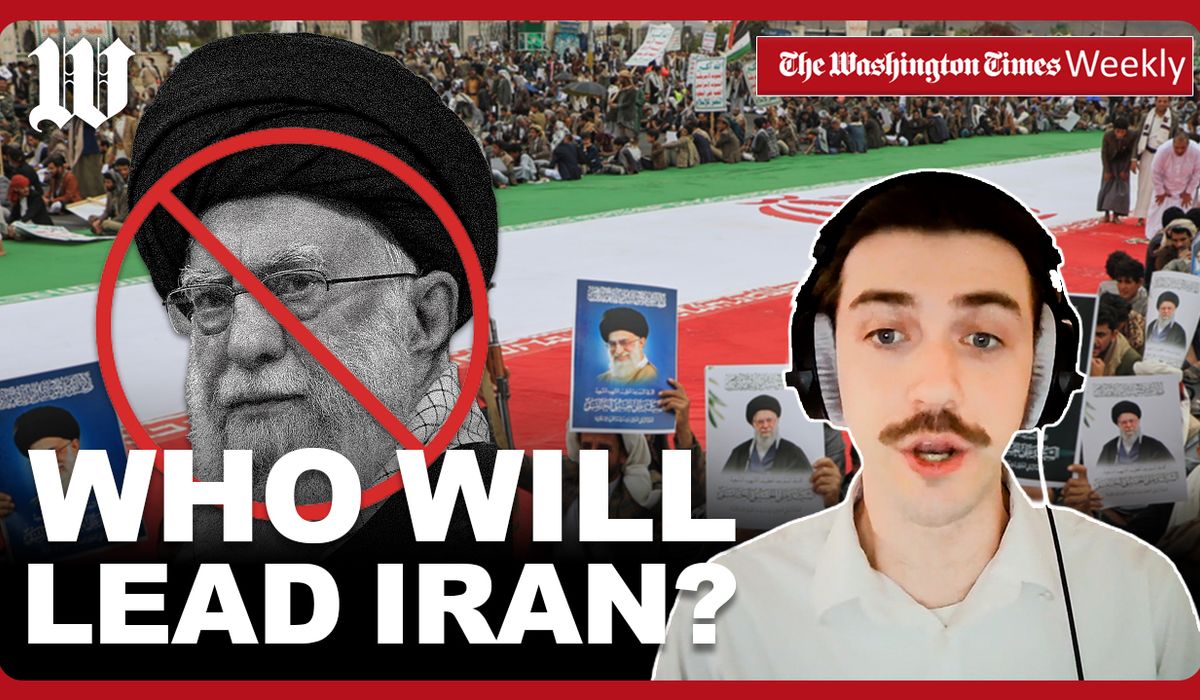
And this week, it is all about the war in Iran, as we get to talk to Foreign Affairs Correspondent Vaughn Cockayne.
[GERBO] First of all, the conflict itself — the United States has sunk a warship with a submarine for the first time in decades off the coast of Iran. That’s part of an escalation of attacks that are kind of going tit for tat, back and forth here, Vaughn, where the U.S. has increased some of those ancillary attacks. Meanwhile, the Iranians are responding with drone attacks to some neighbors in the Gulf region, as well as with threats now coming from Islamic leadership in Iran — threats for the blood of Israel and even President Trump, as one Islamic cleric said recently. And it just appears that we’re now meandering down this road of war here and not really sure where it’s going to go or how it’s going to evolve.
[COCKAYNE] Yeah, it’s different every day. There’s a different headline every day. As you said, this submarine strike is pretty unprecedented, as was the footage. I’m not sure if the viewers saw the footage, but it was extreme. As far as we know, the Iranian frigate was traveling from India, where it was participating in joint exercises, and it was traveling back to the region when it was attacked. Iran has responded pretty forcefully to this, as it has with most of the attacks on its leadership and its military infrastructure, but this one has been one of the more high-profile ones.
As you’ve seen from Secretary Hegseth and Dan Caine, two of the top defense officials that are coordinating Operation Epic Fury against Iran — have really tried to tout this frigate sinking with the submarine strike as sort of the pinnacle and the prime example of what the United States is doing to counter Iran’s naval fleet in the region, which has really been on the chopping block primarily over the past few days, in addition to Iran’s domestic ballistic missile and drone infrastructure, which the United States has also been striking.
We don’t know exactly to what extent Iran’s Navy is damaged or operational at this point, but we will see in the next few days, probably more strikes similar to the one we saw yesterday.
[GERBO] And within Iran, leadership change is coming. What that change looks like is still to be seen. For its part, Trump administration officials still saying mostly that we’re not advocating for regime change, Under Secretary Elbridge Colby from the Pentagon saying that to Congress. Defense Secretary Pete Hegseth said the same thing. President Trump has gone back and forth a little bit, saying that he hopes that there is some sort of movement within the country that is able to come up and help lead it out of the aftermath of these attacks, but also that maybe perhaps a change in regime is necessary at the same time.
It doesn’t feel that the U.S. wants to insert itself into a regime change operation here, Vaughn, as you’ve written about, but also at the same time may come a point where that’s necessary. Because if you’re Iranian, you’ve got the two factions. Does just another Islamic leadership, Islamic-based leadership take the place of the replacement of Ayatollah Khamenei? Or does it truly lead to a peaceful revolution of democracy in Iran? Which is probably the hope of some people in the United States and even some neocon types in the Republican Party, but the administration is trying its best to walk this line while it can, before it may become necessary that it does turn into a type of regime change.
[COCKAYNE] Yeah. And you saw that tightrope walk really play out Thursday in Congress, on the Hill, when Undersecretary of Defense for Policy Elbridge Colby was testifying — I think for the second day this week — in front of lawmakers. And he articulated, again, the United States is not interested in regime change, that the operation is focused primarily on targeting Iran’s capacity to project its force in the region and on United States assets.
But as Representative Adam Smith from Washington pointed out, if there is not regime change, if Iran’s ballistic missile infrastructure is destroyed, then the Islamic Republic can just rebuild it. And this is really the main conflict here when it comes to discussing regime change. And like you said, the president has said that they’re not really interested in focusing on this, but that even though they’re not focused on it, they had a list of people who could potentially take over. But as Trump said, a lot of them were killed.
President Trump said that it was absolutely unacceptable for the next supreme leader of Iran to be Khamenei’s son, who has emerged as the largest and most prominent potential successor. And right now, the Assembly of Experts, the 88-person body in Iran who’s supposed to select the next supreme leader, is currently deliberating. And there are a few options. But as I said, the supreme leader’s son has emerged as the main frontrunner. But it’s unclear if they’ll really name him.
Israel and the United States have both said that he would be a pretty important strategic target for their strikes. So it’s unclear if he’ll be named or if anybody will be named in the next few weeks. It’s possible that the position could be eliminated entirely, at least for the duration of the war — that the three-member Interim Leadership Council could really lead over Iran.
Watch the video for the full conversation.