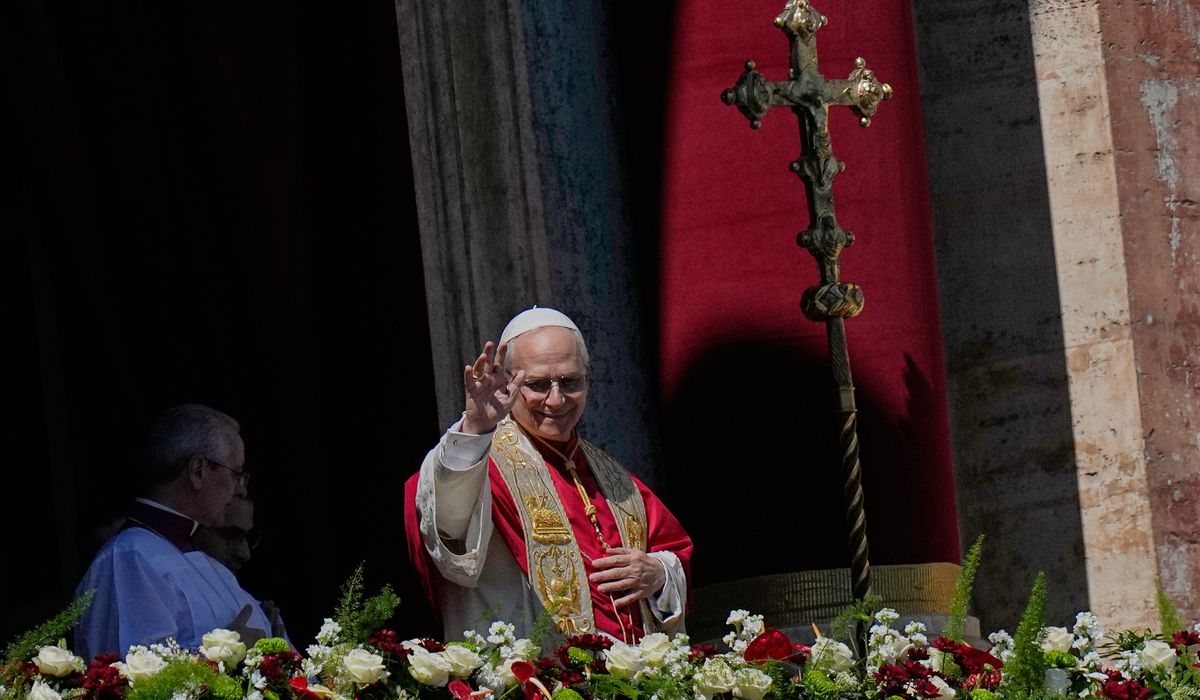
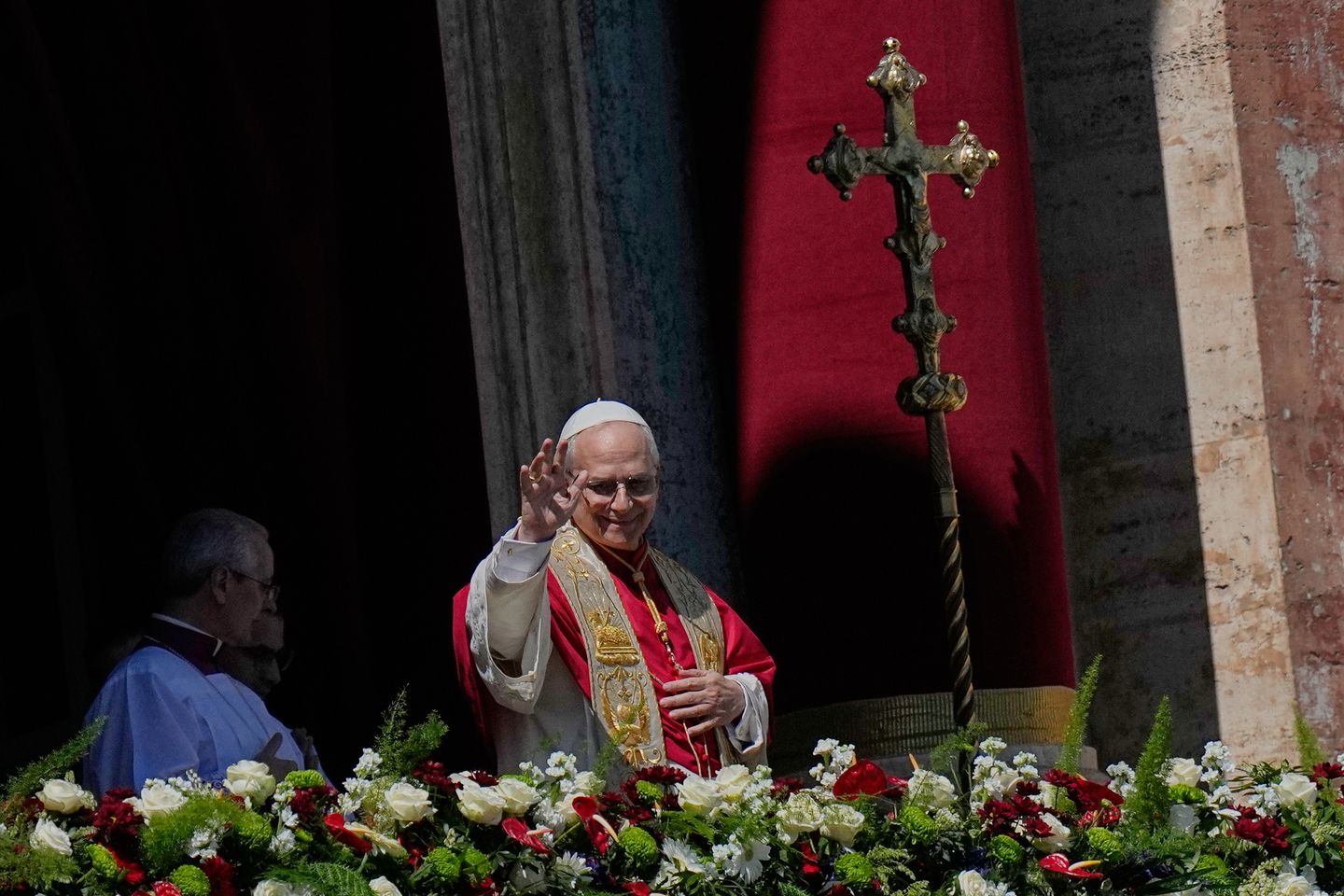
Pope Leo XIV will begin his journey to four African countries – Algeria, Cameroon, Angola and Equatorial Guinea – on April 13, 2026.
Africa represents the fastest-growing part of the Catholic Church worldwide, seeing an increase from 281 million members in 2023 to over 288 million in 2024.
The Vatican has announced a theme for each country along the pope’s journey and four logos that combine Christian images with symbols of each nation. As a scholar of global Catholicism, I argue that these themes, taken together, relate to the major focus of Leo’s papacy: the need for peace in a divided world.
Dialogue and encounter’ in Algeria
In Algeria, the logo is two doves drinking from the same cup, with the words “Peace be with you” in French, along with the traditional Muslim greeting “Peace be upon you” rendered in Arabic. The same phrase is also written in Berber, one of Algeria’s official languages. The theme for this first stop of Leo’s trip is “dialogue and encounter.”
With this symbolism, Leo is inviting deeper understanding and collaboration between Christians and Muslims.
Catholics are a tiny community in Muslim-majority Algeria. Interreligious tension exists, with arbitrary detentions of Christians and arrests under the nation’s blasphemy laws. And Algeria is still dealing with the aftermath of its “Black Decade.” This period from 1991 to 2002 saw nearly 200,000 Algerians killed in violence between the government and Islamist rebel groups.
Nineteen Catholic men and women killed during the conflict were officially recognized as “blessed” by the Vatican because they died as martyrs. Among these were the seven Trappist monks of Tibhirine who were killed by Islamist insurgents after they refused to leave their monastery during the violence. Expecting his own death, the leader of the monastery, Christian De Chergé, had written a spiritual testament that emphasized the power of interreligious encounter and the deep spiritual ties that bind Christians and Muslims.
Against this background, Leo’s planned visit to Maqam Echahid, a memorial honoring Algeria’s struggle for independence, as well as his presence at the Great Mosque of Algiers, will be important opportunities for him to put encounter and dialogue into practice.
Unity in Cameroon
In Cameroon, the logo has Leo praying over an open Bible with a map of Cameroon as an overlay. The theme is “unity in Christ,” specifically relating to Leo’s own motto “in Illo uno unum,” or “In the one Christ, we are one.”
Cameroon is a majority-Christian country, with a significant Muslim minority. Approximately 25% of the population is Catholic.
Within this complex nation, there are real threats to unity. There was violence after the disputed 2025 reelection of 92-year-old Cameroonian President Paul Biya, who first came to power in 1982. Most significantly, there is the “Anglophone crisis,” a consequence of the colonial divide between French- and English-speaking areas of the country. Hundreds of thousands of Cameroonians have been displaced by violence between the government and separatists in the English-speaking north and southwest regions of the country.
There has also been competition between Christian denominations – especially amid the rise of new “Christian revivalist” groups that preach the “prosperity gospel,” which promises that faith in Jesus will bring riches and other material rewards.
Leo has said that the Christian idea of unity respects “the mystery that every person and every community carries within them.” Given the linguistic and ethnic diversity of Cameroon, Leo is calling on Cameroonians to envision how Christianity can become a unifying force for peace in a nation still struggling with a colonial legacy of division.
Reconciliation and peace in Angola
Angola’s logo is dominated by a map of the country, and the motto is “Pope Leo XIV, pilgrim of hope, reconciliation, and peace, blesses Angola.”
Angola is a Christian-majority country, with Catholics constituting approximately 49% of the population. Catholicism came to Angola with the Portuguese in 1491. Angola remained a Portuguese colony until 1975, after which followed a 27-year civil war, which was fueled, in part, by the U.S. and the Soviet Union competing for oil resources and influence during the Cold War.
Of the countries Leo is visiting, Angola has the most income inequality, caused by corruption and the nation’s elite taking advantage of the country’s oil revenue. The nation’s human rights record is also poor.
The theme of reconciliation and peace relates to the continuing aftermath of the civil war, which can be seen not just in wealth inequality but also in the lack of critical infrastructure. The Catholic Church in Angola has been the primary nongovernmental institution filling this gap by establishing schoolsand hospitals. But such efforts require conditions of peace.
Angola has also seen waves of refugees fleeing violence in the neighboring Democratic Republic of Congo. Catholic churches in Angola have played a central role in welcoming and resettling those crossing the 1,560-mile (2,511-kilometer) border between the two nations.
Many Angolan Catholics are especially looking forward to Leo’s visit to a shrine to Mary at the Church of Nossa Senhora da Conceição in Muxima, built in 1599. During the colonial era, slaves were forcibly baptized here before being sold.
When Leo visits Muxima, Angolan Catholics hope for a celebration that reflects the country’s diversity. The shrine regularly attracts 2 million visitors each year, including Protestants and Muslims. Catholic leaders hope that a similar number will attend to see the pope and honor “Mamã Muxima,” the Black Madonna who presides at the shrine.
Hope in Equatorial Guinea
In Equatorial Guinea, the logo for the pope’s visit is a golden cross with the words, in Spanish, “Christ, light of Equatorial Guinea, toward a future of hope.”
Equatorial Guinea is a Catholic-majority country struggling to develop a model of “inclusive growth” that spreads its oil income more equitably. The country has been led by only one leader since 1979, President Teodoro Obiang Nguema Mbasogo.
Most notable will be Leo’s visit to Bata, the site of a munitions explosion that killed over 100 people in 2021. While the exact cause behind the blast is a matter of controversy, the munitions dump ignited while construction and brush clearing was happening in the area.
In choosing Bata as the site for his visit, Leo is drawing attention to how preparations for war can often bring violence to the innocent. The hope that this motto refers to is the hope of the resurrection – of life triumphing over death – as reflected in the golden cross.
A pope of peace
Leo has praised the African church as a “dynamic reality,” meaning that it is growing and evolving. And Africa’s importance to Catholicism is not just about demographics. African Catholicism has a vibrant intellectual life. In particular, African Catholic theologians have addressed what is called contextual theology, which often integrates themes and practices from indigenous African traditions in addition to relying on the Bible.
It will be interesting to see whether Leo will explicitly draw upon African theological resources in his public speeches. As planned now, Leo’s African journey will intertwine the theme of peace with other concerns central to his pontificate: the plight of the poor and marginalized, the experiences of migrants and refugees, and the possibility of finding common ground amid the world’s divisions.
In his most recent Easter blessing, Leo remarked that the power of Christ is “totally nonviolent.” In this sense, the pope is arguing, peace is necessary not just for any kind of social change but for being faithful to the example of Jesus Christ, which likely will be his central message for Africa.
The Conversation is an independent and nonprofit source of news, analysis and commentary from academic experts. The Conversation is wholly responsible for the content.