Republicans on Thursday resoundingly rejected Democrats’ new proposals to reel in ICE, saying the 10-point list of reforms, including barring arrests near schools and courts and giving localities a veto over operations, was the stuff of “fantasy land.”
Democratic leaders have said they will not pass any new spending bill for the Homeland Security Department unless it takes major steps to shackle President Trump’s mass deportation effort. Congress faces a Feb. 13 deadline to approve a new funding deal for the department.
Democrats’ plan, released late Wednesday, wouldn’t abolish U.S. Immigration and Customs Enforcement, but it would reimpose some of the core policies of the Biden era and introduce severe new restraints that would undercut much of the agency’s current work under Mr. Trump.
The list includes banning use of masks to hide officers’ identity, ending “indiscriminate” arrests and barring all arrests near “sensitive” locations such as clinics, churches, courts, day cares and schools. It would give state and local governments veto power over “large-scale” operations and give states explicit power to sue in federal court if they think enforcement has gone too far.
Democrats’ plan would also impose new rules on what evidence officers need to make an immigration stop, undercutting both long-standing DHS policies and a recent Supreme Court ruling that recognized broad leeway for ICE officers and Border Patrol agents.
Sen. Eric Schmitt, Missouri Republican, labeled the proposals “fantasy land,” and Sen. John Barrasso, Wyoming Republican, called them “radical and extreme.”
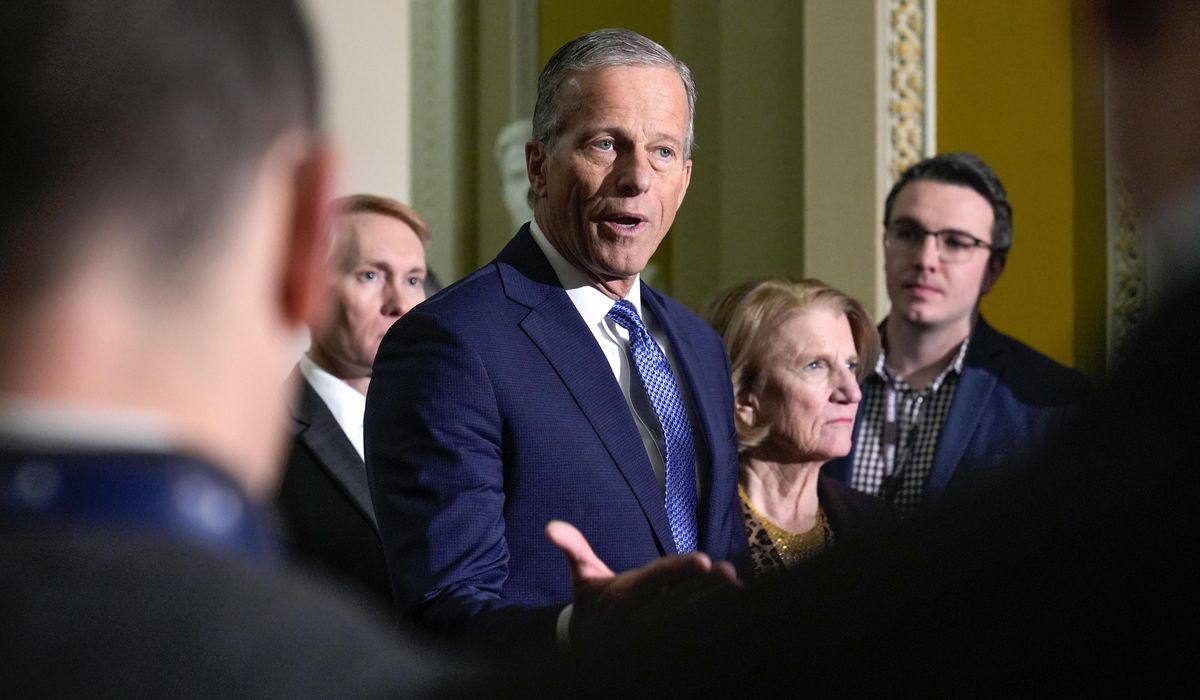
Senate Majority Leader John Thune said if Democrats stick by the list, passing a new DHS spending bill is “not even in the realm of possibility.”
“It seems like they are posturing themselves in such a way that would make any sort of middle ground virtually impossible to find,” the South Dakota senator said.
Still, he said there’s “some room in there to negotiate.”
Democrats, though, see their list as a floor, not a ceiling.
“For me, these demands are red lines, non-negotiable,” said Sen. Richard Blumenthal, Connecticut Democrat, said. “The risk here is so great that we will lose the basic standards that apply to critical freedoms and protections from government overreaching.”
Democrats believe the shooting deaths of two U.S. citizens by DHS personnel in Minneapolis last month have given them the opening to demand a major upheaval in the way the department has been carrying out Mr. Trump’s deportation plans.
“If Republicans can’t go along with that, they shouldn’t count on our votes,” said Senate Minority Leader Charles E. Schumer, New York Democrat.
He said Democrats would send legislative text of their proposals to Republican appropriators as soon as Thursday afternoon, and that the onus is now on the GOP to explain what they will support.
“They have to get their act together. We have,” Mr. Schumer said. “We spent three days diligently, seriously coming up with a comprehensive, commonsense plan that police departments throughout the country use. Where are they?”
Republicans have said their top demand is ending sanctuary policies, which prevent ICE from arresting deportation targets who end up in state and local prisons and jails.
“That’s what’s causing all of this, is the lack of cooperation,” Mr. Schmitt said. “It’s the confrontations that are being created, and why you don’t see this in blue or red jurisdictions that aren’t sanctuary status.”
Mr. Schumer pushed back on the notion that Democrats opened the door to discussing sanctuary policies.
“We are talking about public safety. That’s an immigration bill,” he said, arguing Republicans proposing to bring sanctuary cities into the negotiations “shows how unserious they are” about cutting a deal.
White House press secretary Karoline Leavitt said the Democrats’ list is a mixture of some ideas Mr. Trump is “willing to discuss” and others that are “nonstarters.” She didn’t say which ideas fell into which category.
One of the Democrats’ demands is to outfit immigration agents and officers with body cameras.
That seems like an area of common ground, after DHS Secretary Kristi Noem already announced plans to deploy cameras to all personnel in Minnesota’s Operation Metro Surge and said she would like a nationwide expansion if funding permits. Lawmakers have already agreed to provide at least $20 million for body cameras, but that figure could go up.
Updating use-of-force policies and demanding officers involved in shootings to be removed from the field until an investigation is concluded also seem like possible areas for compromise.
Democrats also proposed higher standards before agents and officers can even make an immigration stop. Their plan would bar use of race, language being spoken or proximity to a certain location as justifications for a stop.
That would reverse a Supreme Court emergency docket ruling last year that allowed such stops to proceed.
The ban on arrests near locations such as clinics and day cares would revive a strict Biden-era policy the Trump team canceled last year.
Mr. Blumenthal said there is room for compromise on the geographical boundaries for stopping enforcement, but he said there need to be some off-limits areas.
“The basic idea is that somebody going to report a crime shouldn’t be arrested because they won’t report crime,” he said. “Someone going to a doctor’s office, taking a child to be treated, someone going to church – my Republican colleagues profess great support for the freedom of religion – there are so-called sensitive locations where there should be an avoidance of interference.”
ICE officers, though, say courts are among the safest places to arrest deportation targets because people have gone through security and aren’t going to be armed. Officers have also told The Washington Times of instances in which they were unable to arrest criminals because of proximity to a sensitive location.
Democrats also called for immigration officers to obtain a “judicial warrant” before entering private property and an end to “indiscriminate arrests.”
In addition to the 10-point list, Mr. Schumer and House Minority Leader Hakeem Jeffries, New York Democrat, said they also wanted to see an end to the enforcement surge in Minnesota and the firing of Ms. Noem.
Mr. Trump indicated Thursday that Ms. Noem’s job is safe.
DHS is operating on a short-term stopgap bill that funds the department at the same levels as 2024. Some parts of the department — chiefly the Border Patrol and ICE — got tens of billions of dollars in extra money in last year’s Big Beautiful Bill budget law and will be able to operate at heightened levels even without a new bill.
Republicans say the bigger losers if there’s no new bill will be the Coast Guard, Transportation Security Administration, Federal Emergency Management Agency and other parts of DHS that aren’t part of the immigration apparatus.