Top Senate Democrats urged large businesses Thursday to pass along a portion of forthcoming tariff refunds to consumers who faced higher prices as a trickle-down effect of President Trump’s trade agenda.
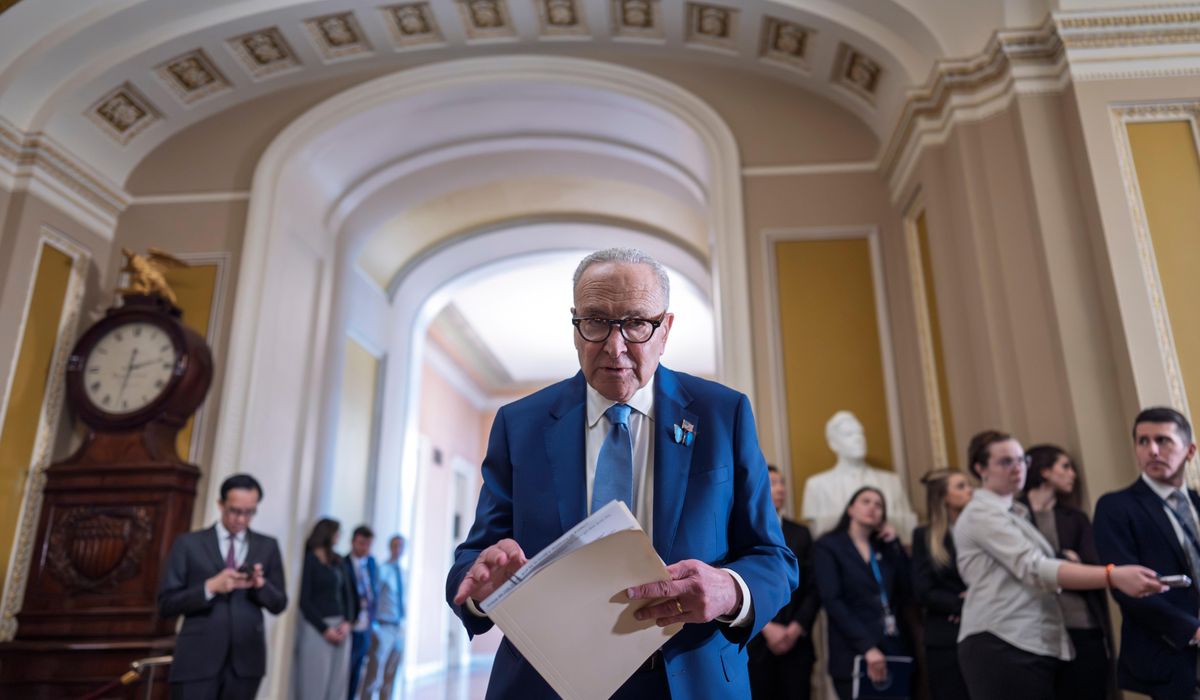
Senate Minority Leader Charles E. Schumer, New York Democrat, and Sen. Ron Wyden, Oregon Democrat, said consumers should share in the windfall after the Court of International Trade issued a midweek ruling ordering the administration to refund money that businesses paid to satisfy tariffs deemed illegal by the Supreme Court.
“While importers can seek refunds of the tariffs they paid to the U.S. government, the economic burden of these illegal taxes was shared by their customers,” the Democrats wrote to U.S. Chamber of Commerce CEO Suzanne Clark. “American families paid higher prices for food, electronics, clothing, and household goods, while small businesses faced additional costs for raw materials, inputs, and equipment. They deserve to be made whole.”
Judge Richard Eaton of the U.S. Court of International Trade on Wednesday said importers were entitled to benefit after the Supreme Court struck down Mr. Trump’s decision to use the International Emergency Economic Powers Act to impose blanket tariffs on trading partners.
Democrats cheered the ruling and pushed for refunds to businesses. Thursday’s letter indicated that Mr. Schumer and other Democrats were mindful that businesses might be getting repaid for costs they already pushed onto everyday Americans.
“Simple fairness demands that the financial burden imposed on small businesses and working families not become a windfall for the largest corporate balance sheets,” they wrote. “Companies that passed along tariff costs should pass along savings from tariff refunds.”
Nearly 2,000 businesses filed legal claims seeking refunds for IEEPA tariffs after the Supreme Court’s ruling. An estimated $130 billion to $175 billion in tariff payments must be paid back.
The justices offered little guidance on how to issue refunds, so the trade court is filling in the details. The judge ordered Customs and Border Protection to issue refunds as part of the liquidation process that finalizes tariff payments and issues refunds, when necessary.
The administration has signaled that its systems were not set up for en masse refunds, so it may take time to process the repayments.
Business coalitions that fought the tariffs are hoping the government moves fast.
“The [trade] court acted swiftly and correctly. Now the ball is in the government’s court, and small businesses are concerned they will drag this out further,” said Dan Anthony, executive director of the We Pay the Tariffs coalition.
Tariffs are duties imposed on foreign goods when they enter U.S. markets.
Mr. Trump says the tariffs are a terrific way to gain leverage over other nations, create revenue and protect U.S. jobs, though critics say they increase costs along supply chains and hurt consumers.
Mr. Trump decried the Supreme Court’s February ruling but worked quickly to rebuild his tariff framework.
He imposed a new 10% global tariff under Section 122 of the Trade Act of 1974. He is working to raise that rate to 15%.
The Section 122 tariffs may remain in place for 150 days, after which Congress must approve them.
The Committee for a Responsible Federal Budget estimated Thursday that the 10% tariff would reap roughly $35 billion in revenue over the 150 days it’s allowed to be in effect. That number rises to around $50 billion if the tariff is set at 15%.
Mr. Trump said his administration is conducting investigations to impose longer-lasting tariffs under authorities that let the president address national security concerns or unfair trade practices by other nations.