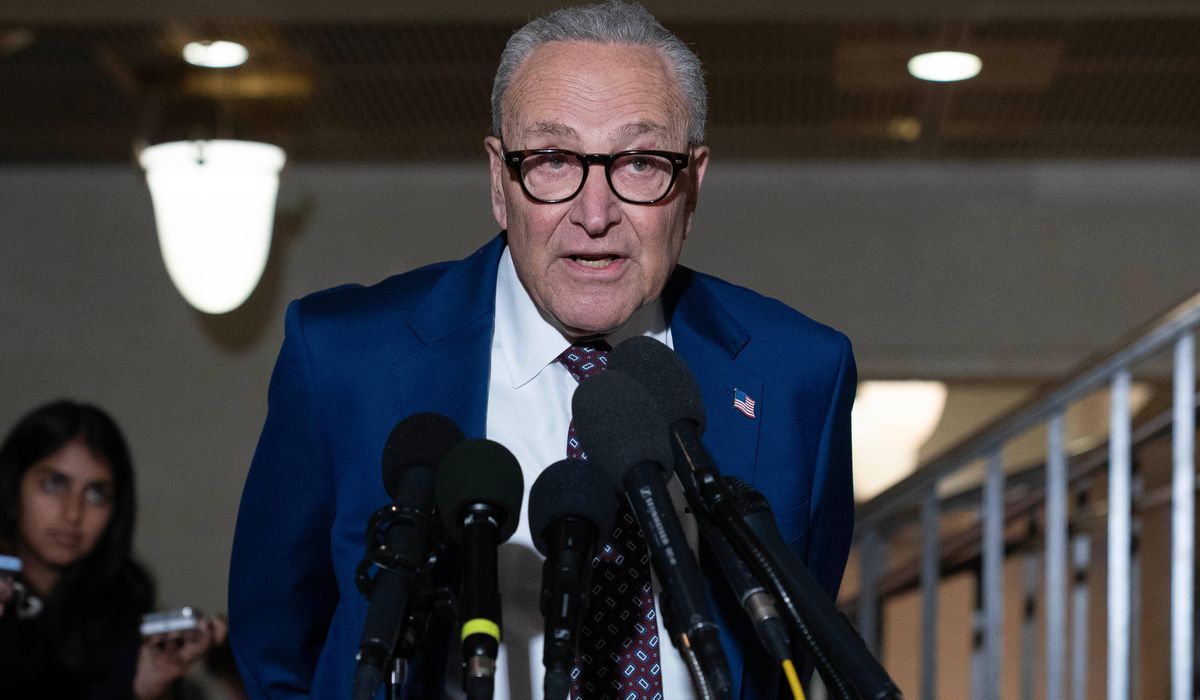
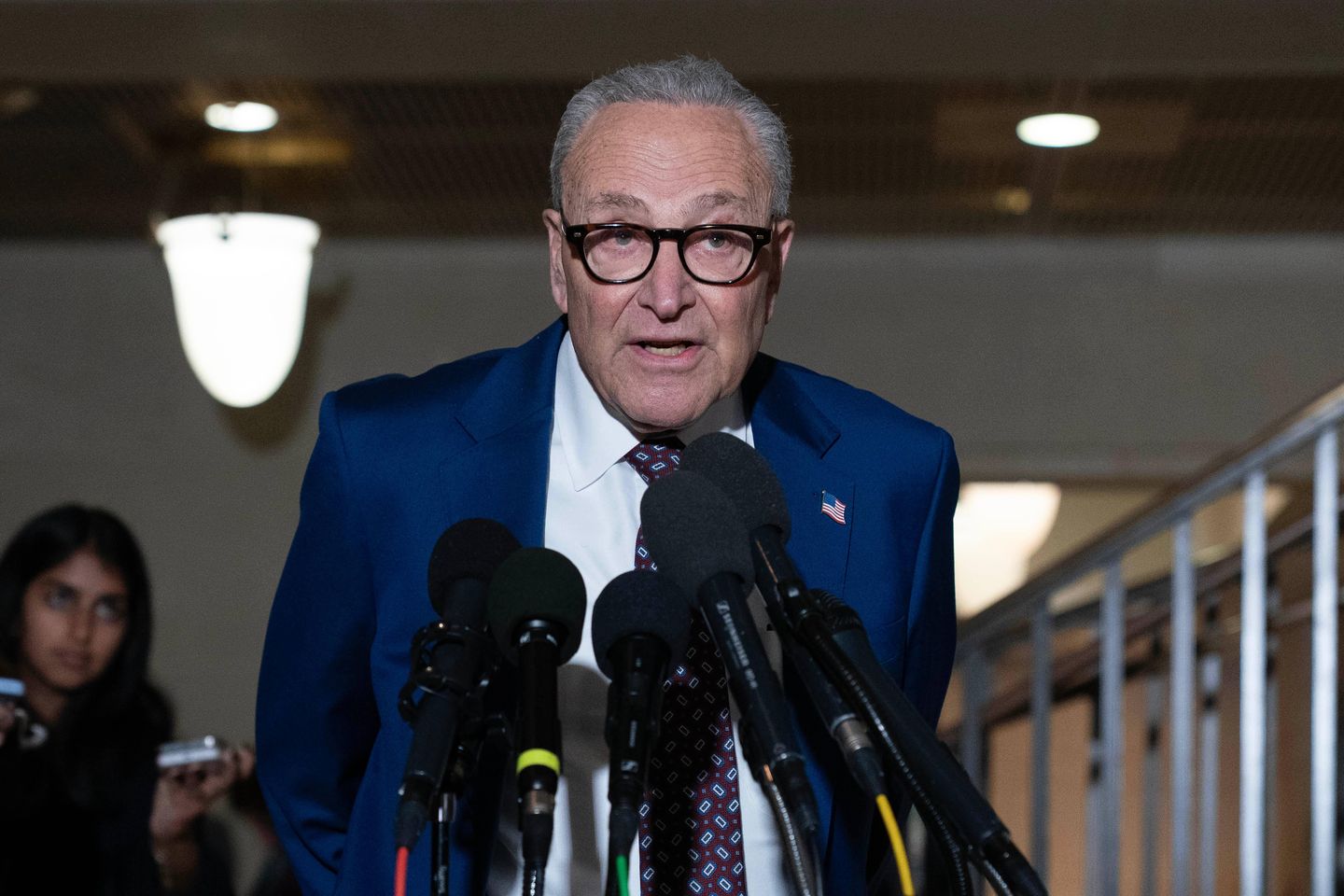
Senate Democratic primaries in 2026 are turning into proxy wars over Charles E. Schumer’s leadership amid a growing desire for wholesale change within the party.
From competitive open races to long-shot bids to unseat incumbents, progressive Senate candidates in at least 13 states are opposed to Mr. Schumer of New York remaining the Democratic leader.
“I absolutely oppose Schumer’s continued leadership due to his failure to confront [President] Trump’s trashing of the Constitution, his ongoing support for the genocide in Gaza and because polling shows Americans have lost faith in the Democratic Party,” Karen Breslin, a lawyer and political science professor running for the Senate in Colorado, told The Washington Times. “The party will not redeem itself without cleaning house.”
Ms. Breslin is one of four Democrats running against incumbent Colorado Sen. John Hickenlooper, and those four believe Mr. Schumer should be replaced. One of those candidates, A.J. Zimpfer, said he would support progressive New York Rep. Alexandria Ocasio-Cortez if she decides to run against Mr. Schumer in 2028.
The anti-Schumer sentiment reflects a broader rebuke of the Democratic Party as out of touch with its base and incapable of effectively countering Mr. Trump.
“The public mood is shifting, and it is clear — Democratic leadership must begin identifying and elevating new leaders capable of moving the country forward with energy, clarity and a forward-looking vision,” Lorita Daniels, a Spotsylvania County School Board member who is running against Virginia Sen. Mark Warner, told The Times.
Democrats running against incumbents — at least 10 of whom say they oppose Mr. Schumer — face an uphill battle in their primary races. But the anti-Schumer sentiment extends beyond the long-shot challengers.
Graham Platner, an oyster farmer and former Marine who is seeking the Democratic nomination to challenge Republican Sen. Susan Collins in Maine, called for Mr. Schumer to step down in November.
The Bernie Sanders-backed candidate blamed Mr. Schumer for the eight Senate Democrats who broke party ranks to end the government shutdown without securing an extension of Obamacare premium subsidies, even though the leader did not vote for the deal.
“This happened because Chuck Schumer failed in his job yet again, because they do not understand that when we fight, we win,” Mr. Platner said in a social media video.
Mr. Schumer recruited and endorsed Maine Gov. Janet Mills for the Senate seat. Her campaign did not return a request for comment on whether she will back him as leader.
Two other Democrats running in the crowded Maine primary, Tucker Favreau and Natasha Alcala, told The Times they oppose Mr. Schumer.
Mr. Favreau said the 75-year-old senator “simply lacks the energy to be the voice of angry Americans across the country that are demanding strong action in the face of this regime.”
A Schumer spokesperson, when asked about the opposition from progressive candidates, pointed to remarks the leader made at a press conference in December defending his decision to back more establishment candidates like Ms. Mills.
“Our North Star is to win the Senate. We are moving ahead strongly. We have very strong candidates,” Mr. Schumer said. “We are on a great path to take back the Senate, and I think we’ve done a very good job that way.”
Mr. Schumer’s critics have been the loudest in races for open seats.
In Michigan, one of the Democrats vying to fill retiring Sen. Gary Peters’ seat said she would oppose Mr. Schumer before officially launching her campaign.
“I would look for other leadership who understands that it’s a different moment,” state Sen. Mallory McMorrow told Politico Magazine in April.
Ms. McMorrow said Mr. Schumer “fought a lot of really great fights” but suggested he follow former House Speaker Nancy Pelosi’s lead and let a new generation take over.
Ms. Pelosi, 85, stepped down from leadership at the end of 2022 after facing internal resistance in her final two bids for speaker.
Michigan Rep. Haley Stevens, who expressed opposition to Ms. Pelosi during her 2018 campaign for the House but ended up voting for her to be speaker, is now running for the Senate with Ms. Pelosi’s endorsement.
She’s appeared to have learned a lesson from her 2018 campaign and is not planning to decide on whether to support Mr. Schumer until after the election.
Mr. Schumer’s path to remaining Democratic leader is easier than Ms. Pelosi’s speaker races because the Senate leadership election is conducted in secret. He needs to earn support from at least half of his party’s senators.
No Democrat has yet expressed interest in challenging Mr. Schumer.
“Anybody who tells you that they’re going to unilaterally oppose one potential candidate without knowing who the alternative is, is either unnuanced or unsophisticated,” Michigan Senate candidate and health care professional Abdul El-Sayed told Politico in April.
His spokesperson told The Times that Mr. El-Sayed would support the leader candidate who is most committed to fighting for working people and delivering on his top priorities: “getting money out of politics, putting money back in people’s pockets and passing Medicare for All.”
Rachel Howard, a combat veteran and another Democrat seeking the Michigan seat, said she can’t give a simple yes-or-no answer on whether Mr. Schumer should remain the leader, saying “a lot of that depends on who the alternatives are and what direction they’re proposing.”
“From what’s visible publicly, there are times when decisions coming out of Washington don’t line up with how I think about governing, especially when it comes to staying focused on practical solutions that actually help people in their everyday lives,” she said.
Opposition to Mr. Schumer has factored into the crowded Illinois Senate primary to replace his No. 2 in leadership, Senate Democratic Whip Richard J. Durbin. At least five of the 10 Democrats running do not want Mr. Schumer to remain leader.
“We need real fighters in Washington, not someone who’s going to give in,” Lt. Gov. Juliana Stratton said in a social media video.
Ms. Stratton and Reps. Robin Kelly and Raja Krishnamoorthi, whose campaigns did not respond to requests for comment, are considered the top contenders in the March 17 primary.
While most of Mr. Schumer’s opponents are new to Washington politics, one exception is in Massachusetts, where Rep. Seth Moulton is calling for wholesale generation change as he challenges 79-year-old Sen. Ed Markey.
“The status quo is not working. The old playbook for Democrats is not delivering,” Mr. Moulton told Forbes in October, saying Mr. Schumer has been “ineffective” at times in standing up to Mr. Trump and congressional Republicans.
Rep. Jasmine Crockett, a Texas Democrat who recently launched a Senate campaign, has not explicitly said she would oppose Mr. Schumer. But after he voted last March for a GOP stopgap funding bill that most Democrats opposed, she said his caucus should consider whether he is the best person to lead them.
“The idea that Chuck Schumer is the only one that’s got a brain in the room and the only one that can think through all the pros and cons is absolutely ridiculous,” Ms. Crockett said on CNN.
In Minnesota, internal splits in the Democratic Caucus are bleeding into the primary, where Lt. Gov. Peggy Flanagan and Rep. Angie Craig are the leading candidates to replace retiring Democratic Sen. Tina Smith.
Ms. Flanagan has endorsements from seven Senate Democrats who primarily represent the far-left wing of the caucus, while Ms. Craig has support from five of the caucus’ more moderate members.
Ms. Craig’s campaign did not return a request for comment on whether she supports Mr. Schumer. Ms. Flanagan’s campaign said she “remains uncommitted.”
Billy Nord, another Democrat running for the Senate in Minnesota, told The Times that Mr. Schumer is “a relic” and representative of the Democratic Party that lost the confidence of the working class in 2024, when Mr. Trump and Republicans won control of Washington.
“He’s of a time of backdoor meetings, and I, like the majority of American people, are done with that kind of governing,” he said. “We want transparency, we want our elected officials to move forward and fast. Not stagnant.”
None of the Democratic Senate candidates who responded to The Times’ inquiries said they want Mr. Schumer to remain in leadership. The Times did not contact any incumbents, who have generally been supportive of their leader.
The candidates who told The Times they oppose Mr. Schumer or have said so in other public forums include:
• Colorado candidates Ms. Breslin, Mr. Zimpfer, Julie Gonzales and Brashad Hasley, running against Mr. Hickenlooper.
• Delaware candidate Christopher Beardsley, running against Sen. Chris Coons.
• Illinois candidates Ms. Stratton, Kevin Ryan, Stephen Botsford, Jonathan Dean and Bryan Maxwell, running for the open seat Mr. Durbin is vacating.
• Iowa candidates Zach Wahls and Nathan Sage, running for an open seat held by retiring GOP Sen. Joni Ernst.
• Maine candidates Mr. Platner, Mr. Favreau and Ms. Alcala, running in an open primary to challenge GOP incumbent Ms. Collins.
• Massachusetts candidates Mr. Moulton and Alexander Rikleen, running against Mr. Markey.
• Michigan candidate Ms. McMorrow, running for the open seat Mr. Peters is vacating.
• Minnesota candidate Mr. Nord, running for the open seat Ms. Smith is vacating.
• New Hampshire candidate Karishma Manzur, running for an open seat held by retiring Democratic Sen. Jeanne Shaheen.
• North Carolina candidate Justin Dues, running for an open seat held by retiring GOP Sen. Thom Tillis.
• Ohio candidate Christopher Volpe, running in an open primary to challenge GOP Sen. Jon Husted.
• Rhode Island candidate Connor Burbridge, running against Sen. Jack Reed.
• Virginia candidates Ms. Daniels and Jason Reynolds, running against Mr. Warner.