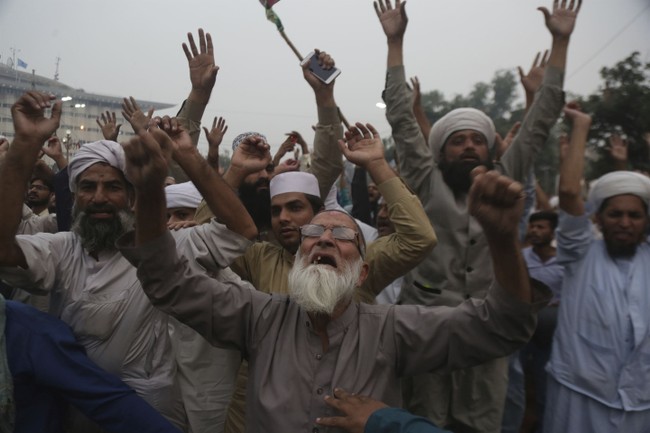
An unidentified assailant recently gunned down a Presbyterian Pakistani pastor outside his home in front of his daughter on Dec. 5, his family said. The pastor had previously survived an attack in September.
The Rev. Kamran Salamat of Gujranwala was preparing to take his 16-year-old daughter to college when an unidentified motorcyclist opened fire on him with a pistol, hitting him in the right wrist, left ear and lower abdomen, said the victim’s brother-in-law, the Rev. Shahzad Salman. Pastor Salamat was 45.
“My brother-in-law succumbed to his injuries at the hospital three hours later,” Pastor Salman told Christian Daily International-Morning Star News.
Sources said Pastor Salamat had made several outreaches to lawless tribal regions in Pakistan’s Khyber Pakhtunkhwa Province, where he preached the gospel to Afghan and Pakistani Muslim tribesmen.
“It’s quite possible that he was martyred due to his missionary work,” a church leader said. “The truth will surface only after the police arrest the assailant.”
Condemning the assassination, the Rev. Reuben Qamar, moderator of the Presbyterian Church of Pakistan, demanded a thorough investigation as well as the immediate arrest of the assailants.
Pastor Naeem Nasir, a prominent Pentecostal preacher, said Pastor Salamat was killed in order to prevent him from proclaiming Christ, reported Christian Daily International.
“Extremists had been pursuing him and threatening him everywhere he went,” Pastor Nasir stated on Facebook, citing a phone call with the mother-in-law of the slain pastor. “He moved from Islamabad to Gujranwala, but they were still not satisfied. They wanted to stop his passion for preaching the gospel.”
Pastor Salamat’s murder took place three months after a Catholic was shot dead and another was wounded while they traveled to a pilgrimage site in Punjab Province. Afzal Masih (who lived in Punjab Province) and his cousin Harris Tariq Masih were among a group of Catholics who were in a passenger van en route to the annual Feast of the Nativity of Mary shrine in Mariamabad when Muslims with a Kalashnikov assault rifle attacked them, said Aurangzeb Peter, a member of the traveling group.
Due to severe religious freedom violations in Pakistan, the US government has once again labelled Pakistan a “country of particular concern.” The US Commission on International Religious Freedom (USCIRF) noted in its 2025 Pakistan country report that:
In 2024, religious freedom conditions in Pakistan continued to deteriorate. Religious minority communities—particularly Christians, Hindus, and Shi’a and Ahmadiyya Muslims—continued to bear the brunt of persecution and prosecutions under Pakistan’s strict blasphemy law and to suffer violence from both the police and mobs, while those responsible for such violence rarely faced legal consequences. Such conditions continued to contribute to a worsening religious and political climate of fear, intolerance, and violence.
Accusations of blasphemy and subsequent mob violence continued to severely impact religious minority communities.
For instance, in May of last year, a Muslim mob violently attacked and lynched Nasir Masih, a 70-year-old Christian man, following accusations that he desecrated a Qur’an. Following his death, authorities arrested, but then swiftly released, hundreds of people in connection with the lynching.
In June, an antiterrorism court in Punjab sentenced to death a 22-year-old Christian man, Ehsan Shan, for blasphemy. He was accused of posting social media photos that showed defaced pages of the Qur’an. Shan remains imprisoned.
The same month, a mob broke into a police station in Madyan (northwestern Pakistan) and lynched a tourist accused of desecrating the Qur’an. The mob also set fire to the police station and burned the victim’s body.
According to a 2025 report by CSW (Christian Solidarity Worldwide),
Lawyers defending blasphemy-related or other sensitive cases relating to minority issues frequently face intimidation and threats of violence, and in some cases extra-judicial killings. Judges have been physically attacked and threatened with torture, even during court hearings. Many are afraid to hear prominent minority cases for fear of reprisal, resulting in slow progress in these cases.
In April, United Nations (UN) experts expressed concern about the worsening pattern of forced conversions to Islam among Pakistan’s minority Christian and Hindu. They noted that local authorities often dismiss forced marriages, in which women and girls are obliged to convert to Islam, and the court system likewise validates the marriage.
The statement highlighted the case of Roshni Shakeel, a 13-year-old Christian girl whom a 28-year-old Muslim man abducted from her family in March. She was forcefully converted to Islam and registered at a new age of 18. Despite Shakeel’s subsequent escape and return to her family, reports indicate that her family continued to face harassment from police, who arrested her father, detained him for three days, and allegedly beat him to coerce him into revealing his daughter’s location.
In addition, Pakistan’s blasphemy laws criminalize anyone who insults Islam, including by outraging religious feeling (Section 295(A)), defiling the Qur’an (295(B)), and Islam’s prophet Mohammed (295(C)), which carries the death penalty or life imprisonment. The CSW UK reports that,
According to the Centre for Social Justice (CSJ), there were 83 registered cases involving the abduction, forced conversion, and forced marriage of religious minority women and minor girls in 2024 – a decrease from 136 in 2023. The true figure is assumed to be much higher as many cases are not reported due to fear of backlash from the abductors or extremist groups.
Perpetrators are emboldened by a culture of impunity, and victims and their families are often intimidated by abductors and their relatives. As a result, crimes are often unreported and figures underestimated. The failure of law enforcement officials to carry out proper investigations further impedes justice.
Pakistan is an Islamic Republic under the leadership of Prime Minister Shehbaz Sharif. Of the country’s estimated 252 million people, 96.5 percent are Muslim (85–90 percent Sunni and 10–15 percent Shi’a) and 3.5 percent identify with other religious communities, including Christians, Hindus, and Sikhs. Pakistan’s constitution establishes Islam as the state religion.
A 2025 USCIRF report notes that blasphemy allegations against religious minorities increased throughout 2024, with a notable shift to online accusations.
According to a report from Pakistan’s National Commission for Human Rights (NCHR), over 700 individuals are in prison across the country on related accusations, representing more than a 300 percent increase from the previous year.
According to the NCHR, the majority of these cases were registered under the Federal Investigation Agency’s Cybercrime Unit. This includes that of Shagufta Kiran, a Christian woman who last year was sentenced to death over blasphemy. Authorities have held Kiran in custody since 2021, after a private citizen accused her of forwarding blasphemous content via WhatsApp. Kiran’s family has reportedly gone into hiding out of safety concerns.
Additionally, human rights organizations note that the Pakistani government has continued to refuse to deliver any accountability for the 2023 violent attacks against Christians in Jaranwala, where mobs attacked and set fire to dozens of churches with impunity. Many Christians in that area continue to report their experiences of marginalization and threats from the perpetrators, whom police have since released from custody.
In its report, USCIRF says that the U.S. should impose targeted sanctions on Pakistani officials and government agencies who are responsible for severe violations of religious freedom. These sanctions would freeze those individuals’ assets and/or prevent their entry into the U.S. under human rights-related financial and visa authorities, citing specific religious freedom violations. Also, USCIRF recommends that the US government enter into a binding agreement with the Pakistani government, under Section 405(c) of IRFA, to encourage substantial steps to address violations of freedom of religion or belief.
The Christian Solidarity Network (CSW) also recommends that the government of the United States urge Pakistan to amend or repeal blasphemy laws and ensure protections for individuals whom these laws target, particularly religious minorities such as Christians and Ahmadis. The U.S. government should, according to CSW, deny visas to individuals directly responsible for religious freedom violations, including the notorious cleric Mian Abdul Khaliq, who is known for spearheading the forced conversion of Hindu women and girls in Sindh Province, and anyone associated with the Islamist Tehreek-e-Labbaik Pakistan (TLP). CSW adds that the U.S. Ambassador-at-Large for International Religious Freedom and USCIRF should request an invitation to visit Pakistan with unhindered access to all parts of the country.
Otherwise, Pakistan’s partnership with the U.S. government has no concrete outcome other than enabling religious freedom violations and empowering radical Islamist groups in the country. It is high time the U.S. government held Pakistan responsible for its continued atrocities against its own citizens, particularly religious minorities, including Christians.
PJ Media tells you the truth, which is a rare commodity today. Gain access to the whole truth: Become a VIP member today—you’ll get all our content and none of the ads. Use code FIGHT for 60% off.