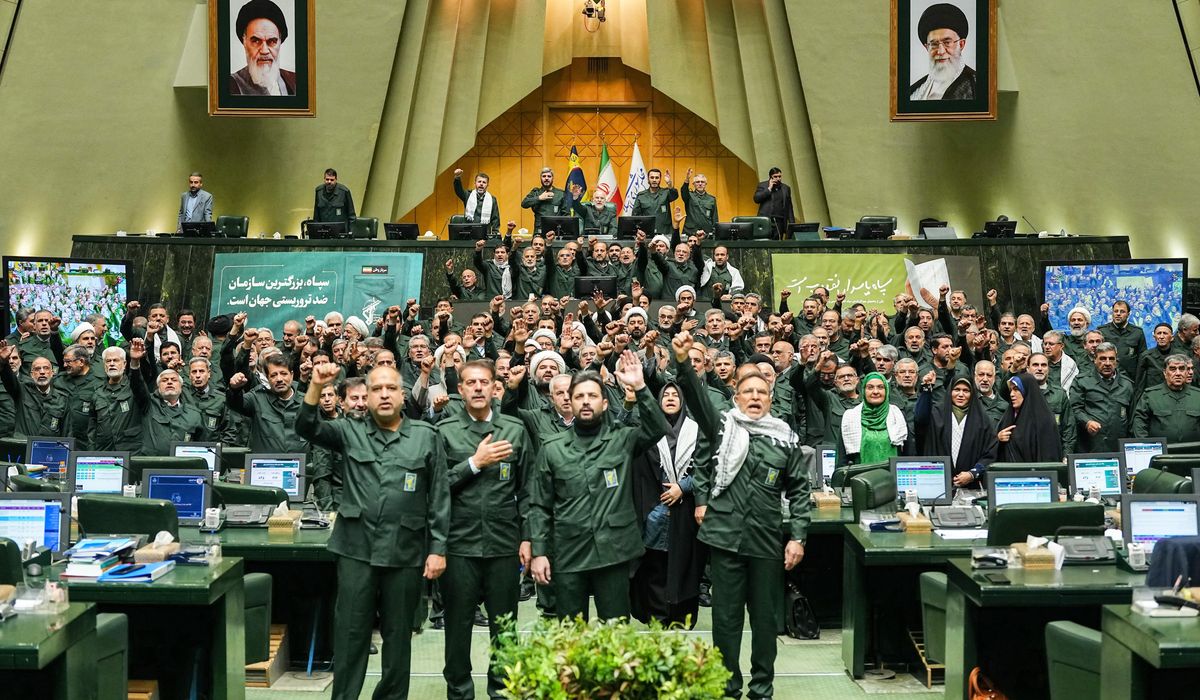
Iran’s supreme leader warned Sunday that the U.S. would risk triggering a larger war in the Middle East if President Trump were to order an attack against Tehran over the regime’s crackdown on nationwide protests.
Ayatollah Ali Khamenei told a crowd in Tehran that they shouldn’t fear the Trump administration’s deployment of the USS Abraham Lincoln aircraft carrier strike group to the Persian Gulf.
“We are not the initiators, and we do not seek to attack any country, but will deliver a firm punch to anyone who attacks or harasses it,” Ayatollah Khamenei said, according to the Iran-owned Islamic Republic News Agency.
“Iran possesses many valuable assets, including its oil, gas, rich mines, and strategic location. Such wealth and importance attract the greedy eyes of covetous powers, who have long sought to dominate the country,” the ayatollah said.
The comments from the 86-year-old cleric mark the most dramatic threat in response to the Lincoln strike group’s arrival in the Arabian Sea. The carrier is traveling with an escort of warships, including the guided missile destroyers USS Frank E. Petersen Jr., USS Spruance and USS Michael Murphy.
Ayatollah Khamenei made his comments on the eve of the 47th anniversary of the return of Ayatollah Ruhollah Khomeini to Iran in 1979, sealing the founding of the current Islamic Republic. Khomeini returned from 15 years of exile after the collapse of the government headed by the shah of Iran.
Reza Pahlavi, the eldest son of the late exiled shah, has emerged as the most prominent figure in the Iranian opposition and has positioned himself as the primary “facilitator” for a transition from Iran’s theocratic regime.
Mr. Pahlavi’s role has expanded rapidly in recent weeks, with numerous protesters calling for his return since the demonstrations began in late December 2025.
Ayatollah Khamenei said the U.S. controlled Iran’s resources for decades before the Islamic Revolution of 1979.
“Their influence has now been cut off, yet they aim to return to the Pahlavi-era status,” he said, according to IRNA. “But the Iranian people stand firm, blocking them. That is the real conflict. Claims about human rights and other pretexts are nothing but empty words.”
Iran is reportedly scheduled to conduct a two-day, live-fire exercise this week in the Strait of Hormuz, a narrow strategic waterway that serves as the only sea passage from the oil-rich Persian Gulf to the open ocean. On any given day, about 100 of the world’s merchant vessels transit the trade corridor, U.S. officials said.
Last week, U.S. Central Command warned Iran’s Islamic Revolutionary Guard Corps to conduct the exercise safely and professionally to avoid any unnecessary risk to freedom of navigation for international maritime traffic.
“U.S. forces acknowledge Iran’s right to operate professionally in international airspace and waters,” Central Command said in a statement. “Any unsafe and unprofessional behavior near U.S. forces, regional partners, or commercial vessels increases risks of collision, escalation, and destabilization.”
Central Command officials said they wouldn’t tolerate IRGC actions targeting U.S. warships in the region when intentions are unclear, including low-altitude or armed overflight or high-speed boat approaches on a collision course.
“The U.S. military has the most highly-trained and lethal forces in the world and will continue to operate with the highest levels of professionalism and adhere to international norms,” Central Command said. “Iran’s IRGC must do the same.”
Reuters reported Sunday that an unidentified Iranian official said the IRGC would not conduct naval exercises in the Strait of Hormuz.