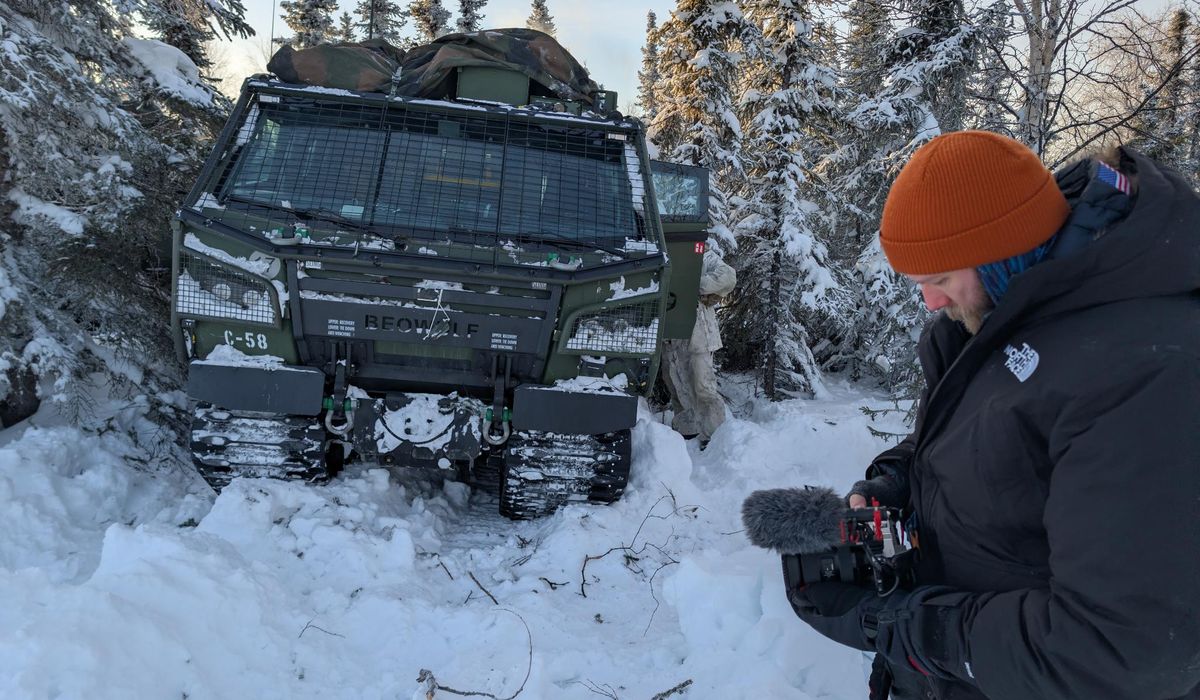
Arctic Notebook, Feb. 23: Washington Times Defense and National Security Correspondent John T. Seward is on assignment in frigid northern Alaska, covering the U.S. Army’s “premier Arctic training exercise.” As tensions rise in the frozen north, Mr. Seward’s reporter’s notebook dispatches go inside his experience observing the American military’s preparation for combat in the sub-zero temperatures.
FORT WAINWRIGHT — The last day I had in Fairbanks, conditions started to get worse. It warmed up to a balmy 11 degrees and the forecast threatened to approach the freezing point, or in this case, the melting point.
Soldiers and leaders that I had spent time with warned that this was yet another risk. It was better, they said, if it stayed cold rather than having 50-degree temperature swings. The dry snow compresses and is almost more maneuverable as it packs down, but at warmer temperatures, the snow gets slushy under foot and vehicle traffic.
After breakfast swapping adventure stories with an old college classmate, I make my way back onto Fort Wainwright to meet with the Canadian division commander. Driving to that final interview of the trip, there isn’t a single stoplight that my wheels don’t spin and slip in the slush.
The Canadian commander’s unit was critical to the U.S. Army’s plan in the training scenario and they pulled it off. But, not without cost. He tells me that at one point a company was down to 50% crewed because of cold weather injuries — things like hypothermia, chilblain, frostbite, and rhabdomyolysis from trudging uphill through waist-deep, unconsolidated powder snow.
Then it got slushy… at 11 degrees.
The entire time I’ve been here, there have been at least three soldiers a day pulled out of the field for cold-weather injury. I’m told that it was at least as many, usually more, over the entire exercise.
It’s the hard reality of military operations in this environment. The units here acknowledge that with their “Rules of the North.”
1. No one is coming to help you. Prepare as if no one is coming.
2. Everything takes longer in the Arctic.
3. It is never summer. Winter is always coming.
4. Everything breaks at -40 degrees.
The training is over, but every leader I’ve spoken to at this point, while extremely proud of their troops, also acknowledges the toll that it’s taken on them. Wet and weathered, their long faces eager to be warm and dry, soldiers started the process of returning their vehicles to base and caring for the gear they’ve put through the toughest paces over the past month.
Temperatures have varied in my short time here from -40 degrees up to 20 degrees. The changes wreak havoc on equipment, muscles, skin and morale. But, the “Arctic Wolves” — 1st Brigade, 11th Airborne Division — couldn’t be prouder of their performance.
Now it’s my turn to deal with the most recent wild temperature swing.
Snow plows have been a near constant the entire time I’ve been in Alaska, but now they’re working overtime. I’ve regretted having a two-wheel drive small car rental the entire time I’ve been here, but no more than on my last day.
The snow is slushy enough that I struggle to get to the airport. I have to change my flights. Thankfully, the gear company that I rented my boots and parka from helped me not to get stuck yet again on their street. There’s a hotel near the airport where I can return my gear.
As I concentrate on controlling the fishtailing back end of my small car, I try to think through my travel arrangements. I’d be back in Washington, D.C. a whole 12 hours later than anticipated because of the slushy car ride. I’ve just barely missed the flight to Seattle, Washington, causing a cascade effect.
But, after I return the car and shed a few layers, I listen to the conversations around me. Alaskans are problem solvers. I overhear numerous conversations working through similar issues, but without much fanfare or emotion. It is normal for them to deal with the wild weather and changing conditions.
As I close for the night, it is a balmy 26 degrees in Washington, D.C., the warmest I’ve been in a while.
This is the final installment of a four-part Threat Status series, “Arctic Notebook.”
Click here to receive the daily Threat Status newsletter delivered directly to your inbox.