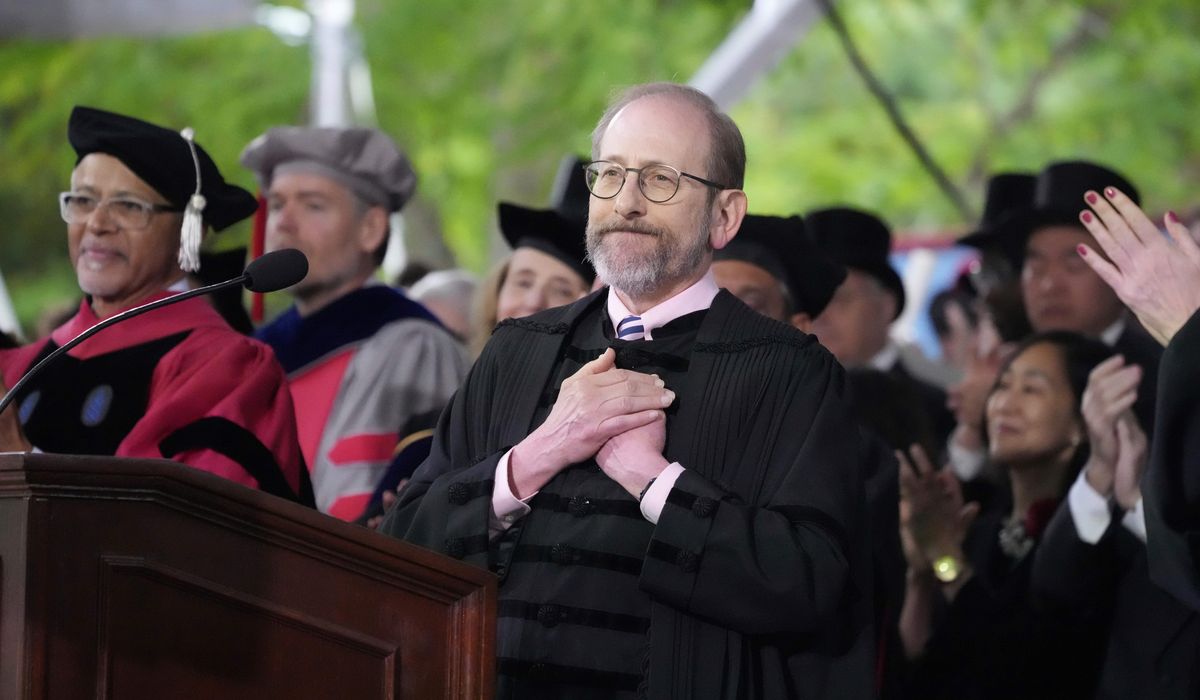
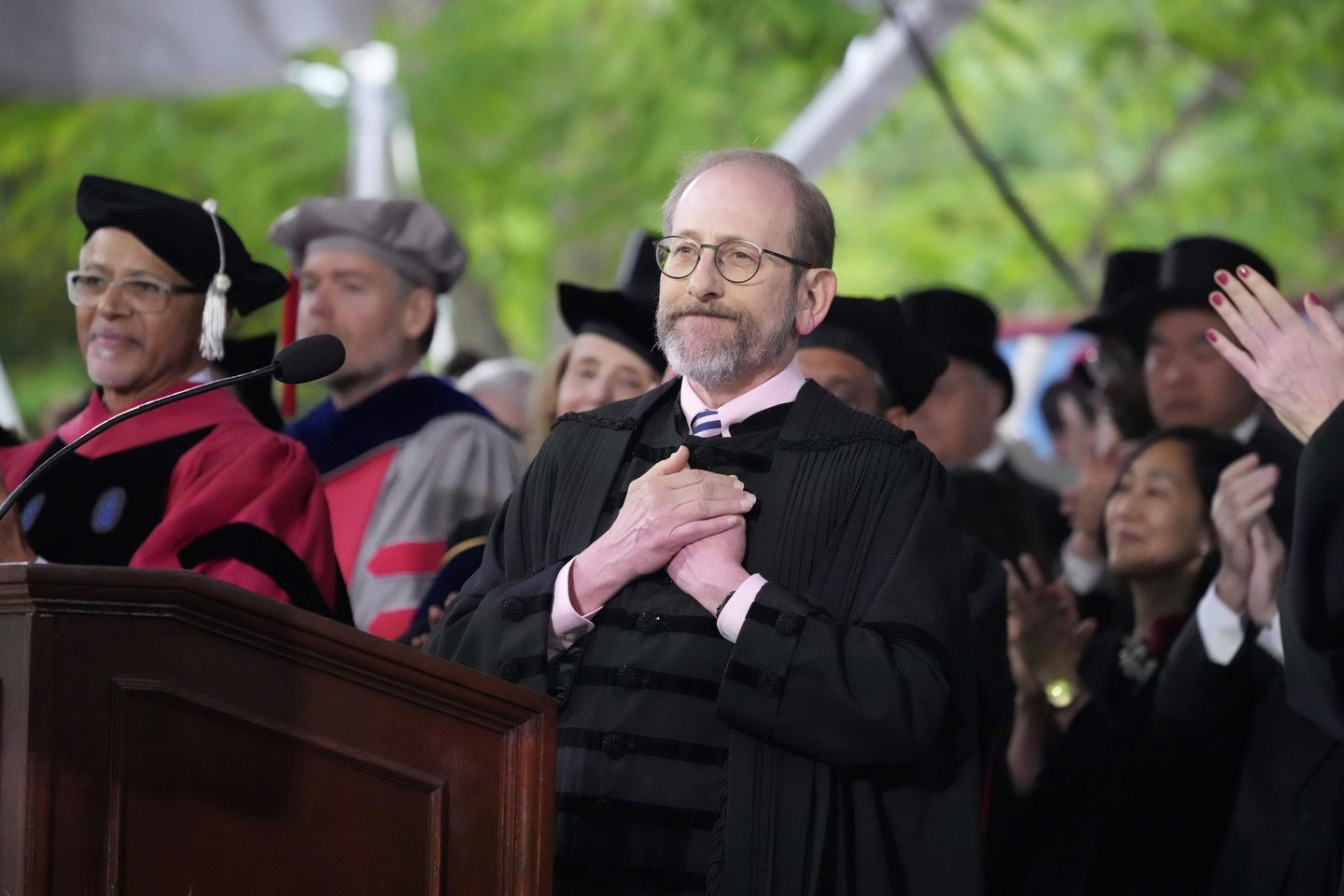
Harvard President Alan Garber may never be confused with Charlie Kirk, but it turns out the Ivy League leader has a problem with ideologically driven professors chilling open expression on campus.
Mr. Garber said academic institutions “went wrong” by allowing instructors to push their political agendas in the classroom, signaling his support for returning to the liberal tradition of professorial objectivity in teaching.
Back when he ran the Center for Health Policy at Stanford, he said, faculty were permitted to express political positions on their own time, “but in their teaching, they had to be completely objective.”
“That’s what has shifted, and that’s where I think we went wrong,” Mr. Garber said in an interview on the Shalom Hartman Institute’s “Identity/Crisis” podcast, which was recorded live at the Vilna Shul cultural center in Boston.
“Because think about it: If a professor in a classroom says, ‘This is what I believe about this issue,’ how many students – some of you probably would be prepared to deal with this, but most people wouldn’t – how many students would actually be willing to go toe-to-toe with a professor who expressed a firm view about a controversial issue?” Mr. Garber asked.
He added that “I’m pleased to say that I think there’s real movement to restore balance in teaching and to bring back the idea that you really need to be objective in the classroom.”
The interview was conducted Dec. 16, a day after the Harvard Corporation extended Mr. Garber’s contract for an “indefinite term” beyond the 2026-27 academic year, but not released until Dec. 30.
The Harvard Crimson called Mr. Garber’s comments the “most explicit public acknowledgement that faculty practices have contributed to a breakdown in open discourse on campus – and that he is committed to backtracking toward neutrality in the classroom.”
Such a commitment may not be popular with activist professors, but it shows Mr. Garber shares some of the same concerns as the Trump administration when it comes to Harvard’s notoriously intolerant campus culture, even if they disagree on how to address it.
Harvard sued last year after the administration cut more than $2 billion in federal funding, telling the prestigious school that getting the money back would require a series of policies aimed at combating antisemitism, including expanding viewpoint diversity in hiring and ending DEI programs.
The university won a federal court ruling in September, prompting the Justice Department to file a notice of appeal last month.
Since Mr. Garber took the helm as interim president in January 2024, Harvard has also enacted tougher protest policies; adopted the International Holocaust Remembrance Association definition of antisemitism; dismissed two faculty directors of the Center for Middle Eastern Studies; and renamed the Office for Equity, Diversity, Inclusion and Belonging, now the Office for Community and Campus Life.
“Even with Harvard publicly taking a stand against federal interference, many of these shifts appear to acquiesce to Trump’s demands,” said the Crimson in a Dec. 16 staff editorial.
That wasn’t a compliment.
Even so, the editorial applauded Mr. Garber, saying he has “passed with flying colors” and calling him “the right choice for turbulent times.”
Mr. Garber’s steps back toward the center weren’t enough to keep one prominent conservative professor in Cambridge.
James Hankins, a tenured history professor who taught at the university for 40 years, announced his resignation Dec. 29, citing a series of incidents that made him decide he no longer wanted to teach at Harvard after his latest four-year contract expired last month.
He cited Harvard’s “strict COVID regime” and its reaction to the 2020 Black Lives Matter protests and riots.
Mr. Hankins accused Harvard of turning down an outstanding applicant for the graduate history program in 2020 because he was White, even though he was “perfect for our program.”
The next year, the Harvard senior with the best overall undergraduate record – who was also a White male – was rejected from every graduate program to which he applied. Mr. Hankins called his friends at other universities to find out why.
“Everywhere it was the same story: Graduate admissions committees around the country had been following the same unspoken protocol as ours,” said Mr. Hankins in a Dec. 29 op-ed in Compact magazine. “The one exception I found to the general exclusion of white males had begun life as a female.”
He also suggested that Harvard has work to do. The university has not hired a tenured professor in the Western history field in a decade, he said, despite losing eight such historians during that time.
“I will be the ninth, and I am not expecting to be replaced,” Mr. Hankins said.
Mr. Hankins agreed that Harvard is “now on a better course under its current president, Alan Garber,” but that he has nonetheless decided to relocate.
He will teach at the Hamilton School of Classical and Civic Education at the University of Florida.
“The reason why is that the Hamilton School is committed to teaching the history of Western civilization,” Mr. Hankins said. “When late liberal pedagogy replaced Western civilization courses with global history, serious harm was done to the socialization of young Americans. When you don’t teach the young what civilization is, it turns out, people become uncivilized.”
The university was headed by former Sen. Ben Sasse, Nebraska Republican, until he stepped down in July 2024.
Mr. Sasse said in a Dec. 23 post on X that he has been diagnosed with terminal pancreatic cancer.
In his Shalom Hartman Institute interview, Mr. Garber said that “I have long been a believer in pretty much unfettered free speech,” but he has since realized that having policies permitting freedom of expression aren’t enough.
“What’s changed is that we need to enable our students to have the skills to exercise free speech effectively. That means being better able to express your ideas that might be offensive in ways that people can hear them,” he said. “And listen and respond and react in a constructive way. It also means having the skills to listen to ideas that may be very different from your own and that you might find offensive and to have a charitable view of what the speaker is trying to say.”