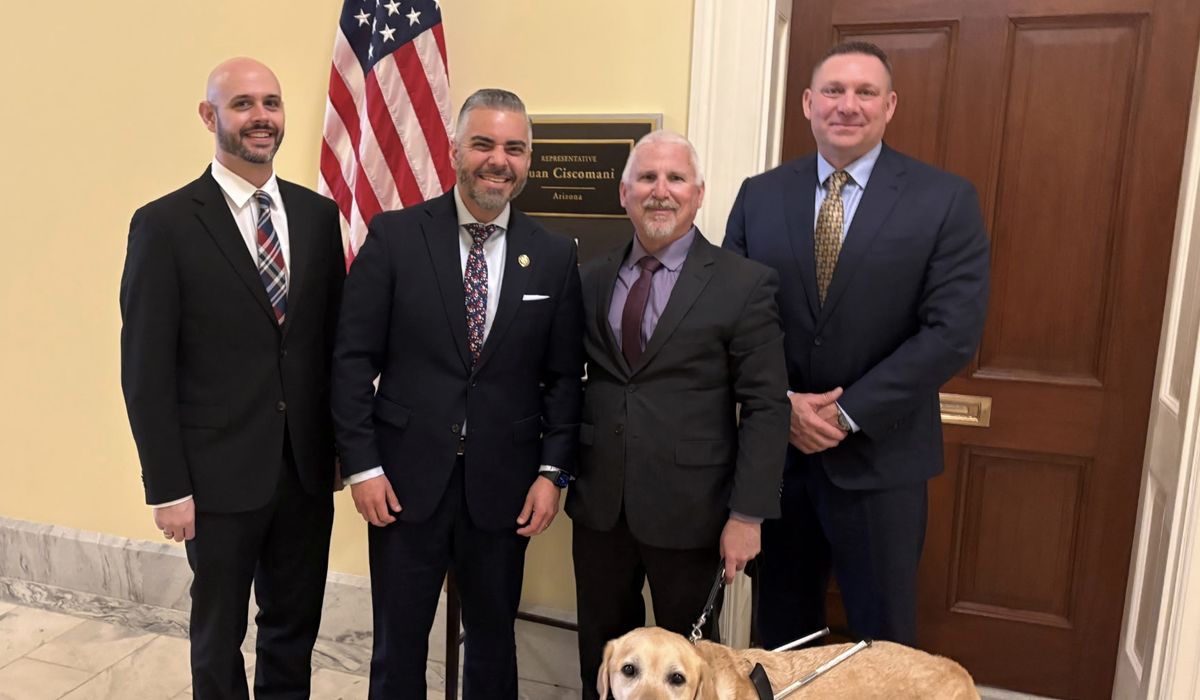
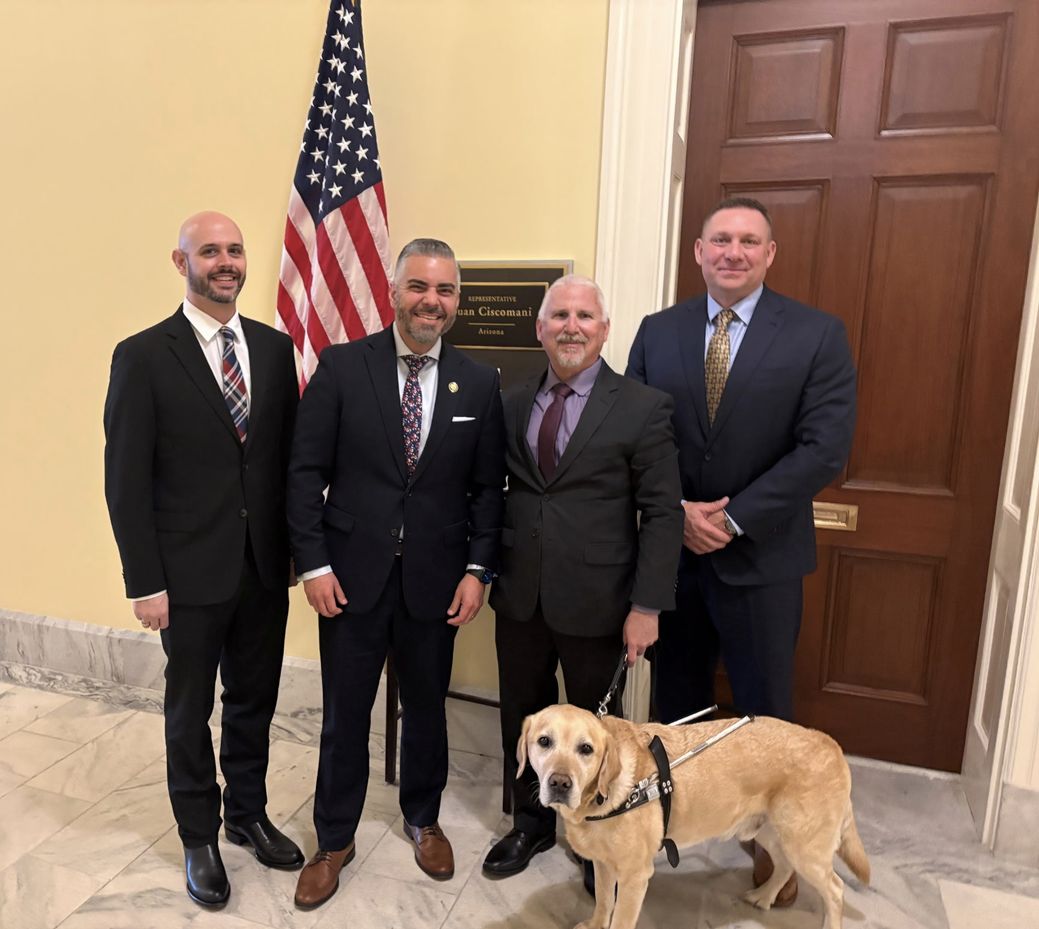
David Steinmetz slowly lost his vision after being diagnosed with retinitis pigmentosa when he was a teenager.
Going blind initially hampered Mr. Steinmetz’s career trajectory as employers viewed him as a “liability.” Then he found a job with Arizona Industries for the Blind (AIB), a nonprofit organization that provides fulfillment and other services for the Department of Defense.
Mr. Steinmetz has since worked his way up from the administrative position for which he was initially hired to a leadership role supervising the company’s document imaging and manufacturing operations.
Now, he’s lobbying Congress to expand use of the AbilityOne federal contracting program that works with nonprofits like AIB to provide job opportunities to Americans who are blind or have other severe disabilities.
“I had to earn that job and prove that I can do the job. And that’s where I see what this program does for individuals who have that will and desire to grow their career, to be self-sufficient,” Mr. Steinmetz said in an interview with The Washington Times. “We want to be autonomous, make our own decisions, and that’s what this program allowed me to do.”
Mr. Steinmetz was one of several advocates from the blind community who visited with lawmakers on Capitol Hill this week. They are asking for language in the next defense authorization bill directing the Pentagon to spend 1% of its procurement budget on contracts with AbilityOne nonprofits.
Current law does not have any set requirement. In fiscal 2025, the Defense Department spent 0.59% of its procurement budget on goods and services provided through the AbilityOne program.
“The 1% goal would in essence double the spend within our program, and would also significantly increase employment for people with disabilities across the nation,” said Cindy Watson, who has been involved with AbilityOne for two decades.
Ms. Watson is currently president and CEO of Vibrant Works, an AbilityOne nonprofit based in San Antonio that manufactures textiles and apparel for the military and provides retail services on bases.
“The cotton is grown in the U.S., the raw materials are sourced and they’re all made by Americans in the United States,” she said. “So it supports the initiative of the current administration.”
AIB, where Mr. Steinmetz works, stores, packs and ships more than $110 million worth of government materials, including insignia for military uniforms, to different branches of the armed forces.
“We always say that we’re like an Amazon, but we have a more talented workforce, a more committed workforce, and we outperform their workforce,” Mr. Steinmetz said.
The National Industries for the Blind, one of two organizations that help match people with disabilities to jobs with AbilityOne nonprofits, helped coordinate the lobbying blitz.
Advocates from across the country met with lawmakers and staff from their state delegations to make their case.
Mr. Steinmetz said Arizona Reps. Greg Stanton, a Democrat, and Juan Ciscomani, a Republican, are among the lawmakers championing the AbilityOne program and supporting the effort to increase its use.
Mr. Stanton introduced an amendment to the defense authorization bill last year to try to implement the 1% target but was unsuccessful in getting a vote on it.
“This year, they committed to working with us and getting an earlier start and pushing that through again,” Mr. Steinmetz said.
Mr. Stanton’s office did not return a request for comment.
While Mr. Steinmetz said all of his conversations with lawmakers and aides were positive, one Republican’s office did raise concern about backing what could be perceived as a DEI program.
Republicans have endeavored to eliminate programs in the Defense Department and across the government that they believe prioritize diversity, equity and inclusion metrics over skills and performance.
Mr. Steinmetz said he does not view AbilityOne that way.
“We hire talented people that nobody really else is hiring, and it’s their loss,” he said.
Danny Kelly, president and CEO of IFB Solutions, a North Carolina nonprofit that manufactures military garments and provides other services, said AbilityOne is nonpartisan.
He said the program provides a return on investment by employing people who may otherwise be receiving government unemployment or disability benefits.
“It’s a no-brainer to work to expand this program that helps pull people out of poverty, put them to work, create jobs and support our warfighters with all their mission-critical goods and services,” Mr. Kelly said.