
The Supreme Court on Wednesday rebuffed Republicans’ challenge to California’s new congressional map, delivering a significant boost to Democrats’ hopes of taking control of the U.S. House in November’s elections.
Both the federal Justice Department and state Republicans had asked the justices to put the map on hold, but the high court turned back the request in a brief order, without comment.
Democrats hope to net five seats from California’s new map, offsetting the potential five-seat loss they could face from Texas, where Republicans completed their own gerrymander last year. Indeed, it was Texas’ effort that spurred California to retaliate.
The Supreme Court had previously rejected a challenge by Democrats and liberal groups to the Texas map and, with Wednesday’s order, the justices have now delivered legal victories to both sides.
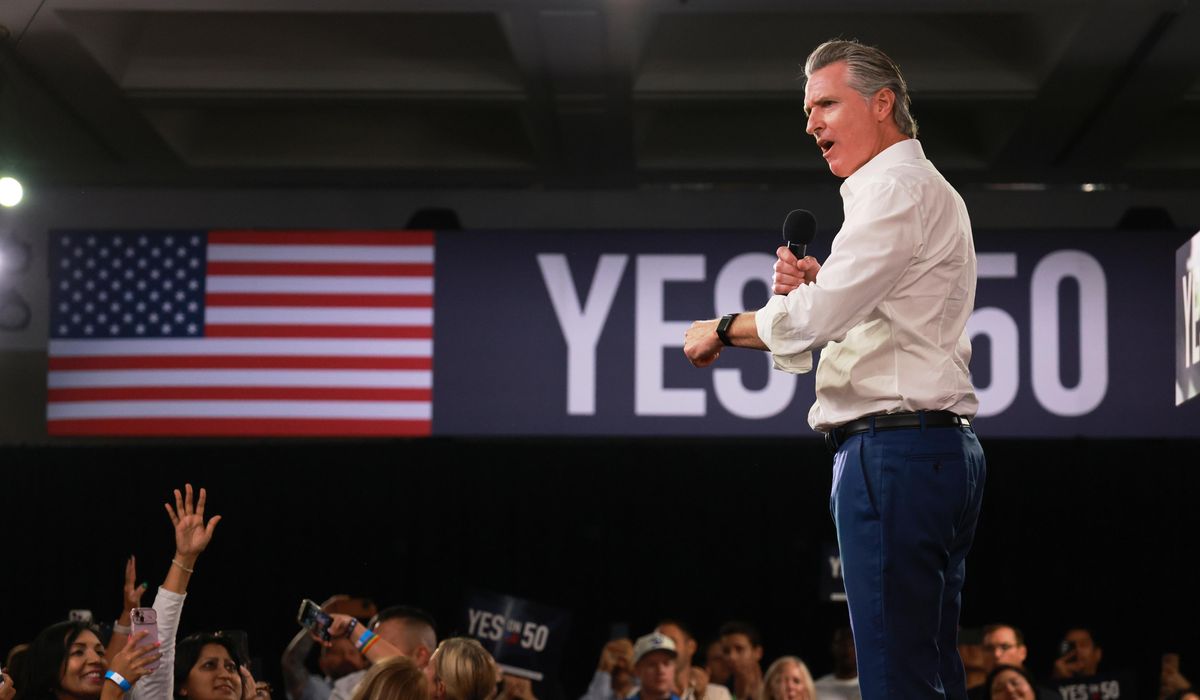
California Gov. Gavin Newsom, a Democrat with White House aspirations who led his state’s retaliatory effort, celebrated the ruling.
“Donald Trump said he was ‘entitled’ to five more congressional seats in Texas. He started this redistricting war. He lost, and he’ll lose again in November,” Mr. Newsom said in a statement.
If California’s map plays out the way experts predict, it would reduce the GOP to just four seats out of the state’s 52-member congressional delegation. That works out to just 8%, in a state where President Trump won 38% of the vote in 2024.
In Texas, experts believe the map could reduce Democrats to eight out of 38 seats, or 21%, in a state where then-Vice President Kamala Harris collected 42% of the vote.
Texas passed its map through its legislature, acting at the behest of Mr. Trump and the federal Justice Department, which said some of the state’s old majority-minority districts were no longer legally supported.
Mr. Newsom then led his legislature in passing a new map. Because it supplanted a map drawn by an independent commission, Mr. Newsom had to submit the Democratic gerrymander to voters, who approved it with 64% of the vote last November.
The Supreme Court has upheld the idea of political gerrymanders.
Republicans had argued in a lower court that California’s map went beyond political purposes and specifically carved out a new district for Hispanic voters. GOP lawyers said that was an illegal racial gerrymander.
A lower court rejected that in a 2-1 ruling.
“We find that the evidence presented reflects that Proposition 50 was exactly what it was billed as: a political gerrymander designed to flip five Republican-held seats to the Democrats,” wrote U.S. District Judge Josephine Staton, an Obama appointee to the court in central California.
Circuit Judge Kenneth K. Lee, a Trump appointee, dissented, saying the focus on the Hispanic seat went too far.
“To be sure, California’s main goal was to add more Democratic congressional seats. But that larger political gerrymandering plan does not allow California to smuggle in racially gerrymandered seats,” Judge Lee wrote.
Republican lawyers pressed that argument in briefs filed with the Supreme Court, as they asked for the new California map to be put on hold. That would have left the old map in place for this year’s election, even as legal arguments developed.
The high court wasn’t buying it.
Congressional district lines are usually only redrawn near the start of each decade, after the Census Bureau releases its numbers.
But there is nothing to prevent a mid-decade redrawing.
Texas’ move set off a chain reaction with California, and other states following.
North Carolina, Missouri and Ohio have since adopted new maps in favor of the GOP. A court ruling, meanwhile, has delivered a more Democrat-friendly map in Utah.
Virginia and Maryland are still pursuing Democratic gerrymanders.
And Florida Gov. Ron DeSantis, a Republican, last month announced a push to redraw his state’s lines.