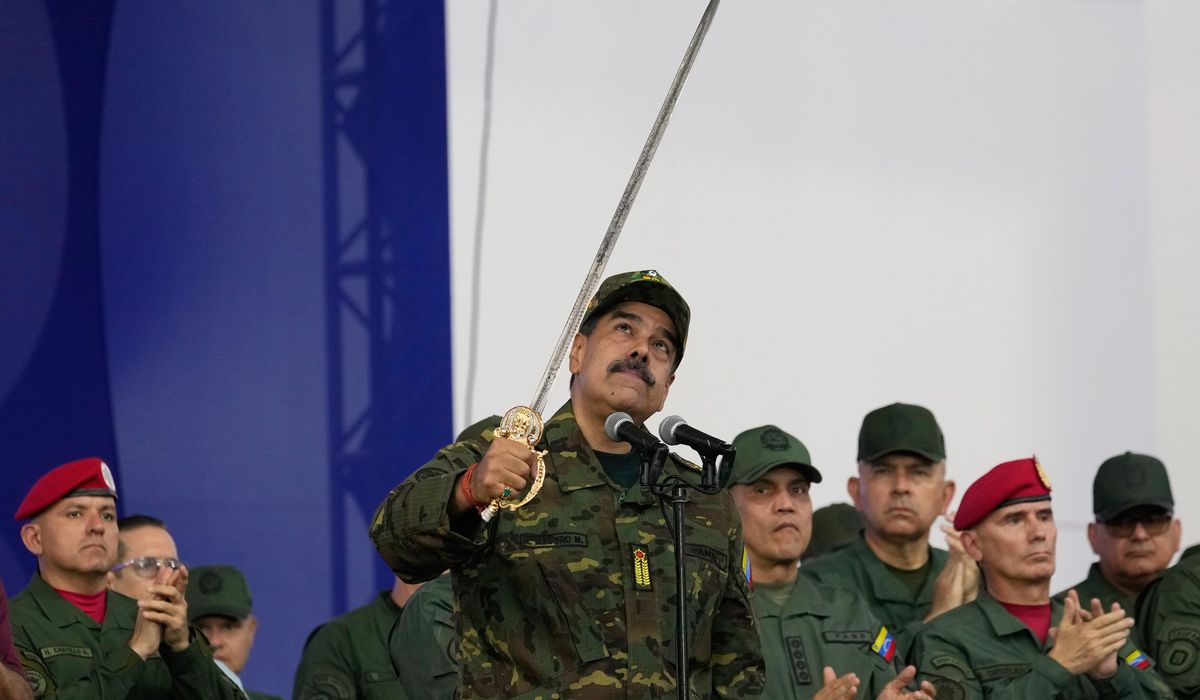
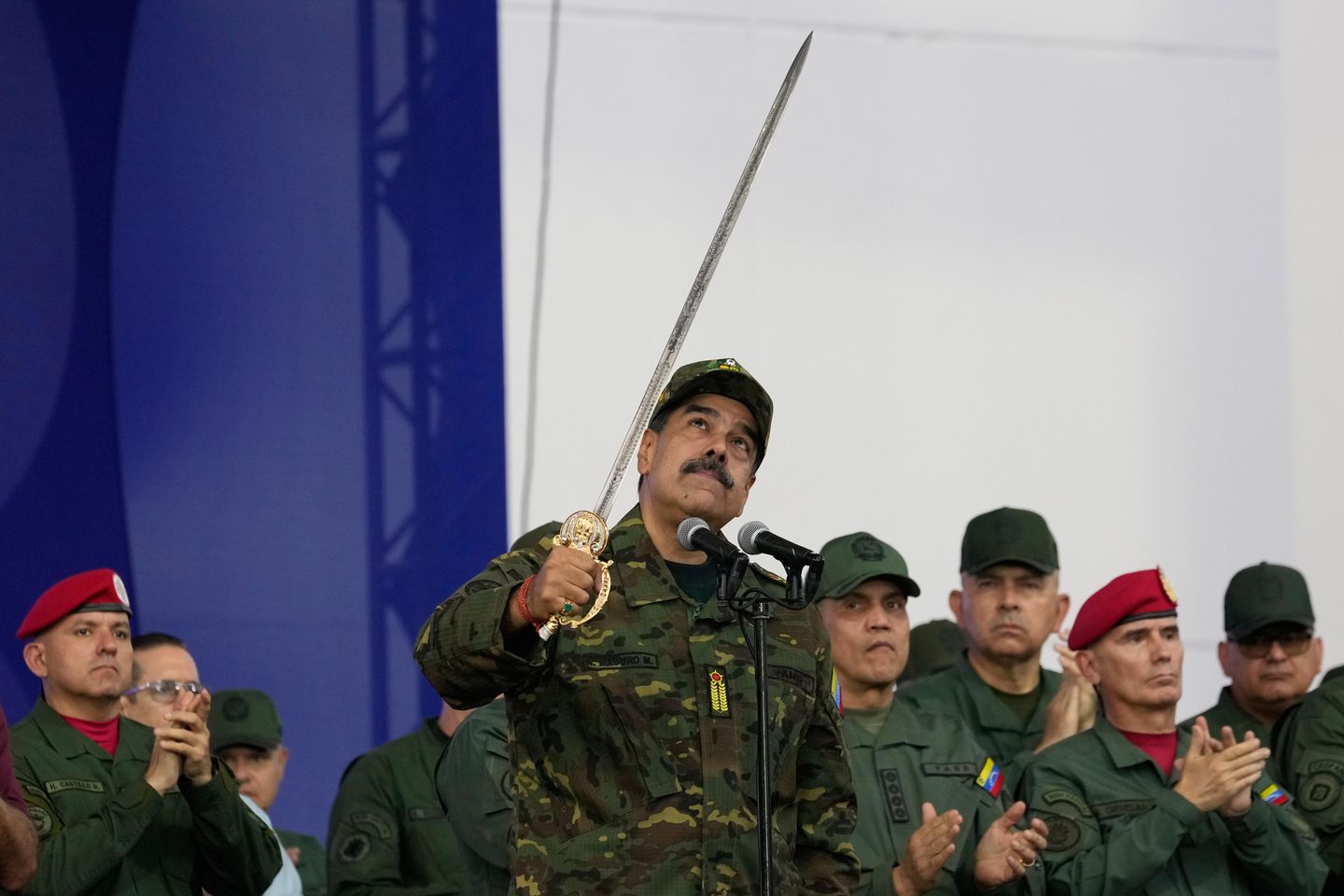
President Trump’s intense pressure campaign on Venezuela isn’t just about drugs, or oil and natural resources, or even a long-term plan to reinvigorate America’s dominance of its own hemisphere and strangle the growing regional influence of China and Russia.
Instead, analysts and foreign policy insiders say, Mr. Trump’s fixation on Venezuela reflects a unique combination of factors, from the geopolitical to the economic to the personal, that has led the White House to pursue a multi-pronged push to squeeze what many see as the illegitimate government of Venezuelan President Nicolas Maduro. That strategy could include direct U.S. military strikes on Venezuela itself, in addition to the continued targeting of boats allegedly transporting drugs or more seizures of Venezuelan tankers moving illicit oil.
Nearly a year into his term, Mr. Trump views Venezuela as one of the most important pieces on a high-stakes global chessboard. The administration seems to be operating on the theory that Venezuela, through a series of military and geopolitical moves and perhaps a bit of good luck, could be transformed from a hostile narco-state to a friendly democracy with major reserves of gold, minerals and heavy crude oil.
At the same time, specialists say, Mr. Trump wants to make good on a personal goal he failed to achieve in his first term: Overthrowing Mr. Maduro.
“There’s a sense of unfinished business,” said Christopher Sabatini, senior fellow for Latin America at Chatham House, a leading think tank based in London.
Mr. Sabatini said that key figures inside the administration, led by Secretary of State Marco Rubio, seem to have convinced Mr. Trump that the Maduro regime is as weak as it’s ever been. And they are pushing the idea that things have changed since Mr. Trump’s first term, when a failed attempt to formally recognize Venezuelan opposition figure Juan Guaido as the country’s rightful leader became something of a foreign policy embarrassment for the president.
SEE ALSO: Pete Hegseth declines to release full video of widely debated Sept. 2 strikes on drug boat
Mr. Maduro has hung on to power despite virtually all credible international observers believing that he lost last year’s presidential election to former Venezuelan diplomat Edmundo González. That controversial election, some administration officials seem to believe, has resulted in the Maduro government being in an especially weak position and highly vulnerable to U.S. pressure.
That reality, along with Mr. Trump’s deep desire to crack down on both illegal immigration and the flow of drugs from Latin America into the U.S., has thrust Venezuela into the center of the administration’s foreign policy.
“They converge on this policy that originally went from justifying this as an anti-narcotics strategy … to clearly an anti-Maduro strategy, to seizing the oil tanker and probably more to come, and the threat of U.S. military action,” Mr. Sabatini said in an interview.
But there’s a potential downside for the president, he added.
“Trump is now really backed into a corner,” Mr. Sabatini said. “He could have, if he had stuck to the narcotics narrative, proclaimed that we took out a whole bunch of boats … and mission accomplished. But now he’s leaned in on the whole ’Maduro has to go’ thing. And that’s problematic. Because if he doesn’t deliver regime change, it will make him look weak. It really has come down to Trump versus Maduro.”
That conclusion was underscored Tuesday by Sen. Lindsey Graham, one of the Senate’s most hawkish members.
After a debriefing on Venezuela by Secretary of State Marco Rubio and Defense Secretary Pete Hegseth, the South Carolina Republican warned that leaving Mr. Maduro in power would be a “fatal mistake to our standing in the world.”
“That’s the worst possible signal you can send to Russia, China, Iran,” he told reporters.
Military endgame
The administration has shown no signs of backing down from its hardball approach. U.S. forces on Tuesday struck another alleged drug boat in the region, killing eight people. There have been at least 25 such strikes so far killing at least 95 alleged “narco-terrorists.”
Last week, U.S. forces seized the Venezuelan crude oil tanker Skipper, which the Justice Department said was being used as part of a covert oil shipping network supporting Hezbollah and Iran’s Islamic Revolutionary Guard Corps.
Mr. Trump has said that the military campaign could soon expand to land targets in Venezuela.
“We’re going to start doing those strikes on land too,” Mr. Trump said at a Dec. 2 meeting of his Cabinet officials. “The land is much easier, much easier and we know the routes they take. We know everything about them. We know where they live.”
But key lawmakers say the administration so far has failed to make a clear and compelling case for why further military engagement in Venezuela might be necessary.
“Yes, it would be great to get rid of Maduro. But in terms of the question, Donald Trump has not come to the American people and said, ’here are our goals in Venezuela,’” Sen. Mark Warner, Virginia Democrat and vice chairman of the Senate Intelligence Committee, told CBS’ “Face the Nation” program on Sunday.
“We’ve got troops potentially in harm’s way,” Mr. Warner said. “I think the president needs to make the case if he’s going to try to put boots on the ground in Venezuela.”
Behind closed doors, part of that case could center on breaking Venezuela’s deepening ties with Russia, its leading arms supplier, and China, which has invested billions of dollars in Venezuela and has its eye on Venezuela’s vast deposits of resources.
A gold mine of resources
Toppling the Maduro regime would in theory make it easier to stop the flow of drugs from Venezuela to the U.S.
But there could be another factor at play.
María Corina Machado, the Venezuelan opposition leader recently awarded the Nobel Peace Prize, seemed to suggest that a new government in Caracas could give the U.S. greater access to the country’s gold and minerals.
“How do we restructure our debt? How do we open markets for international investment and give security to international investment in oil, in gas, in infrastructure, critical minerals?” she said in an interview Sunday on CBS’ “Face the Nation” program. “I mean, Venezuela is unique in terms of the amount of the natural endowments we have. And you know, we’re located three hours by plane from Florida.”
Mr. Maduro has said he believes exploiting those resources is the true overarching goal of the American pressure campaign against his country — a claim many analysts reject.
Still, the sheer amount of resources is notable. A 2021 report from the Organization for Economic Cooperation and Development estimated the total value of mined Venezuelan gold to be as much as $2.2 billion each year.
Mr. Maduro has publicly said the total value of his country’s mineral reserves is $1.36 trillion, including some of the rare earth elements needed to power cellphones, fighter jets and other key pieces of 21st-century technology. China dominates the global market of rare earth element processing.
The figures cited by Mr. Maduro are virtually impossible to independently confirm.
But it’s indisputable that Venezuela has the world’s largest oil reserves, estimated at more than 300 billion barrels, or as much as 17% of the total global supply. That oil, however, is heavy crude and requires more refining than oil found in other regions.
Former Venezuelan strongman Hugo Chavez accelerated the country’s nationalization of its oil industry, exerting direct government control over the resource.
Venezuela’s overall oil production has fallen dramatically in recent decades, from about 3.2 million barrels per day in 2000 to just 735,000 barrels per day in September 2023, according to the U.S. Energy Information Administration.
The U.S. seizure of the tanker Skipper, which authorities said was violating international sanctions on Iranian oil and transporting Iranian and Venezuelan oil to Cuba, could cut into Venezuela’s oil profits even further. And it also could have much broader geopolitical reverberations.
Specialists say that if such seizures were to continue, it could directly impact Beijing.
“Introducing tanker seizures as a tool in Washington’s toolkit will certainly raise eyebrows in China, whose imports of oil from sanctioned suppliers, Russia, Iran, and Venezuela, constitute more than a quarter of its import supply chain,” Clayton Seigle, a senior fellow in the Energy Security and Climate Change Program at the Center for Strategic and International Studies, wrote in a recent analysis. “Beijing will see growing tanker seizure risk in the context of its strategic imperative to cushion its considerable oil import dependency” and look for other suppliers, he wrote.