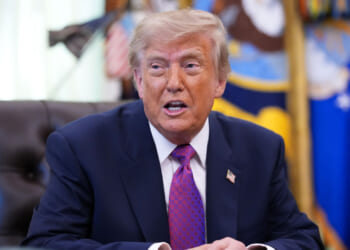
President Trump may be the drug boat destroyer, but he has a long way to go before he tops the drone warrior.
While Mr. Trump’s campaign against drug couriers is garnering headlines, it’s also sparking comparisons to President Barack Obama, who led a years-long mission to kill people he identified as terrorist targets — including an American citizen overseas — through drone strikes.
Mr. Obama’s death toll, figured to be in the high hundreds or even low thousands, is well above the 83 presumed kills recorded by Mr. Trump’s drug-boat strikes, though the current president is quickly adding to his numbers.
Mr. Trump has been untroubled by the deaths, saying he’s certain those he’s killing deserved it.
“We know everything about them,” he said.
Mr. Obama, too, privately celebrated his death toll.
“Turns out I’m really good at killing people. Didn’t know that was gonna be a strong suit of mine,” Mr. Obama told senior aides in 2011, according to the book “Double Down” by Mark Halperin and John Heilemann.
The comparison has put a spotlight on members of Congress who either defended or were largely silent about Mr. Obama’s strikes in the Middle East, while harshly critical of Mr. Trump’s action in the Caribbean and Pacific.
Congressional Democrats say they see differences — chiefly that Mr. Obama was acting as part of the global war on terror, authorized by Congress in the resolution that gave permission to root out al Qaeda in the wake of the 2001 terrorist attack.
“They were all tied into the 9/11 war authorization, where Congress voted to go after non-state terrorist organizations. So the drone strike on a boat — it’s a similar use of a kinetic activity, but it’s not congressionally authorized. And I just feel like anything like this that’s not congressionally authorized is legally suspect,” Sen. Tim Kaine, Virginia Democrat, told The Washington Times.
Both men are part of a long line of presidents who have led military action and kept Congress at arm’s length. In addition to the drone strikes, Mr. Obama sent U.S. forces to conduct air strikes on Libya and placed troops on the ground amid Syria’s civil war.
“Those who appear ‘troubled’ by videos of military strikes on designated terrorists have clearly never seen the Obama-ordered strikes, or, for that matter, those of any other administration over recent decades,” said Rep. Rick Crawford, Arkansas Republican and chairman of the House intelligence committee.
“I call upon them to remember their own silence as our forces conducted identical strikes for years — killing terrorists and destroying military objectives the same as in this strike — and ask themselves why they would seek to attack our forces today,” Mr. Crawford said.
Charlie Dunlap, a law professor at Duke and former deputy judge advocate general of the United States Air Force, pointed all the way back to Thomas Jefferson, who sent warships to attack the Barbary pirates without getting Congress’s approval first.
Jefferson later sought it retrospectively.
Mr. Dunlap said there’s not enough information known yet about Mr. Trump’s drug-boat strikes.
“We do not have sufficient public information to definitively conclude, one way or another, on the legality of the boat strikes,” he wrote on social media.
Other legal scholars say both Mr. Obama’s and Mr. Trump’s actions are questionable.
“Our country has become much too ready to conduct operations without the clearest congressional authorization than it should be and when there was no direct and imminent danger to the homeland,” said Eugene Fidell, who teaches military justice at Yale Law School.
But he said any comparison with Mr. Obama shouldn’t be seen as a justification for Mr. Trump.
“The fact that prior administrations may have engaged in questionable uses of force is water over the dam and should not distract the country from the continuing current operation.”
Mr. Trump’s campaign has lately come under scrutiny after reports — now confirmed — that the U.S. conducted a “double-tap” on the boat attacked on Sept. 2, killing two crew who survived the initial American missile strike.
The White House said Adm. Frank M. “Mitch” Bradley, the head of U.S. Special Operations Command, issued the order for that second strike, and said he was correct to carry out the follow-on attack.
“[Defense] Secretary [Pete] Hegseth authorized Adm. Bradley to conduct these kinetic strikes,” press secretary Karoline Leavitt said. “Adm. Bradley worked well within his authority and the law, directing the engagement to ensure the boat was destroyed and the threat to the United States of America was eliminated.”
Sen. Mark Warner, Virginia Democrat, told The Times that the administration is just passing the blame on to Mr. Bradley.
“The administration seems to be throwing him under the bus, and I think that’s pretty despicable,” Mr. Warner said.
Mr. Obama had his own crisis moment after a drone strike in 2011 assassinated Anwar al-Awlaki, an American-Yemeni cleric the Obama administration said was a legitimate target because of his ongoing association with al Qaeda, which the U.S. was authorized to strike.
Lawsuits, including one from the ACLU, challenging the administration’s authority to kill U.S. citizens without due process, were all dismissed by the courts.
Sen. Mark Kelly, an Arizona Democrat who has been critical of the Trump strikes, told The Times he didn’t know who Awlaki was.
He was firm, however, in his belief that Mr. Trump crossed lines with the double-tap strike in September.
“When you have shipwrecked crew members, there is a duty to rescue them, and that if you restrike them and kill them, that is against the law,” said Mr. Kelly, a retired Navy captain.
Mr. Kaine defended the al-Awlaki kill by the Obama administration, saying it was “pursuant to a congressional authorized war against non-state terrorist groups.”
“He was an American citizen, but he had chosen to associate himself with terrorist groups against whom Congress had declared war,” he said.
Kyle Shideler, director and senior analyst for homeland security and counterterrorism for the Center for Security Policy, said from a tactical standpoint, there was not really that much of a difference between how the U.S. “would approach striking drug boats, versus how we would approach striking a caravan of known or suspected jihadist terrorists.”
He said the drone strikes were an alternative to capturing terrorism suspects, which he said was not attractive to an Obama administration that was rushing to empty the detention facility at Guantanamo Bay, Cuba.
“They had a policy where they did not want to take a terrorist prisoner because that would require sending them to Guantanamo, which they were trying to close,” Mr. Shideler said.
“So they went away from capture missions, which would have required them taking somebody prisoner, and then you could send them to Guantanamo, get interrogation and get intelligence from them. And in order to further their effort, they went almost wholly to ’We’re just going to do drone strikes.’”
He added, “Now [Democrats] are complaining that the U.S. military didn’t pick up some narco terrorists after a strike.”
Mr. Shideler noted that there is a “difference in the sense that there was an authorization for the use of military force to go after any entity associated with the 9/11 attacks,” but that the Trump administration has implied that “they believe this is an inherent part of their Article II powers of the president.”
Brenner Fissell, who teaches military and national security law at Villanova University, also said the 2001 authorization to use force against terrorists across the globe didn’t excuse all of the strikes.
“The only difference is Obama had some congressional authority to fight Al-Qaeda through the AUMF. But the drone strikes were illegal in a number of cases because they killed U.S. citizens, as in Al-Awlaki, without due process, or they killed an excessive number of civilians who should not have been targeted, or who should have been taken into account when making the targeting decision.”