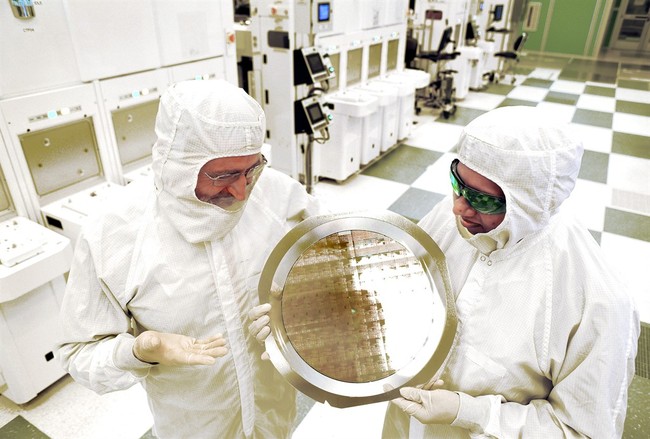
The world’s leading manufacturer of advanced chips is TSMC in Taiwan. Back in 2020, President Trump helped convince TSMC to make a major investment in building chips here in the US, specifically in Arizona.
Taiwan Semiconductor Manufacturing Company has agreed to build an advanced chip factory in the United States, in a response to the Trump administration’s growing concerns about the security of the global electronics supply chain and its competitive tensions with China.
The decision by T.S.M.C., which operates enormous plants in Taiwan to produce chips used in most smartphones and many other devices, was confirmed late Thursday after earlier press reports.
T.S.M.C. said the factory would be built in Arizona, with unspecified support from the state and federal government. T.S.M.C. estimated its own investment in the plant from 2021 to 2029 at $12 billion…
In fact, that $12 billion investment was just the start. TSMC is now planning to spend more than 10 times that building multiple fabrication plants or fabs at the site north of Phoenix. The first of those is already opening and operational. The second has just completed construction. This story is from April:
Taiwan Semiconductor Manufacturing Co. completed construction of its second fab at its north Phoenix campus ahead of schedule to meet AI-related chip demand from customers, the company’s top executive said on an April 17 earnings call.
TSMC CEO C.C. Wei said the company is “working on speeding up the volume production schedule” for its second fab, which will utilize 3-nanometer process technologies.
Things may be ahead of schedule but this week the NY Times reported that the complexity of building these factories has turned out to be far greater than the Taiwanese company expected. It’s a lengthy story but certain issues crop up repeatedly, an almost impenetrable thicket of regulations and complaints from unions.
The process that has turned a blank spot on the map into what some now call the Silicon Desert underscores a defining feature of American life: A tangle of bureaucracy often hinders ambitious visions, sowing confusion, uncertainty and delay. That tends to reinforce inertia and discourage development…
At home in Taiwan, TSMC is used to moving aggressively, gaining whatever resources, personnel and government approvals are required to propel its astonishing expansion. Yet in Phoenix, TSMC and its suppliers have wrestled with the intricacies of a different system.
They have been tripped up by a confusing process to gain permits. They have struggled to find workers with needed skills. They have contended with higher costs of doing business, succeeding through force of will and vast sums of money.
In Taiwant, where TSMC is by far the most powerful company, things are different.
In Taiwan, TSMC and its suppliers build facilities in dedicated industrial zones that generally require one permit from a central authority. In Arizona, they must negotiate municipal, county, state and federal regulations, requiring thousands of approvals.
“Every step requires a permit, and after the permit is approved, it takes at least twice as long as in Taiwan,” TSMC’s chief executive and chairman, C.C. Wei, said this year at National Taiwan University.
The company was required to gain permits from city and county authorities to comply with state and federal regulations. In many instances, regulations for its industry did not exist at the local level, so TSMC had to convene a team of experts to craft its own language and gain approvals.
“We ended up establishing 18,000 rules, which cost us $35 million,” Mr. Wei said…
Imagine having to pay $35 million to write your own regulations.
In Taiwan, economic growth is dominated by chip making, so the government is “focused on making everything streamlined,” said Chris Miller, an economic historian at Tufts University and author of the best-selling book “Chip War.” “It wouldn’t be rational for us to change everything to suit the chip industry.”
Would it be irrational to streamline the process to build chip fabs here in the US? Given how important these chips are to everything else at this point, technology, manufacturing, AI, cars, etc. it seems to me we would want to make this process as streamlined as possible. This isn’t just another product it’s the product that makes all the other products of modern life possible. And as we discovered during the pandemic, a slow down in this one product creates problems for the entire economy.
And then there’s the US tendency to sue and claim everything is an environmental issue.
Ms. Bartelheim, 65, lives on a reddish-brown landscape dotted by cactuses and wildflowers. She bought her home a decade ago. “It was about the peace, the serenity, the solitude,” she said. “There’s a magical feeling here.”
Last year, she learned that Amkor Technology was planning to construct a so-called advanced semiconductor packaging plant nearby. It would assemble chips made by TSMC. She and other residents were horrified. They envisioned tractor-trailers bearing toxic chemicals and a massive draw on scarce local water. They mobilized in opposition.
They won. Amkor moved to another site.
The whole story is worth a read. On the one hand, this really is a triumph for President Trump and could make a huge difference if China decides to invade Taiwan. On the other hand, all of the problems and delays along the way are going to ensure these chips that eventually get produced cost more than the ones coming from Taiwan. It just seems like a perfect place for some sort of DOGE effort to bring permitting under control.
Editor’s Note: Do you enjoy Hot Air’s conservative reporting that takes on the radical left and woke media? Support our work so that we can continue to bring you the truth.
Join Hot Air VIP and use the promo code FIGHT to get 60% off your VIP membership!