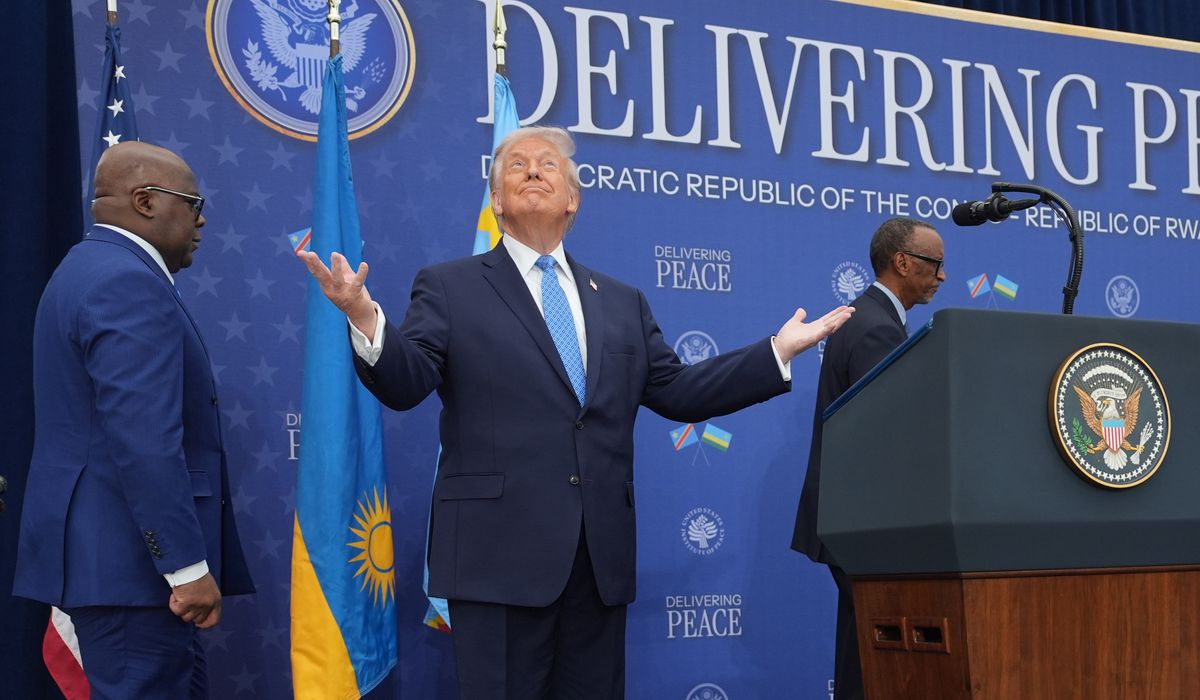
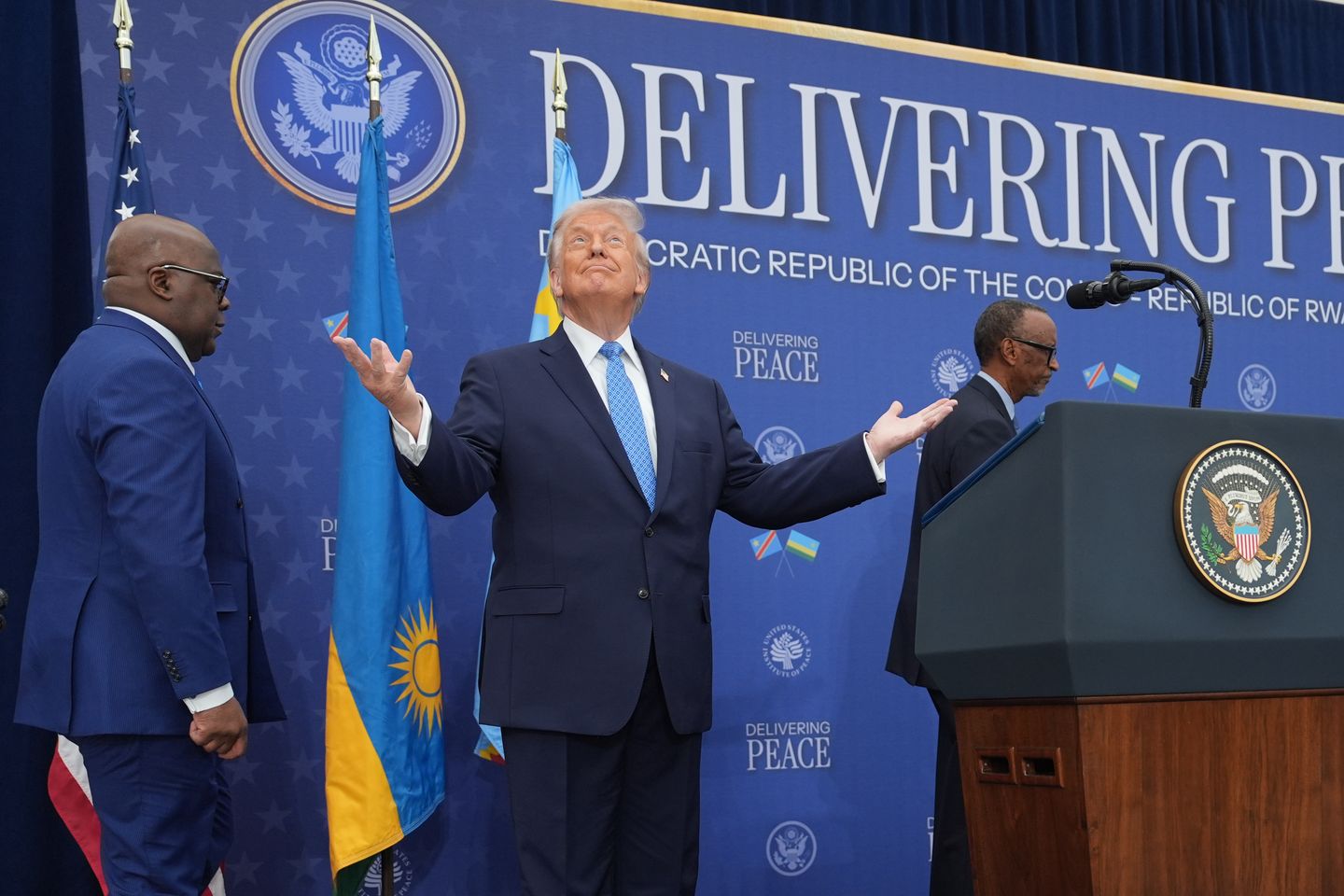
President Trump joined the leaders of Rwanda and the Democratic Republic of Congo in Washington Thursday to sign a peace treaty they say will end a 30-year war, even as fighting continues in the region.
The three leaders met at the White House and then convened at the U.S. Institute of Peace, which was renamed for Mr. Trump a day earlier by the State Department.
The agreement, known as the Washington Accords, was months in the making. The three men signed a preliminary peace deal at the White House in June, though talks as well as violence continued over the past few months.
Mr. Trump said the peace deal formalizes the terms of the June deal. It includes a permanent ceasefire, the disarmament of non-state forces, provisions for refugees to return to their homes, justice and accountability for those who have committed “illegal atrocities” and a new framework for economic prosperity.
“I have a lot of confidence in both leaders,” Mr. Trump said. “We’ll keep these commitments. I know they’re going to keep them and follow through on the agreement and create a much brighter future for the people of their countries, and they’re heroes within their countries.”
As part of the peace agreement, the U.S. signed its own mineral deals with both the DRC and Rwanda that Mr. Trump said will “unlock new opportunities for the United States to access critical minerals and provide economic benefits for everybody.”
Eastern Congo is rich in gold, tin, tungsten and tantalum, which is used in electronic devices. The DRC is also the world’s biggest cobalt producer and the second-largest source of copper.
The president said the U.S. will also be sending some of its “biggest and greatest companies” to both countries to extract some of the rare earth minerals.
“Everybody is going to make a lot of money,” Mr. Trump said.
Rwandan President Paul Kagame praised Mr. Trump as an “even-handed” leader who is “never taking sides.” He hailed Mr. Trump for “immediately” taking an opportunity to bring peace to a region that “is far from the headlines.”
“As a result, we have the clearest and most viable path forward that we have ever had,” Mr. Kagame said.
DRC President Felix Tshisekedi expressed “deep gratitude and clear hope” that peace will reign in the region and vowed to uphold his side of the deal.
Despite the feel-good nature of Thursday’s event, clashes between the Rwanda-backed M23 rebels and the DRC army were reported in several areas of the South Kivu province. The rebels say the DRC troops have bombed several civilian areas.
M23 has fought the DRC government in North Kivu province for over a decade. The group, which has roots in the 1994 Rwandan genocide, is among the more than 100 groups in eastern DRC that were targeted by the Hutu in Rwanda.
M23 resurged in 2021 with the alleged support of Rwanda, a claim the country has denied. Instead, Rwanda insists it has acted in self-defense against the DR’s military and ethnic fighters in the region.
Thousands of people, many of them civilians, have been killed in the violence, which surged at the beginning of this year as M23 seized two of the DRC’s largest cities.
Fighting has continued sporadically during the peace talk process. At least 319 civilians were killed in the DRC by M23 fighters aided by the Rwanda Defense Force in July, shortly after the initial White House deal, according to the United Nations.