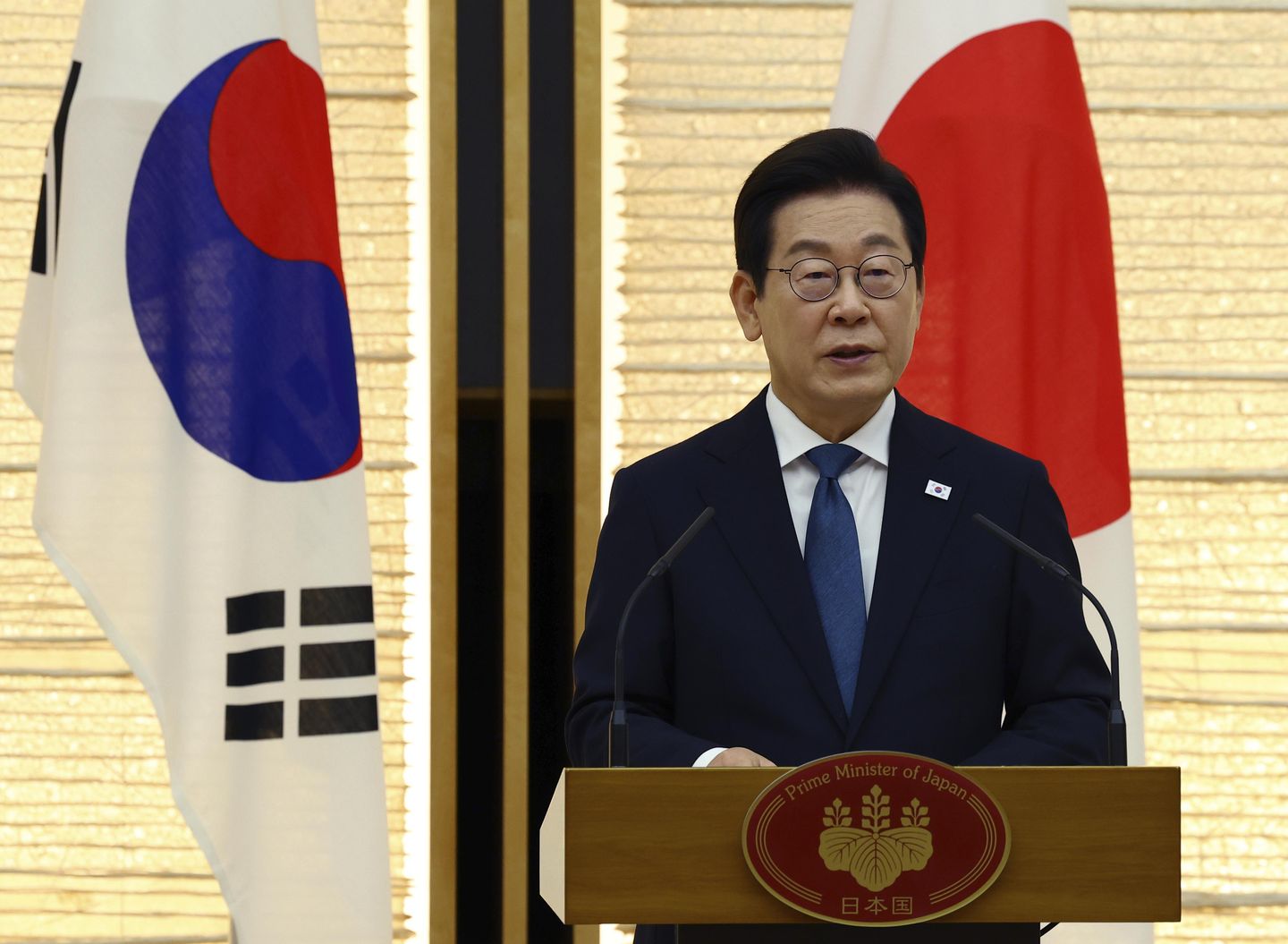
SEOUL, South Korea — The nuclear genie keeps trying to wriggle its way out of a tight South Korea bottle, with President Lee Jae-myung addressing radioactive rumors about Seoul going critical Tuesday.
“It would be great to go nuclear. And hard. The problem is, is that realistically possible?” he asked his Cabinet Tuesday in a televised meeting that was picked up by regional media.
Though U.S. President Trump has given a green light for the use of U.S.-developed nuclear reactors to power South Korea’s submarine fleet, Mr. Lee said that acquiring nuclear weapons — while desirable, given the threats the Asian democracy faces — was “impossible.”
His predecessor, Yoon Suk Yeol, had been the first president to publicly broach the matter in 2023, saying that if North Korea continued expanding its atomic arsenal, Seoul would consider the acquisition of nuclear arms.
Since then, the topic has been a frothy constant in sub-governmental discussions. Pundits, media and polling companies have all weighed in.
Mr. Lee, who took office in June and has since tried to strike a more diplomatic tone with South Korea’s adversaries like North Korea and China, put his foot down Tuesday.
“If we were to go nuclear, it would be impossible to gain the approval of the U.S. or the international community, and economic and international sanctions would immediately follow,” Mr. Lee said. “Would we be able to bear that?”
Buzz about a sovereign bomb has picked up since an October summit between Mr. Lee and Mr. Trump. A surprise outcome of their discussion was the U.S. president’s granting of South Korean requests for nuclear-powered submarine technologies.
Though Mr. Lee made clear that the submarines would be nuclear-propelled, not nuclear-armed, experts reckon that the anticipated deal will accelerate Seoul’s pathway from nuclear latency to nuclear breakout.
“Nuclear latency” refers to the training of human resources, amassing of nuclear technologies and enrichment of fissile materials in the civilian power-generation sector — a sector in which South Korea already boasts core strengths
“Breakout” is the ability to shift that asset portfolio to military use, while enabling the capability with delivery systems, command networks and usage protocols.
Mr. Lee hinted that due to “various kinds of talk” in U.S. government departments, the promised nuclear submarine development is being slow-marched in the U.S.
“The uranium enrichment and nuclear reprocessing issues are in some ways not proceeding smoothly and swiftly,” Mr. Lee said. “The reason for that is there are concerns about nuclear armament.”
Multiple public opinion polls in South Korea in recent years have suggested that about 70% of the public would support their country’s development of a nuclear arsenal.
But when pressed, even hard-line expert sources are downbeat about the likelihood.
“If it was possible, we’d have done it already! It’s all about choices,” said Yang Uk, a defense analyst with the Asan Institute, a Seoul think tank. “If we are ready to accept sanctions, we can go nuclear, but we are not ready.”
That refers to a widespread belief that if South Korea were to trigger the exit clause in the Nuclear Proliferation Treaty — to which Seoul is a signatory — it would face sanctions from trading partners, notably the U.S., China and Japan.
Not everyone agrees.
A source from the European Union told foreign reporters during the Yoon administration that if South Korea — widely seen as a responsible, democratic, middle power — exited the NPT, the EU would likely deliver verbal censures, but not actual sanctions.
China, Russia and the U.S. are established nuclear powers, while middle powers France and the U.K. were grandfathered into the so-called “nuclear club.” Since then, India and Pakistan have both broken out — without suffering major economic damage.
Export powerhouse South Korea, however, is vulnerable, due to its relationships with importers.
“India and Pakistan don’t have so much trade with the Western world, so they could go ahead with nuclear development,” said Mr. Yang. “But South Korea is heavily dependent on trade: If the economy goes south, would Korean people take the hardships? I don’t think so.”
North Korea, which defied the global community to detonate its first nuclear device in 2006, provides a grim example.
Conservative estimates are that the nuclear-armed state spends 26-27% of its national budget on defense. The heavily sanctioned nation is a black hole in the heart of economically powerful, technologically advanced and increasingly prosperous Northeast Asia.
Still, South Korea — trapped between a self-interested U.S. and a North Korea capable of striking the U.S mainland — is nervous about the reliability of the U.S. nuclear umbrella.
Those jitters take the shape of a rhetorical question posed by French President Charles DeGaulle and U.S. President John F. Kennedy, which the former used to justify the French nuclear deterrent: “Would you sacrifice New York for Paris?”
The question repeatedly posed next to the coffee stands of multiple Seoul strategy fora is: “Would America sacrifice L.A. or San Francisco for Seoul?”
That query should be bounced up to Pyongyang, reckons Daniel Pinkston, a Seoul-based U.S. international relations expert who teaches at Troy University.
Referencing Pyongyang’s limited nuclear capabilities vis-à-vis Washington’s, as well as the country’s minimal “strategic depth” — its small geographical size — he re-phrased the question for North Korean generals: “Would you trade San Francisco or Tokyo or Busan for everything you have?”
U.S. officials have repeatedly stated that North Korean nuclear use would result in the end of the North Korean state. And — contrary to tabloid reportage that paints North Koreans as crazy — Pyongyang’s risk calculators are ice-cold strategists.
“North Koreans are more rational than anyone: You don’t get to rise to the Central Military Commission unless you have prepared every single move in your life,” Mr. Pinkston said of the military elite. “They think all this through, they game it out.”
Even so, he raised another risk for any Seoul breakout attempt: That Pyongyang might preempt with conventional action.
“Would they sit and do nothing while the South Koreans break out?” he asked. “They could do what the Israelis did to Iraq and Syria and Iran.”