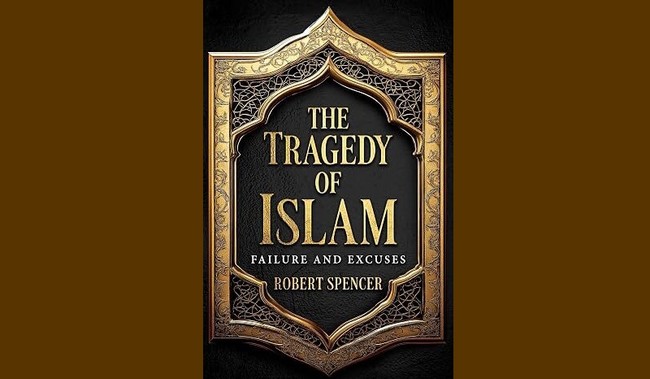
In the past week, we’ve seen the invasion of Ceuta. The images are horrifying, but they should be expected. Astute observers who have engaged Robert Spencer’s latest work, The Tragedy of Islam: Failure and Excuses, know why this was inevitable.
In his concluding chapter, Spencer cites historian Bernard Lewis, who, back in 2004, said that Europe will be Islamic by 2100. He quotes historian Bat Ye‘or who pointed out the framework for Eurabia began after the OPEC oil crisis, in 1973, when the “then-European Community (EC) created a structure of Cooperation and Dialogue with the Arab League.”
That benign-sounding entity had as a goal: “support the Arab anti-Israeli policy in exchange for wide commercial agreements.” These included movement of people and technology across Europe and the Middle East. As Ye’or said, “This structure became the channel for Arab immigration into Europe, of anti-Americanism, and of Judeophobia, which—linked with a general hatred of the West and its denigration—constituted a pseudo-culture imported from Arab countries.”
Spencer doesn’t just quote Western writers. He quotes numerous Islamic jurists and religious leaders to make his points. You can easily check everything he says if you don’t wish to rely on his lifetime of scholarship.
As a contributing writer and editor at PJ Media, Spencer posted his discussion of this work earlier this year. Each article delves into different details, more than I can cover here. Read further to understand why it took me so long to finish this important book.
In the first chapter, Spencer gives us a definition of Islam that sheds needed light on this religion of peace. “It must be remembered that Islam is much more than just a religion in the Western sense,” he wrote.
“It is a total way of life, offering a political system, a social system, and even an economic system. Islamic apologists brag about this in making negative comparisons of Islam with Christianity; the latter, they say, offers only a handful of vague moral principles, while Islam encompasses literally every detail of human behavior. There is no aspect of human activity that Islamic law doesn’t cover.”
Explaining the failures of Islam
Islam has failed to bring prosperity to the societies that adopted it. Look at Iran, with a worse Gross National Income (GNI) than Bangladesh and Vietnam. Saudi Arabia is enormously wealthy, but only due to the good fortune of oil. Examine the Ottoman Empire, which at its height counted as its largest revenue source the jizya (cizye in Turkish), the tax levied on Christians and Jews. Or consider the Mughal Empire in India, which made Hindus “people of the book” since there were too many to convert or kill. Their honorary status made them eligible for paying jizya. In both empires, once the rulers stopped collecting the tax, the economy fell apart.
In Islamic societies, there’s no such thing as a ‘Protestant work ethic.’ In fact, Mohammad commanded his followers to plunder and “raid the caravans of the Quraysh, the polytheistic Arabs of Mecca.” The state is supported by taxes collected from the Dhimmis. “This doesn’t mean that no one works in Muslim countries, but work is not generally valued as something that is good in itself and can bring blessings upon the worker,” Spencer writes. “The ideal situation is one in which the Muslims do not work, and the non-Muslims serve them.”
What excuses does it offer for failure?
When Islam fails, what excuses do Muslims give? Naturally, it’s the Jews’ fault. They’re enemy number one. If not the Jews, then it’s the Christians or other infidels. It’s never the fault of Islam. They can’t blame themselves because, after all, they’re simply living according to the dictates of their book, which they regard as the perfect word of God.
Spencer blows holes in many of the myths liberals cherish. Al-Andalus (Islamic-occupied Spain, 711-1492) was not a paradise of toleration. Christians suffered as second-class citizens, the same way the Coptic Christians in Egypt suffer today. And woe betide the Christian or Jew who got above their station. Like today, imprisonment or physical torture was the punishment for casually invoking Mohammad’s name. Muslims massacred about 4,000 Jews in Granada when the King appointed a Jew as Vizier.
In the same vein, Spencer castigates the many Western apologists for the religion, from Martin Luther to Voltaire and Edward Gibbon to G.B. Shaw, who called it a “religion of wonderful vitality” to present-day religion scholar Karen Armstrong.
Exclusively for our VIPs: Want a Flawless Funeral? Get Thee to the South Where You’ll Get a Proper Send-Off.
Caution: This Book Requires a Strong Stomach
The one thing I did not like about this book, which caused me to take weeks to finish, is that I would grow so furious reading it, I’d either slam the book down, throw it across the room, or have to put it away so I could calm down. Each chapter gives new evidence of how Islamic societies turn against those they conquered. I’d turn a page and read of a new Jihad, of new examples of Islamic leaders treating so-called infidels as dogs.
In the first chapter, Spencer quotes influential twentieth-century Pakistani Muslim intellectual Sayyid Abul A‘la Maududi on what Islam truly seeks to accomplish. “In reality Islam is a revolutionary ideology and programme (sic) which seeks to alter the social order of the whole world and rebuild it in conformity with its own tenets and ideals.” So smart of him to dress his perspective in Marxist language.
The fact that Islam is taking root in the United States infuriates me most of all. Spencer describes the totality of the Islamic system thusly: “There is no aspect of human activity that Islamic law doesn’t cover.”
I don’t want sharia law in the United States. After reading this book, you will not consider Islam merely a religion. It is a political and legal system that treats non-Muslims as second-class, taxing their labor and living off them. Spencer’s book lays out the dangers that await. Do we have the courage to consider that perhaps a system which would change our laws so drastically is not just a religion and does not deserve First Amendment classification as a religion? Do we dare protect ourselves?
Editor’s Note: For decades, former presidents have been all talk and no action. Now, Donald Trump is eliminating the threat from Iran once and for all.
Help us report the truth about the Trump administration’s decisive actions to keep Americans safe and bring peace to the world. Join PJ Media VIP and use promo code FIGHT to get 60% off your VIP membership.