The latest version of the machines used to produce advanced microchips have been described as the most complicated machine ever made by man. Only one company in the world, ASML, produces them and ASML itself is dependent on mirrors which are only produced by one company in Germany.
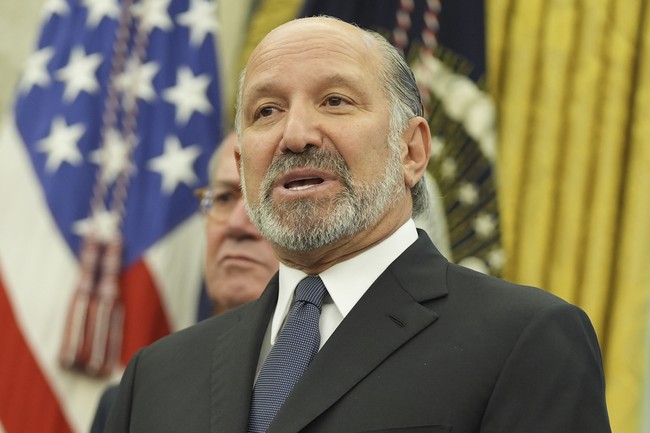
Since the first Trump administration, the Dutch company ASML has not been allowed to ship any of the latest $250 million machines to China. But recently, U.S. Commerce Secretary Howard Lutnick has held meetings with ASML and has indicated he believes China has somehow come into possession of one of those machines.
According to Bloomberg, U.S. Commerce Secretary Howard Lutnick has, in a series of recent meetings, told senior ASML executives he’s concerned that one of the Dutch chipmaker’s extreme ultraviolet lithography machines — the EUV systems that are the only tools on Earth capable of printing the most advanced semiconductor patterns — may have ended up in China. That would be a major breach of export controls that have barred ASML from selling EUV to China since the first Trump administration.
It’s a serious claim. Senior administration officials told Bloomberg they have evidence that ASML shipped EUV-related components and transport equipment to China, though they’ve declined, repeatedly, to show it — to Bloomberg or, apparently, to ASML itself.
Why does any of this matter? Because these EUV lithography machines are the world’s sole source of the advanced chips that are driving the AI market. If China were able to get their hands on one, it would allow them to leap forward in the AI race, something the US and the world probably does not want to see.
Every cutting-edge processor made by TSMC, the foundry behind Nvidia’s and Apple’s chips, depends on ASML tools that took the company roughly two decades and untold billions to develop. There is, at present, no second supplier. That monopoly has made ASML Europe’s most valuable public company, with a market capitalization that has been trading in the neighborhood of $700 billion as of this week, up sharply over the past year on the back of insatiable AI-driven chip demand.
That scale is exactly why the China question matters so much. If even one EUV machine made it into Chinese hands, it would represent one of the most consequential breaches of the export-control regime the U.S. has built over the past several years to keep advanced AI capability out of Beijing’s military and industrial base.
For its part, ASML denies shipping any advanced EUV parts or complete machines to China. At $250 million each and needing frequent maintenance from ASML engineers, the company claims they know the location of every one they have ever produced.
“ASML has never shipped an EUV machine to China nor have we shipped to China any component, module or equipment specially designed to be used in an EUV machine,” the chipmaker told Reuters in an emailed statement…
“When it comes to the export of semiconductor manufacturing equipment, the Netherlands works with clear rules and control lists, based on the European Dual-Use Regulation and additional national measures,” the Dutch Ministry of Foreign Affairs said in an emailed statement.
Denials aside, it’s hard to understand why Lutnick would be unwilling to share the evidence for the transfer even to ASML itself. Maybe there’s some kind of sources and methods reason not to reveal this but without showing some proof and with ASML denying it we seem to be at a stalemate.
Late last year, Reuters reported that after a multi-year “Manhattan project” China had succeeded in building a prototype EUV machine of its own, though it was expected to be years before it could be used to make chips.
Completed in early 2025 and now undergoing testing, the prototype fills nearly an entire factory floor. It was built by a team of former engineers from Dutch semiconductor giant ASML, opens new tab who reverse-engineered the company’s extreme ultraviolet lithography machines or EUVs, according to two people with knowledge of the project…
China’s machine is operational and successfully generating extreme ultraviolet light, but has not yet produced working chips, the people said.
In April, ASML CEO Christophe Fouquet said that China would need “many, many years” to develop such technology. But the existence of this prototype, reported by Reuters for the first time, suggests China may be years closer to achieving semiconductor independence than analysts anticipated.
So instead of being ten years or more behind the state of the art, China may be closer to 5 years behind. But if China were somehow able to get hold of a working ASML machine, that would make it much, much easier to reverse engineer the technology.
Editor’s Note: Do you enjoy HotAir’s conservative reporting that takes on the radical Left and woke media? Support our work so that we can continue to bring you the truth.
Join HotAir VIP and use promo code FIGHT to receive 60% off your membership.