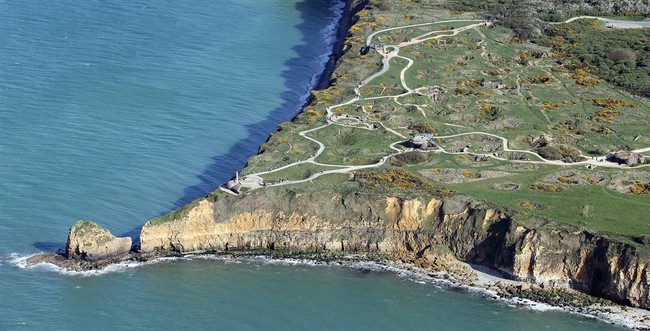
The U.S. Army Rangers climbed into legend at Pointe du Hoc on D-Day because the mission didn’t end when the plan broke. Lt. Col. James Rudder, commander of the 2nd Ranger Battalion, led Companies D, E, and F toward 100-foot cliffs on June 6, 1944. From the Army Historical Association:
Pointe du Hoc, a prominent position along the coast of Normandy, was a focal point of the amphibious assault by U.S. forces during the early morning hours of D-Day, 6 June 1944. The cliff top (sometimes referred to as Pointe du Hoe) is located between Utah and Omaha Beaches and sits atop overhanging cliffs up to 100 feet in height. The careful and thorough planning of the Normandy invasion determined that several key missions would require painstakingly accurate execution in order for the invasion to go as planned, and one of those missions was the capture of Pointe du Hoc. As such, Allied planners named Pointe du Hoc one of the most dangerous German defensive positions on the Norman coast.
Early on in the war, following their defeat of France in June 1940 and occupation of the northern part of the country, the Germans came to understand the strategic importance of Pointe du Hoc. As a part of their defensive system along the Norman coast known as the Atlantic Wall and established under the direction of Field Marshal Erwin Rommel, the Germans installed a battery of 155mm guns on top of the cliff. The guns had a range of approximately 20,000 yards and could cover both Utah and Omaha Beaches with artillery fire. Defended by elements of the 716th and 352d Infantry Divisions, along with artillerymen, Pointe du Hoc became a heavily fortified bastion for the Wehrmacht that threatened the lives of the thousands of American soldiers who would soon be landing on the nearby beachheads.
Their job was brutally simple: scale the cliff, seize the German position, and destroy the six guns that were zeroed on Omaha and Utah Beaches. Rudder was wounded during the fight, but he stayed in command while his men fought upward under machine-gun fire, rifle, grenade, and artillery fire.
Allied planners expected six German 155 mm guns at the top. The Rangers reached the positions and found gun pits, but the guns were moved, with telephone poles replacing them. The Germans had moved the guns south from their prepared sites before the landing.
A lesser force might have stopped there, reported the surprise, and waited for new orders.
Rudder’s Rangers kept moving.
They pushed inland because the mission was never really about a cliff; it was about silencing guns that would kill Americans landing on the beaches below.
First Sgt. Leonard Lomell and Staff Sgt. Jack Kuhn, both from Company D, 2nd Ranger Battalion, followed tracks and found five of the six missing guns hidden inland. Lomell used thermite grenades to disable two guns and smashed the sights on another, while Kuhn covered him. From the Army Historical Foundation:
At around 0900, a two-man patrol from Company D consisting of First Sergeant Leonard Lommell and Staff Sergeant Jack E. Kuhn stumbled into a camouflaged gun position approximately 250 yards south of the coastal highway and discovered five of the six missing 155mm guns (the sixth was never found) and large quantities of ammunition. With Kuhn covering him, Lommell went to work destroying the guns. He dispatched two of them by placing thermite grenades in the guns’ recoil mechanisms, effectively fusing the parts together. After smashing the sights of a third gun, Lommell returned to friendly lines to acquire more thermite grenades, but upon arriving back at the gun position, he found that a second patrol from Company E had finished the job. The Rangers returned to their lines, but not before tossing grenades into the powder charges and starting a large fire. A runner was also sent off to let Lieutenant Colonel Rudder, who had moved his CP to the top of the cliffs, knew that the guns, the main focus of the assault on Pointe du Hoc, had been located and eliminated.
Throughout the rest of the day and into the night, the Rangers maintained their positions along and forward of the coastal highway, enduring German snipers, artillery fire, and counterattacks. At around 2100, the Rangers received reinforcements with the arrival of First Lieutenant Charles H. Parker and his 1st Platoon, Company A, 5th Ranger Battalion, which had become separated in the confusion at Omaha Beach and marched overland to Pointe du Hoc. During the night, beginning at 2300, the Germans launched a series of three strong counterattacks against the Rangers’ lines. The final attack at 0300 on 7 June drove the Rangers back to their lines just north of the coastal highway. Several men from Company E were killed or captured, while a number of Rangers from Company D did not hear the order to withdraw and were cut off. While some made it back to friendly positions, several were forced to hide among the hedgerows and ditches to avoid capture. While discovery by the Germans was certainly a problem for the Rangers, another cause for concern was friendly fire as shells from Allied ships supporting the landings fell perilously close the American positions.
Before 9 a.m., the German battery that had worried Allied commanders was out of action.
The fight didn’t end with the guns; Rudder’s men set up blocking positions near the coastal road and held against German counterattacks for two days. Lt. Colonel Max Schneider, commander of the 5th Ranger Battalion, later brought relief from Omaha Beach with elements of the 29th Infantry Division.
By then, only about 90 Rangers from Rudder’s original force were still able to fight. Their stand bought time, blocked German movement, and helped protect the wider D-Day landings from another deadly threat.
The famous Ranger motto also belongs in the story, but it needs to be correctly placed. Brig. Gen. Norman Cota, assistant division commander of the 29th Infantry Division, met Rangers from Schneider’s 5th Ranger Battalion on Omaha Beach, and pushed them forward with the words that became immortal:
“Rangers lead the way!”
From the Descendants of WWII Rangers:
The 2nd and 5th Ranger Battalions participated in the June 6, 1944, D-Day landings at Omaha Beach, Normandy. It was during the bitter fighting along the beaches that the Rangers gained their official motto. As the situation became critical on Omaha Beach, Brigadier General Norman D. Cota, Assistant Division Commander of the 29th Infantry Division, stated that the entire assault force must clear the beaches and advance inland. He then turned to Lieutenant Colonel Max F. Schneider, commanding the 5th Ranger Battalion, and said, “Rangers, lead the way!” The 5th Battalion spearheaded the breakthrough that enabled the Allies to drive inland from the invasion beaches.
The phrase wasn’t born because conditions were easy; it was born in confusion, smoke, fear, and duty. It still fits Pointe du Hoc because Rudder’s men had already shown the same spirit on the cliffs.
Pointe du Hoc remains sacred ground because courage there was practical. The Rangers didn’t give speeches about valor while standing safely behind the line; they climbed wet ropes, crossed cratered ground, searched for missing guns, destroyed what they found, and held until help arrived.
Gen. Omar Bradley, commander of the U.S. First Army during Operation Overlord, needed men who could turn a failed assumption into a finished mission. Rudder, Lamell, Kuhn, Schneider, Cota, and the Rangers gave him exactly that.
82 years later, Pointe du Hoc still teaches a hard American lesson: plans matter only until war wrecks them.
Mike Tyson had it right; all plans go out the window when you’re punched in the face.
Courage shows itself when the map is wrong, the guns are missing, the commander is wounded, and the enemy still holds the ground. On D-Day, Rudder’s Rangers didn’t stop at the cliff; they went looking for the guns, found and destroyed them, and held the road.
“Rangers lead the way” wasn’t a slogan in the morning; it was a record of what they had already done. Thank God for such men.
The men at Pointe du Hoc earned remembrance through action, not noise. PJ Media keeps telling the stories of courage, duty, and sacrifice that too much of modern culture tries to forget. Join the PJ Media VIP family today and get 60% off with promo code FIGHT.